
Will AI Replace Architectural Designers by 2030? Sonder Architecture’s Honest Take
If you’ve typed “will AI replace architects” into Google recently — and given the millions of people doing exactly that in 2025, you probably have — you’ve encountered a spectrum of takes ranging from calm reassurance to flat-out apocalyptic. The conversation is everywhere, and it matters, especially if you’re an Auckland homeowner thinking about a renovation or new build and wondering whether the profession you’re about to engage with is on the way out.
Short version: it isn’t. But the longer version is more interesting, more nuanced, and ultimately more useful for making smart decisions about your home project. That’s why we’ve written this blog series — a comprehensive, honest exploration of what AI can and can’t do in architectural design, what’s actually changing in our industry right now, and what it all means for homeowners in Auckland and across New Zealand.
We’re Sonder Architecture — a full-service architectural design studio based in Wairau Valley, Auckland, specialising in residential renovations, extensions, new builds, and consenting. We work with Auckland homeowners and renovation companies every week, navigating the real complexities of building design in this city. We’re not spectators in this conversation — we’re practitioners living it, and we think that perspective is worth something.
In this series, you’ll find:
- Section 1: What the AI-replacing-architects hype gets wrong — and what the research actually shows
- Section 2: The AI tools genuinely reshaping how architectural designers work in 2025, including those we use at Sonder
- Section 3: The five core skills AI cannot replicate — and why they matter for your Auckland home project
- Section 4: How AI is making your architectural designer better, faster, and more value for money right now
- Section 5: Our honest prediction for what architectural design looks like in New Zealand by 2030
Whether you’re a homeowner at the start of a renovation journey, someone curious about where the profession is heading, or simply a person who’s seen one too many breathless tech headlines and wants a grounded perspective — this series is for you. Grab a coffee, and let’s get into it.
Will AI Replace Architectural Designers? Here’s What the Hype Gets Wrong
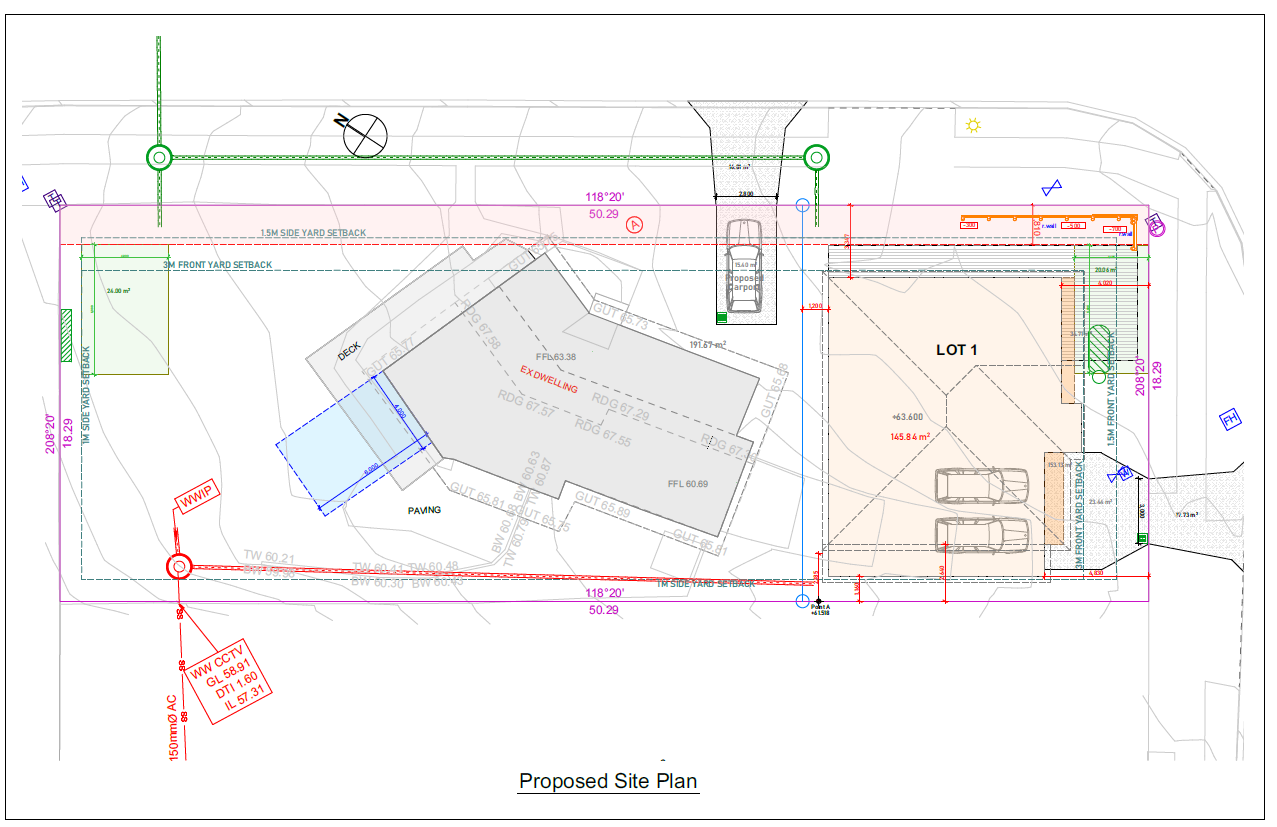
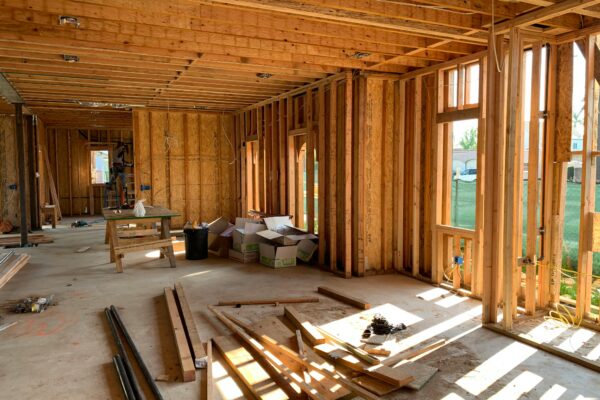
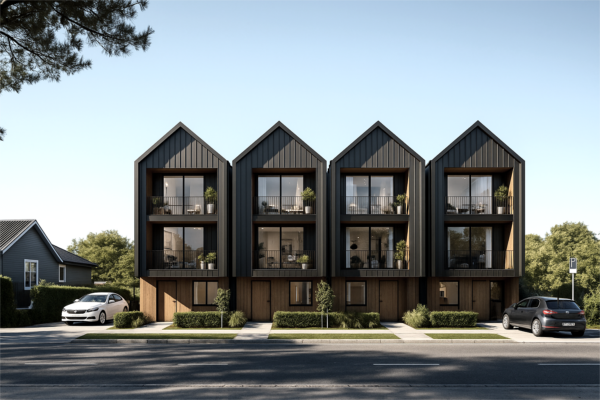
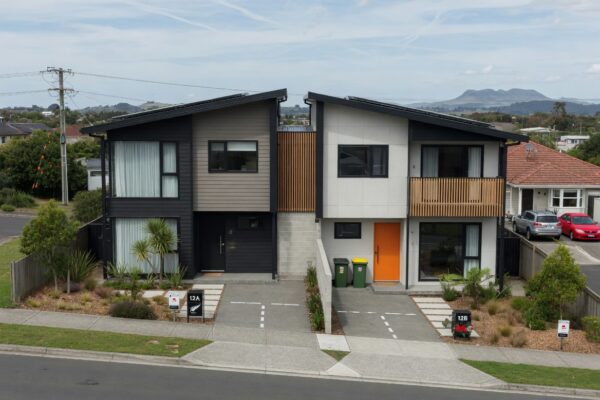
Example of a site where an existing property is being subdivided, and a new dwelling is to be built.
You’ve seen the headlines. “AI will replace 80% of all jobs by 2030.” “Architects are obsolete.” “Just prompt ChatGPT and get your house designed for free.” If you’ve been half-paying attention to the news lately, you’d be forgiven for picturing a robot sitting at a drafting table, cranking out building plans while your architect is off collecting the dole.
Here’s the thing though — those headlines are selling clicks, not reality. And as an Auckland-based architectural design studio that works hands-on with homeowners every single day, we at Sonder Architecture feel pretty well-placed to separate the actual signal from the considerable noise. So grab a flat white, settle in, and let’s have an honest conversation about where AI fits into the world of architectural design — and where it absolutely doesn’t.
The Question Everyone’s Asking (And Why It’s the Wrong One)
The real question isn’t “Will AI replace architects?” It’s “What will architecture look like when AI is embedded in the process?” That’s a very different conversation. One is a doomsday scenario; the other is the practical reality already unfolding across studios in Auckland, Wellington, and everywhere else.
Think about it this way. When CAD software arrived in the 1980s, people said draftspeople were done. When Building Information Modelling (BIM) came along, people said junior designers were redundant. Neither prediction came true — both technologies simply changed how design professionals work, and ultimately made them more productive. Every major technology shift in architecture has enhanced the profession, not erased it.
“AI will not replace architects, but architects who use AI will replace those who don’t.”
That quote is doing a lot of heavy lifting, and it deserves to sit with you for a moment. The professionals who will feel the pinch aren’t architects broadly — they’re the ones who refuse to adapt. Sound familiar? The same was true for every profession that encountered a powerful new tool.
What AI Can Actually Do in Architecture Right Now
Let’s give credit where it’s due. AI tools in 2025 are genuinely impressive, and architectural designers across New Zealand — including our own team — are already using them to work faster and smarter. Here’s an honest look at what AI does well in the design space:
| AI Capability | What It Means in Practice | Human Still Required? |
|---|---|---|
| Rapid concept visualisation | Tools like Midjourney generate photorealistic renders in minutes rather than days | Yes — to interpret, refine and make buildable |
| Floor plan generation | AI tools like Maket.ai can generate layout options from a text prompt | Yes — AI layouts often ignore site context, gradient, orientation |
| Code compliance checking | AI can scan drawings against NZ Building Code clauses in seconds | Yes — interpreting ambiguous clauses and negotiating with Auckland Council requires judgment |
| Document management | AI tools track drawing revisions, version control, and drawing set organisation automatically | Partially — oversight still essential |
| Cost estimation | AI can generate indicative build cost ranges based on area, materials, and region | Yes — site-specific variables require human assessment |
| Energy modelling | AI can simulate thermal performance, passive solar gain, and ventilation scenarios | Yes — interpreting results in NZ climate context requires expertise |
💡 Quick tip for skimmers: AI handles the repetitive, data-heavy tasks brilliantly. It is not (yet) capable of understanding your family’s specific lifestyle, the quirks of your Remuera site, or the nuances of Auckland’s Unitary Plan. Those are human skills.
Why Architecture Is Different from Other “At-Risk” Professions
When Goldman Sachs published research suggesting that 37% of architecture and engineering work tasks “could be automated by AI,” it created a lot of anxiety. But that figure refers to tasks — routine, repeatable activities within a job — not the entire job itself. And architecture is one of those professions where the most valuable work is precisely the stuff that can’t be automated.
Consider what happens when we start a new renovation project with an Auckland homeowner. We’re not just drawing walls on a page. We’re sitting around the kitchen table in Herne Bay, listening to a family describe how they live — how they move through the house in the morning, where the kids do homework, why the light never reaches the back bedroom. That conversation, that human connection, is where a great design begins. No AI system is walking into that kitchen.
Architecture is deeply contextual. Every site in Auckland is different — a North Shore section with a harbour view has completely different design priorities than a south-facing Mt Albert villa that needs passive solar gain. AI tools process patterns from existing data; they don’t feel the salt wind off the Waitemata or understand what it means to your client that their new home echoes the bach they grew up in.
The New Zealand Context Makes This Even Clearer
Designing and consenting a home in Aotearoa is not a generic process you can automate from a prompt. New Zealand has specific and relatively complex requirements that demand local expertise.
Auckland Council’s consent process alone involves layers of regulation — the Building Act 2004, the New Zealand Building Code, and the Auckland Unitary Plan all intersect in ways that require genuine interpretive skill. According to Auckland Council, the building consent process involves trained professionals across architecture, engineering, construction, and plumbing — and as of late 2025, plan changes like PC78 (affecting Medium Density Residential Standards) mean the regulatory landscape is actively shifting. You need a human to keep up with that.
Our director John Mao, a Licensed Building Practitioner (Design Class), deals with Auckland Council submissions regularly. The back-and-forth, the RFIs (Requests for Further Information), the ability to call a council processing officer and talk through a complex weathertightness detail — that’s relationship-based, judgment-heavy work. AI cannot hold a productive conversation with the Auckland Council consent desk. Not in 2025, and not in 2030.
What the Industry Data Actually Shows
Industry research published by the AIA (American Institute of Architects) — whose membership now exceeds 95,000 architects — found that 84% of architects are optimistic about AI’s potential to solve complex problems and drive innovation, and view it as augmenting their work, not replacing it. Here in Aotearoa, the AI Forum New Zealand’s Architecture, Engineering and Construction (AEC) Working Group, which contributes to the country’s GDP at over $17.6 billion (or 6.3%), is actively developing roadmaps for responsible AI adoption — not panicked responses to displacement.
The picture that emerges from actual practitioners is nuanced and encouraging. AI is collapsing timelines for repetitive tasks — code research that took days now takes minutes, rendering options that took weeks are generated overnight. That means designers like us have more time for the high-value stuff: listening, creating, problem-solving, and guiding clients through the complex world of consents and compliance.
“Design is an inherently human process. AI should not be a tool for circumventing a human designer.”
So, Will AI Replace Architectural Designers by 2030?
Short answer: No. Not in any meaningful sense of the word “replace.” The longer answer is that architectural design in 2030 will look different from today — AI tools will be embedded in every stage of the design process, making practices faster and more efficient. But the licensed, accountable, relationship-driven professional at the centre of it all? That person isn’t going anywhere.
For Auckland homeowners, this is genuinely good news. The adoption of AI tools by your architectural designer doesn’t mean a robot is drawing your home — it means your designer has more time and better tools to focus on what matters most: creating something that’s truly, specifically, beautifully yours. At Sonder Architecture, that’s exactly what we’re doing. We’re embracing the tools that make us better at our jobs, while holding firm to the irreplaceable human elements that make a house a home.
In the next section of this series, we’ll look at the specific AI tools already reshaping how architectural designers work — including some we use at Sonder — and what that means for the quality and speed of your home renovation or new build in Auckland.
The AI Tools Reshaping Architectural Design in New Zealand (And How We Actually Use Them)

There’s a scene that plays out regularly in our Wairau Valley studio. A client comes in with a Pinterest board, some vague ideas about “open plan” and “natural materials,” and a section in Titirangi that slopes like a ski run. A few years ago, translating that vision into something concrete — something you could actually walk through before a single board was cut — took weeks. Today? We can show them photorealistic visualisations of multiple design directions within hours.
That’s the practical reality of AI in architectural design right now. It’s not replacing designers. It’s giving us superpowers. And for Auckland homeowners embarking on a renovation or new build, that speed and visual clarity can be transformative. But let’s be specific — because “AI in architecture” covers a lot of ground, and not all of it is equally useful or hype-free.
A Realistic Tour of AI Tools in the AEC World
The Architecture, Engineering and Construction (AEC) sector in Aotearoa is actively developing frameworks for AI adoption through the AI Forum New Zealand’s AEC Working Group. The group’s mission is to enhance productivity and sustainability across the sector — and the tools gaining traction are genuinely impressive. Here’s a grounded look at what’s actually being used, and how it maps to real residential design work in Auckland:
1. Generative Visualisation Tools (Midjourney, DALL-E, Stable Diffusion)
These image-generation platforms have become the most visible face of AI in architecture. Type in a description — “Scandinavian-influenced single-storey extension, cedar cladding, North Shore Auckland, large glazing to north” — and get a photorealistic image back in seconds. For early-stage client conversations, this is a genuine game-changer. Homeowners can react to a visual rather than trying to interpret a technical drawing they’ve never been trained to read.
The limitation? As architect Justin Kwon puts it, AI imagery is “really good at creating an image that elicits an emotional reaction. The lighting is always soft and misty… but when it comes to being useful, buildable, practical or even good — those are fair conversations for us to be having.” A pretty picture is not a building design. The structural logic, the thermal envelope, the stormwater drainage — none of that is in the image. That’s where the designer earns their fee.

2. AI-Assisted Floor Plan Generation (Maket.ai, Architechtures)
Platforms like Maket.ai market themselves as “an architect in your pocket” — you describe what you want in plain language and the AI generates floor plan options in seconds. This is useful for rapid ideation and for showing a client the range of what’s possible on a given footprint. It’s considerably less useful for actually designing a compliant, buildable home on a specific Auckland site.
Here’s why. An AI floor plan generator doesn’t know that your section in Blockhouse Bay has a covenant restricting building height to 7 metres. It doesn’t know that your neighbour’s fence line is in dispute. It doesn’t know the Auckland Unitary Plan rules for your specific zoning, or that there’s a protected pohutukawa tree that will dictate where the foundations can go. A Licensed Building Practitioner does.
3. BIM Integration with AI (Autodesk, Revit, AutoCAD 2025)
The latest release of AutoCAD 2025 introduced the Autodesk Assistant and AI-driven drafting features specifically aimed at speeding up repetitive design tasks and improving accuracy for engineers and architects in Aotearoa — as noted by Engineering New Zealand in August 2025. Within BIM environments, AI is increasingly handling clash detection (where building elements conflict with each other) and automated quantity take-offs.
In practical terms for a homeowner: this means fewer costly errors during construction, and faster pricing. When our team runs AI-assisted clash detection on a set of drawings, we catch conflicts between structural elements and plumbing runs before the builder ever breaks ground. That saves time and money — and ultimately benefits you.
4. AI for Compliance and Code Research
One of the most genuinely useful applications of AI in our work is compressing the time it takes to research compliance requirements. Checking a project against the New Zealand Building Code used to mean flipping through multiple documents across multiple clauses. AI tools can now analyse a design against code requirements in minutes.
But here’s the critical nuance — and this is something the AI optimists sometimes gloss over. Interpreting ambiguous code language, understanding what a clause intends versus what it literally says, and negotiating with Auckland Council when a project sits in a grey area? That requires human judgment and experience. As the National Council of Architectural Registration Boards notes, “regulatory expertise involves complex interpretation that extends beyond automated compliance checking.” Our team does this daily, and it’s not something you’d want an algorithm handling without oversight on a $500,000 home renovation.
5. AI Energy Modelling and Sustainability Analysis
This is one area where AI is delivering real, measurable value in New Zealand residential design. Tools that simulate a home’s thermal performance, natural ventilation, and daylight access are now faster, cheaper, and more accessible than ever. For Auckland homeowners, this translates to homes that are genuinely warmer in winter, cooler in summer, and cheaper to run — all aligned with our sustainability commitment at Sonder Architecture.
💡 Tip for skimmers: AI energy modelling helps your designer optimise your home’s orientation, window placement, and insulation spec early in the design process — before anything is locked in. Ask your architect if they’re using energy simulation tools. If they’re not, ask why.
What Does This Mean for Your Auckland Home Project?
The practical upshot for homeowners considering a renovation, extension, or new build in Auckland is this: AI tools in the hands of a skilled architectural designer make your project better and faster. They don’t replace the designer. They free them up to do better design.
Consider what our process at Sonder Architecture looks like when we incorporate these tools. After our initial site visit and feasibility study, we use AI-assisted visualisation to quickly generate concept options for client review. What used to be a two-week process of hand-drawing and CAD work can now produce multiple credible design directions in a fraction of the time. That means you, as a homeowner, make faster, more informed decisions. It means we spend less time on production and more time on design quality. And it means the final product — your home — benefits from more iterative refinement.

The Honest Limits of AI in Residential Architecture
Here’s something the tech evangelists rarely admit: AI doesn’t understand three-dimensional space. Not really. It generates images and floor plans based on pattern recognition from existing data — but it doesn’t experience the sense of compression and expansion when you move from a narrow hallway into a generous living room. It doesn’t understand what it means for a kitchen to face north in Auckland, where morning light floods in and makes a space feel alive by 7am. These are spatial, emotional, sensory qualities that require human intelligence to design and human experience to feel.
There’s also the question of accountability. Under New Zealand law, every set of building consent drawings must be signed off by a qualified practitioner. A Licensed Building Practitioner (Design Class) — like our director John Mao — carries professional and legal responsibility for the work. AI has no licence. It carries no liability. It can’t be accountable to you or to Auckland Council. In the context of building your family home, that accountability isn’t a technicality — it’s the foundation of the entire professional relationship.
Our Honest Take at Sonder Architecture
We’re enthusiastic users of AI tools where they genuinely help us serve our clients better. We’re equally clear-eyed about what they can and can’t do. The right framing isn’t “AI vs. architects” — it’s “what combination of human expertise and intelligent tools produces the best outcomes for Auckland homeowners?” That’s the question we’re asking every day in our studio, and it’s the right one.
The State of AI in Architecture report from Chaos and Architizer, drawing on insights from over 1,200 design professionals, found that 46% of architecture professionals currently use AI tools, with another 24% planning to adopt them. The profession isn’t retreating from AI. It’s integrating it thoughtfully — and that’s exactly the approach that produces better homes.
Next up in this series: we’ll dig into what AI genuinely can’t replicate about the architectural design process — the human skills that no algorithm is touching by 2030, and why they matter specifically for New Zealand homeowners navigating complex renovation projects.
The 5 Things AI Cannot Do That Your Architectural Designer Does Every Single Day
There’s a thought experiment worth entertaining. Imagine you’re about to spend $350,000 on a home extension in Grey Lynn. You sit down with an AI design tool — you describe your family, your lifestyle, your hopes for the space. It generates twenty floor plan options. They’re all technically feasible. Some of them look great in render. But which one is actually right for you? Which one accounts for the fact that your teenager needs a retreat that doesn’t sit directly above your bedroom? Which one responds to the specific quality of afternoon light on your north-western boundary? Which one protects your resale value while also respecting the character of the street?
This is where we separate genuine capability from marketing hype. AI tools are genuinely impressive at certain tasks. But there are five core competencies in architectural design that require human intelligence, experience, and judgement — and no amount of machine learning is closing that gap by 2030. Here’s what they are, and why they matter for your Auckland home project.
1. Contextual Design Judgement
Every Auckland site is unique. The slope of the land, the prevailing wind direction, the view corridor, the relationship to neighbours, the character of the street — these factors interact in ways that can’t be captured in a dataset. A designer with experience across hundreds of Auckland projects develops an intuition for this. They walk onto a North Shore section and immediately see the design opportunities: the pohutukawa that should anchor the living spaces, the ridge that offers a glimpse of the harbour if you position the upper floor carefully, the neighbour’s house that makes a north-east outlook awkward.
AI tools process patterns from historical data. They identify what has been done before. They’re trained to recognise successful design outcomes based on past examples. What they can’t do is make the leap from “this is a common approach” to “this specific combination of factors on this specific site calls for something we haven’t seen before.” Original contextual judgement is a uniquely human capability.
At Sonder Architecture, the site visit and feasibility study is always our first step — and it’s always a human visit. We check solar access, wind exposure, views, service connections, and drainage patterns. We talk with you about how you live. We stand in your space and feel it. That’s step one of our eight-step process, and no app is replacing it.
2. Emotional Intelligence and Client Empathy
Architecture is a profoundly emotional enterprise. Clients aren’t just specifying a building — they’re describing who they are and how they want to live. A couple in Ponsonby renovating a villa they’ve owned for twenty years are making decisions loaded with memory, identity, and aspiration. A family in Botany adding a second storey are negotiating priorities: the kids want their own bathrooms; the parents want a quiet office; the grandparents are coming to stay semi-permanently and need something on the ground floor.
Navigating that conversation — holding competing priorities, reading what’s said and what isn’t, helping people articulate a vision they can feel but can’t yet name — that’s emotional intelligence. As our founder John Mao puts it: “We design with empathy, knowing every home holds a unique story. Our team listens, collaborates, and creates spaces that truly feel like yours.”
AI has no emotional intelligence. It processes text inputs and pattern-matches against training data. It cannot understand that when a client says “I want a bit more space,” they actually mean “I’m exhausted by how this house makes me feel cramped and I need you to help me understand why.” That interpretive, empathic layer is where design actually starts — and it’s entirely human.
3. Navigating Auckland’s Regulatory Environment
This one deserves particular emphasis for New Zealand homeowners, because it’s genuinely complex and the stakes of getting it wrong are very real. Building without proper consent in Auckland can result in fines of up to $200,000, forced demolition, or serious complications when you try to sell — as the LIM report will flag unconsented work and potentially crater your property value.
The regulatory landscape in Auckland involves multiple layers working simultaneously:
- The New Zealand Building Code — the technical standard every building must meet, covering structure, weathertightness, fire safety, insulation, plumbing, and more
- The Auckland Unitary Plan — Auckland’s planning rulebook, which governs zoning, height limits, site coverage, setbacks, and character overlays
- The Building Act 2004 — the legal framework governing who can carry out restricted building work (RBW) and the LBP licensing system
- Resource Management Act consents — for projects that affect the environment or fall outside permitted activity standards
- Specific overlays and covenants — heritage areas, special character suburbs, flood plains, volcanic viewshaft protections, restrictive covenants from original developers
As Auckland Council itself acknowledges, this process “involves trained professionals in a range of building disciplines including architecture, engineering, construction and plumbing.” It’s not a process you can automate — particularly as the regulatory environment is actively shifting. In late 2025, Plan Change 78 partially modified the Medium Density Residential Standards that had applied since 2022, meaning that projects relying on those permitted activity rules needed to be reassessed. An AI tool trained on data from six months ago wouldn’t know that.
💡 Tip for skimmers: Regulatory navigation in Auckland is living, changing, and relationship-dependent. Your architectural designer maintains up-to-date knowledge of consent requirements and council expectations. An AI tool that can’t attend a pre-application meeting or respond to an RFI cannot replace this.
4. Professional Accountability and Legal Responsibility
In New Zealand, certain building work is classified as “Restricted Building Work” (RBW) — work related to primary structure, weathertightness, or fire safety. This work can only be designed and supervised by a Licensed Building Practitioner (LBP). The LBP system, governed by the Building Practitioners Board, exists specifically because homes need to be safe, and someone needs to be legally accountable when things go wrong.
John Mao, our director and owner, holds an LBP Design Class licence. That’s not just a credential — it means he’s passed rigorous assessments, maintains ongoing professional development, and operates under a strict code of ethics. When he signs off on a set of drawings for your home extension, he’s staking his licence and his professional reputation on the quality and compliance of that work. An AI tool has no licence to stake, no reputation to lose, and no legal accountability for the outcomes.
For homeowners, this distinction is not abstract. If an AI-generated floor plan omits a critical structural detail and your builder follows it, who’s responsible? Not the algorithm. Not the software company (their terms of service will make that very clear). The LBP who signs off on the work carries that responsibility — which is why having a qualified, accountable professional is non-negotiable, regardless of what tools they use to produce the drawings.
5. Creative Problem-Solving in Three Dimensions
Architecture is not primarily a two-dimensional discipline — it’s about how humans experience space in three dimensions over time. The height of a ceiling and its relationship to the width of the room determines whether a space feels generous or oppressive. The way light enters a stairwell at different times of day can make or break the daily experience of moving through a house. The moment of transition between a compression point and an open space — a narrow corridor opening into a sun-filled kitchen-living room — is one of the most powerful experiences in domestic architecture. And it’s entirely spatial, experiential, and human.
“One thing AI doesn’t currently understand is true three-dimensional space — a notable limitation in the world of design. It doesn’t understand the sense of contraction or expansion of space, the kinds of things architects think about.”
This spatial intelligence is something that develops over years of designing and visiting built projects. It’s the product of studying great buildings, making mistakes, getting feedback from clients, and refining your understanding of how human beings inhabit space. It cannot be trained into a model on existing data — because the best spatial solutions often involve departing from convention, not reproducing it.
Putting It Together: The Case for Human-Led Design
| Capability | AI (2025–2030) | Human Architectural Designer |
|---|---|---|
| Generating visual options quickly | ✅ Excellent | ✅ Good (slower but more targeted) |
| Contextual site analysis | ❌ Limited — no site visit possible | ✅ Core competency |
| Client empathy and vision translation | ❌ No emotional intelligence | ✅ Core competency |
| Auckland regulatory navigation | ⚠️ Partial — data quickly outdated | ✅ Current, relationship-based expertise |
| Legal accountability (LBP) | ❌ None — no licence or liability | ✅ Required for restricted building work |
| Three-dimensional spatial design | ⚠️ Images only — no spatial intelligence | ✅ Core creative skill |
| Building consent management | ❌ Cannot interact with Auckland Council | ✅ End-to-end consent management |
The picture is clear. AI is a powerful set of tools in the hands of a skilled designer. It’s not a replacement for one. For Auckland homeowners, this should be genuinely reassuring — the service you get from a professional architectural designer is richer, faster, and smarter thanks to AI, but it’s still fundamentally driven by human expertise, empathy, and accountability.
If you’d like to understand more about when and why you need an architect for your Auckland home renovation, check out our detailed guide on building consents — it covers the specifics of what requires professional sign-off and what doesn’t.
In the next section, we explore how AI is actually changing the day-to-day work of architectural designers — and what that means for the speed, cost, and quality of your renovation or new build project.
How AI Is Already Making Your Auckland Architect Better, Faster, and More Value for Money
There’s a misconception worth dismantling. When people hear “AI in architecture,” they often picture one of two things: either a robot that replaces the architect entirely, or a gimmicky visualisation tool that produces dreamy images with no practical value. Neither is accurate. The real story of AI in residential architectural design is more interesting and more directly useful for Auckland homeowners — it’s about compressing timelines, improving accuracy, and freeing up the people doing the design work to do more of what they’re actually best at.
Let’s get specific about how AI tools are changing the practical experience of working with an architectural designer in 2025 — and what that means for your home project.
Faster Concept Development, Clearer Client Decisions
One of the most frustrating parts of the traditional architectural design process — for both designers and clients — was the gap between “I can picture it in my head” and “I can see it on paper.” For decades, this gap was bridged by hand drawings and CAD work that could take days or weeks to produce. Most clients would see a first concept after two or three weeks, often finding it didn’t quite match their mental image, which kicked off another round of revisions.
AI-assisted visualisation has compressed this dramatically. We can now generate multiple concept directions for a client to react to within a single design session — not final designs, but credible visual explorations that help the conversation happen faster and with more shared understanding. For homeowners, this means you spend less time trying to interpret technical drawings you weren’t trained to read, and more time making genuine design decisions about your home.
This aligns with how we run our process at Sonder Architecture: from site visit and feasibility study through to sketch concepts and CAD development, our eight-step process is designed for clarity and client involvement at every stage. AI tools make the early stages of that process faster and more visual — which means you get to the decisions that matter sooner.
More Efficient Documentation, Fewer Costly Errors
Here’s a stat worth knowing: architectural documentation errors — conflicting dimensions, clashes between structural and services drawings, missed code requirements — are a significant contributor to cost overruns in residential construction. When a builder discovers that the plumbing stack runs through the load-bearing beam your engineer specified, everyone loses time and money while the fix is designed and resubmitted for consent.
AI-assisted clash detection within BIM environments is catching these conflicts before they ever leave the drawing office. Several vendors across the AEC sector are now integrating AI-powered clash detection and automated quantity take-offs directly into their standard BIM workflows — as noted by Engineering New Zealand’s sector reports in late 2025. The result for clients is fewer surprises during construction, more accurate pricing, and smoother progress through the build.
💡 Tip for skimmers: When choosing an architectural designer, ask what coordination and clash-detection processes they use. Modern studios using BIM and AI-assisted documentation are significantly less likely to produce drawings with errors that cause costly on-site problems.
Smarter Energy and Sustainability Design
Auckland’s climate is more variable than many Kiwis appreciate — warm, humid summers and cool, damp winters create a set of thermal design challenges that require careful handling. Getting a home’s orientation, glazing, insulation, and ventilation right can make a $200–$400 per year difference in energy bills, which over a 30-year ownership period is genuinely significant.
AI energy modelling tools allow designers to simulate multiple thermal scenarios in the early design phase — before anything is locked in. Want to know whether adding a large north-facing window will make your living room delightfully warm in winter or unbearably hot in summer? AI simulation can answer that in minutes, rather than the days it would have taken previously. At Sonder Architecture, our commitment to sustainable design is baked into every project — and AI tools are increasingly central to how we deliver on that commitment.
Streamlined Building Consent Preparation
If you’ve ever navigated the Auckland Council building consent process, you’ll know it’s not a casual exercise. Auckland Council’s consent process involves detailed documentation requirements: architectural drawings, structural plans, specifications, engineering calculations, and producer statements — all prepared and organised for lodge. A single missing item or inconsistency can trigger an RFI (Request for Further Information) that adds weeks to your timeline.
AI-assisted document management and checklist tools are now making this preparation process significantly more reliable. Automated compliance checking flags potential issues before lodgement; document management AI ensures that drawing sets are internally consistent and that all required documentation is present. The result is fewer RFIs, faster council processing, and a smoother path from consent lodgement to approval.
Auckland Council targets a 20-working-day processing window for standard building consent applications. RFIs stop that clock — every time the council asks for more information, the clock pauses. Fewer RFIs means fewer delays, and in a construction environment where builder availability and material pricing can shift quickly, timing genuinely matters.
What This Means for the Cost of Architectural Services
Here’s a question we hear frequently from Auckland homeowners: “Will using AI tools make your services cheaper?” The honest answer is nuanced. AI tools are making us more efficient, which means we can deliver more value in a given timeframe — more concept options, more detailed analysis, more thorough documentation checks. Whether that translates into lower fees or higher-quality outcomes for the same fee depends on the scope of work and the studio you’re working with.
What we can say with confidence is that the alternative — hiring a designer who isn’t using these tools — is increasingly likely to produce slower, less accurate work. A firm that takes three weeks to produce what another can produce in three days isn’t providing better service; it’s providing slower service at the same price. The adoption of AI tools is raising the baseline quality and efficiency of architectural services across the board.
| Design Phase | Traditional Timeline | AI-Assisted Timeline | Impact for Homeowner |
|---|---|---|---|
| Initial concept visualisation | 2–3 weeks | 1–3 days | Faster alignment on design direction |
| Energy performance analysis | 3–5 days | Hours | Better informed design decisions earlier |
| Drawing coordination / clash detection | Manual review, days | Automated, hours | Fewer on-site errors and cost overruns |
| Consent preparation documentation check | Manual review | AI-assisted checklist | Fewer RFIs, faster council processing |
| Code compliance research | Days of document review | Minutes via AI search | More time for design, not administration |
The Human Dividend: What Designers Do With the Time AI Saves
Brooks Scarpa Architects, a 17-person Florida firm, achieved 25% profit growth and 50% efficiency gains by implementing integrated practice management tools — without reducing headcount. Instead, they redirected the time saved into higher-value creative and client-focused work. The same pattern is playing out across architecture firms globally: AI saves time on production, and skilled designers use that time to produce better design outcomes.
For Auckland homeowners, the practical implication is this: when you work with an architectural designer who uses AI tools intelligently, you get more of their attention on the design thinking and less of their time on repetitive documentation tasks. That’s a genuine improvement in the quality of service — and it’s one of the reasons we’re enthusiastic about these tools at Sonder Architecture, even as we’re clear-eyed about their limitations.
Want to understand what the full architectural design process looks like in practice? Our guide to the architectural design process in New Zealand walks through each stage from site visit to consent, so you know exactly what to expect when you engage an architectural designer for your Auckland home project.
In the final section of this series, we’ll look ahead — to 2030 and beyond — and offer our honest assessment of where AI is taking the architectural profession, what the future of human-centred design looks like in Aotearoa, and what it all means if you’re planning a home renovation or build in the next few years.
The Future of Architectural Design in New Zealand by 2030: Our Honest Prediction
Five years is not a long time in the construction industry. The house you’re living in right now was probably designed using methods and tools that would be recognisable to an architect from the 1990s. CAD software got better. BIM became standard in larger firms. 3D printing remained a niche curiosity. The pace of change in residential architecture has historically been slower than in many other industries.
AI is changing that pace — but it’s worth being clear about what “change” means in this context. It means the profession is evolving, not disappearing. It means the tools are getting more powerful, not the humans redundant. And for Auckland homeowners planning renovation or new build projects over the next five years, it means things will get faster, more visual, and potentially more sustainable — while the core of the professional relationship remains what it has always been.
Here’s our honest prediction of where things are heading, grounded in what’s actually happening in the industry right now.
What the Architecture Profession Will Look Like in 2030
AI Becomes Infrastructure, Not Innovation
By 2030, AI tools won’t be something architectural designers talk about as new or exciting — they’ll be the invisible infrastructure of everyday practice, just as email and CAD are today. Energy modelling, clash detection, document management, and initial concept generation will all be AI-assisted as standard. Studios that haven’t integrated these tools will be at a genuine competitive disadvantage — slower, less accurate, and less responsive.
For clients, this means the baseline quality of services from professional studios rises. The question won’t be “do you use AI?” but “how thoughtfully do you use it?” The best firms — like what we’re aiming to be at Sonder Architecture — will use AI to enhance the human creativity and expertise at the centre of the work, not to substitute for it.
New Specialisations Will Emerge
The research from Monograph points to emerging architectural specialisations responding to climate and technology challenges. Here in New Zealand, several areas are particularly relevant:
- Climate-resilient residential design — Auckland’s flood events of 2023 were a stark reminder that residential construction needs to take climate risk seriously. Designers with expertise in resilient, flood-adapted, and climate-responsive design will be in high demand.
- Medium-density residential design — with Auckland’s housing shortage continuing, the design of well-resolved terrace housing, townhouses, and minor dwellings on compact sites is a growing specialisation. Our guide to subdividing in Auckland in 2025 covers how these regulations are evolving.
- Sustainable retrofit — New Zealand has a large stock of older housing that needs to be made more energy-efficient and weather-tight. Designers specialising in retrofit and recladding — a core Sonder service — will have strong demand through 2030 and beyond.
The LBP System Remains Central
Whatever happens with AI tools, New Zealand’s Licensed Building Practitioner framework isn’t going away — if anything, it’s likely to become more important as building complexity increases and accountability requirements tighten. The legal requirement for qualified sign-off on restricted building work is a structural feature of the New Zealand construction system, and it protects homeowners in ways that can’t be outsourced to an algorithm.
By 2030, the designers who thrive will be those who combine genuine LBP expertise with sophisticated AI tool use — not designers who’ve been replaced by those tools, and not designers who’ve ignored them. The Auckland homeowners who get the best outcomes will be those who understand this distinction and choose their design professionals accordingly.
What Won’t Change
For all the excitement about AI, there are fundamental things about architectural design that aren’t changing — and probably never will. Let’s be clear-eyed about them.
The importance of a good brief. Every great design starts with a great brief — a clear, honest articulation of how you live, what you need, and what you’re trying to achieve. No AI can extract that from you. It requires conversation, listening, probing, and interpretation. The quality of your designer’s briefing skills will remain one of the most important determinants of your project’s success.
The value of experience on Auckland sites. A designer who has worked across dozens of Auckland properties — in different suburbs, with different topographies, under different planning rules — brings knowledge that no training dataset can replicate. They’ve been through the difficult consent, navigated the complex neighbour issue, solved the drainage problem that stumped the engineer. That experiential knowledge compounds over time.
The human relationship at the centre of the process. You’re spending hundreds of thousands of dollars on your home. The person helping you make those decisions needs to understand you, earn your trust, and be accountable to you. That’s a relationship, not a transaction with a software tool. In 2030 as in 2025, the quality of that relationship will determine the quality of the outcome.
A Message to Auckland Homeowners Planning Projects in the Next 5 Years
If you’re planning a home renovation, extension, garage conversion, recladding, or new build in Auckland over the next few years, here’s what this all means for you in practical terms:
Don’t wait for AI to design your home for you. The tools aren’t there yet, and the accountability framework that makes building in New Zealand safe requires human, licensed professionals at the centre of the process. An AI-generated floor plan isn’t a building consent application — it’s a starting point at best.
Do look for designers who are using technology intelligently. Ask about their process. Do they use energy modelling? Do they use AI-assisted visualisation to help clients make faster, more informed decisions? Do they use BIM coordination tools that catch documentation errors before they reach the builder? These aren’t luxury features — they’re marks of a modern, professional practice.
Value the human relationship. The best architectural design outcomes come from genuine collaboration — a designer who listens well, challenges your assumptions in useful ways, and brings expertise you don’t have. Technology can make that collaboration faster and more visual, but it can’t replace the relationship itself.
“We shape our buildings; thereafter they shape us.”
Churchill’s observation is as true today as it ever was — and it points to why architectural design can never be purely a technological exercise. The buildings we create shape the lives we live in them. Getting that right requires human intelligence, human empathy, and human accountability. In 2030, it will require those things alongside increasingly sophisticated AI tools. But the human elements will remain, as they always have, the most important.
The Sonder Architecture Perspective
We came together as a studio with a shared vision: to make architectural services more personal, more accessible, and more aligned with the real needs of Auckland homeowners. That vision doesn’t change because AI tools are getting more powerful — if anything, it becomes more important. As the production tasks get easier, the human elements of design — the listening, the empathy, the contextual judgement, the accountability — become more valuable, not less.
Every homeowner has a story, and every home should be designed with that story in mind. No algorithm can tell that story. But a talented designer, equipped with the best tools available and grounded in a genuine understanding of you and your site, can translate it into a home that serves your family for decades.
That’s what we’re here to do. And it’s not something a 2030 AI is going to displace.
Have thoughts on this? We’d genuinely love to hear from Auckland homeowners about how you’re thinking about AI and design. Drop a comment below or get in touch — let’s start the conversation.
So, Will AI Replace Architectural Designers? The Bottom Line
You’ve made it through five sections, and if you’ve read even half of them, you’ve got a genuinely nuanced understanding of what’s actually happening at the intersection of AI and architectural design in New Zealand. Let’s bring it together.
AI is transforming the tools of architectural design, not the discipline itself. The speed of concept generation, the accuracy of documentation, the sophistication of energy modelling, the efficiency of consent preparation — all of these are improving rapidly thanks to AI tools, and the best designers in Auckland and across Aotearoa are embracing them. A designer who ignores these tools is like an accountant who refuses to use spreadsheets — not exactly a sign of professional excellence.
But the things that make a great architectural designer great — contextual judgement, emotional intelligence, regulatory expertise, three-dimensional spatial creativity, professional accountability — are distinctly and enduringly human. They’re the product of years of experience, thousands of client conversations, dozens of consent navigations, and a deep, personal investment in the outcomes. No algorithm is replicating that in five years. Probably not in ten.
For Auckland homeowners, the practical message is this: work with designers who are intelligent adopters of AI tools and who bring deep human expertise to your project. Ask them about their process. Understand what they do to catch errors, shorten timelines, and make better decisions earlier. Value the relationship as well as the technology. And remember that the most important thing your designer brings to your project isn’t the software they use — it’s their genuine understanding of you, your site, and your aspirations.
At Sonder Architecture, we’re excited about where technology is taking our profession. We’re also clear-eyed about what will never change: every home has a unique story, and every story still needs a human to tell it through design.
Ready to start a conversation about your Auckland home project? Get in touch with the Sonder Architecture team — we’d love to hear about what you’re planning.
Will AI replace architects and architectural designers in New Zealand?
No — at least not in any meaningful timeframe. Industry research consistently shows that 84% of architectural professionals view AI as augmenting their work, not replacing it. In New Zealand specifically, the Licensed Building Practitioner (LBP) system requires qualified human professionals to sign off on restricted building work — a legal requirement that AI tools cannot fulfil. The profession is evolving, not disappearing.
Are architectural designers in New Zealand already using AI?
Yes. Tools for AI-assisted visualisation, energy modelling, BIM coordination, clash detection, and compliance checking are already being used across the profession. The AI Forum New Zealand's AEC (Architecture, Engineering and Construction) Working Group is actively developing roadmaps for responsible AI adoption across the sector. At Sonder Architecture, we use AI tools where they genuinely enhance our service to clients.
Can I use AI to design my own home and skip the architect?
You can use AI floor plan generators to explore ideas, but you cannot use them to get a building consent in Auckland. Building consent applications require detailed, compliant documentation prepared and signed off by a qualified professional. Unconsented building work in Auckland can result in fines of up to $200,000 and serious complications when selling your property. For any project involving structural work, weathertightness, or significant alterations, a qualified LBP designer is not optional.
How does AI make architectural design services better for homeowners?
AI tools compress the timeline for concept generation (meaning faster client decision-making), improve documentation accuracy (fewer costly errors on site), enable more sophisticated energy modelling (better-performing homes), and streamline consent preparation (fewer RFIs and faster approval). The result is higher-quality service in less time — benefiting both designers and their clients.
What is the Auckland building consent process and can AI automate it?
Auckland Council's building consent process involves submitting detailed architectural drawings, structural plans, specifications, and supporting documents. The council targets a 20-working-day processing window, though RFIs (Requests for Further Information) can extend this. AI can assist with document preparation and compliance checking, but cannot interact with council, respond to RFIs, or provide the professional accountability required by the consent process. A licensed designer remains essential.
What's the difference between an architect and an architectural designer in NZ?
Will hiring an architectural designer who uses AI cost more?
Not necessarily. AI tools make designers more efficient, which means they can deliver more value in a given timeframe. Whether that translates to lower fees or higher-quality outcomes for the same fee depends on the studio. What's clear is that working with a designer who doesn't use modern tools is increasingly likely to mean slower timelines and more documentation errors — which can cost more in the long run through delays and on-site fixes.
How should I choose an architectural designer for my Auckland renovation project?
Look for an LBP (Design Class) with experience in residential renovation work in Auckland specifically. Ask about their design process, how they handle building consent submissions, what tools they use for coordination and quality checking, and check their portfolio for projects similar to yours. A studio that combines genuine local expertise with modern tools — like AI-assisted visualisation and energy modelling — will typically deliver better outcomes.