

Last updated:
Duplex Design Auckland: Rules, Costs, and What You Need to Know Before You Start
Quick answer: Building a duplex on an Auckland section is possible on many Mixed Housing Urban and Terrace Housing and Apartment Buildings zoned sites — but since the Medium Density Residential Standards were removed as a permitted activity in October 2025, zoning rules now vary more by location. Build costs typically range from $3,200 to $4,500 per square metre, and a feasibility assessment is the essential first step before committing to anything.
You’ve got a decent-sized section. Maybe it’s a 1960s brick-and-tile in Mt Eden, a weatherboard home in Grey Lynn sitting on 700 square metres, or a flat site in Henderson that’s been sitting underutilised for years. And you’re wondering: could this become two homes instead of one?
It’s a question we hear regularly at Sonder Architecture. The idea of building a duplex, two dwellings side-by-side or stacked and sharing a wall, is genuinely appealing. Live in one and rent the other. Sell both and release serious equity. Or keep both as long-term investment properties in one of New Zealand’s most undersupplied housing markets.
But Auckland’s planning rules have been through significant change in the past three years, and the landscape shifted again at the end of 2025. The Medium Density Residential Standards (the government rules that briefly made it simpler to build multiple dwellings across most Auckland residential zones without resource consent) were removed as a permitted activity on 9 October 2025, when Auckland Council withdrew Plan Change 78 and notified Plan Change 120 as its replacement.
That doesn’t mean duplex development has stopped. Far from it. The operative Auckland Unitary Plan, the city’s planning rulebook, still allows duplexes as of right in Mixed Housing Urban and Terrace Housing and Apartment Buildings zones. What’s changed is the planning environment around it, and understanding your zone and your site’s specific characteristics is now more important than ever.
This guide covers the rules, the costs, the consent process, and the feasibility questions every Auckland homeowner should be asking before they make any decisions. We’ve written it in plain language, because this stuff doesn’t need to be complicated — it just needs to be accurate.
What Is a Duplex? And Why Are Auckland Homeowners Interested?
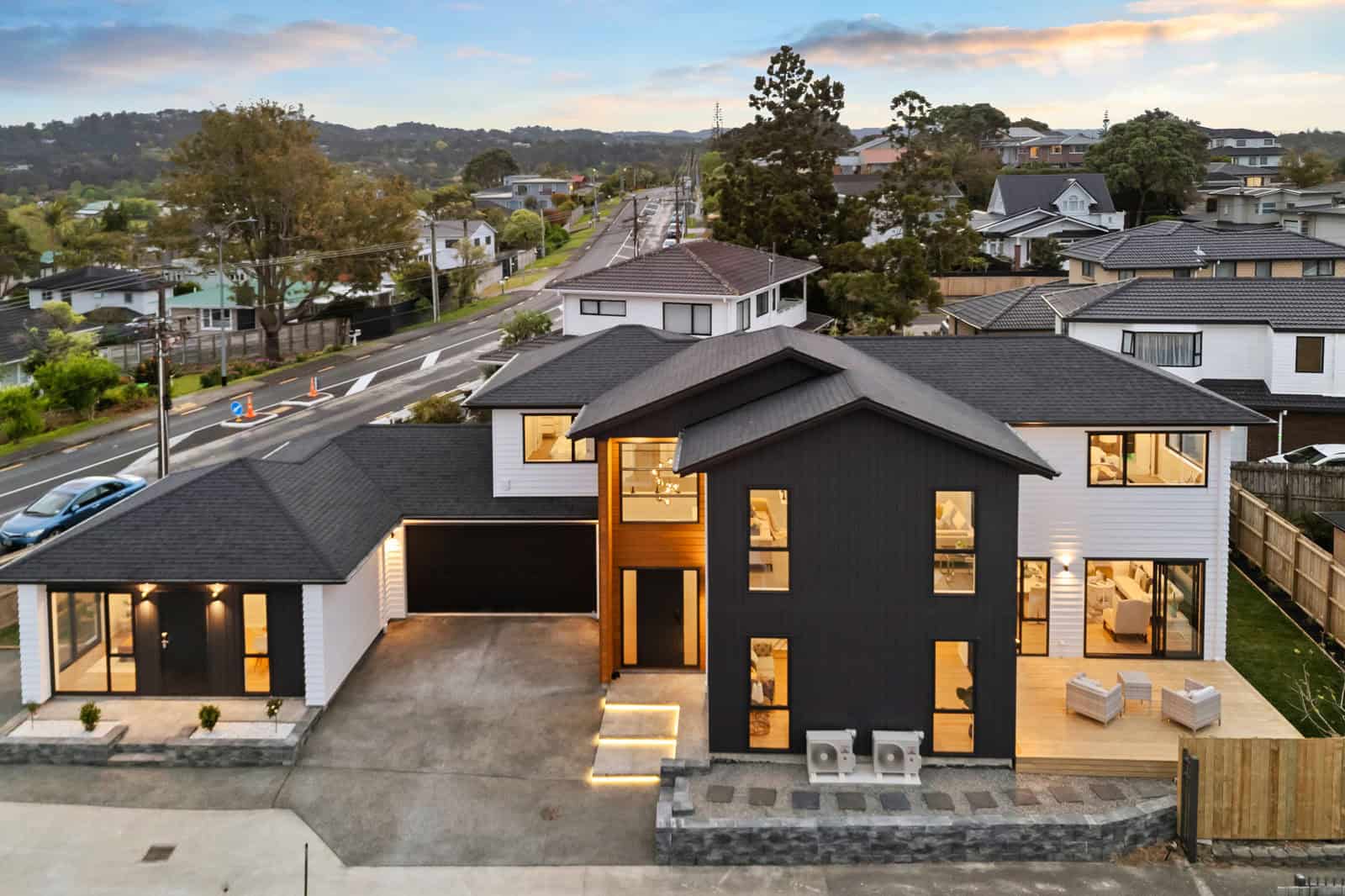
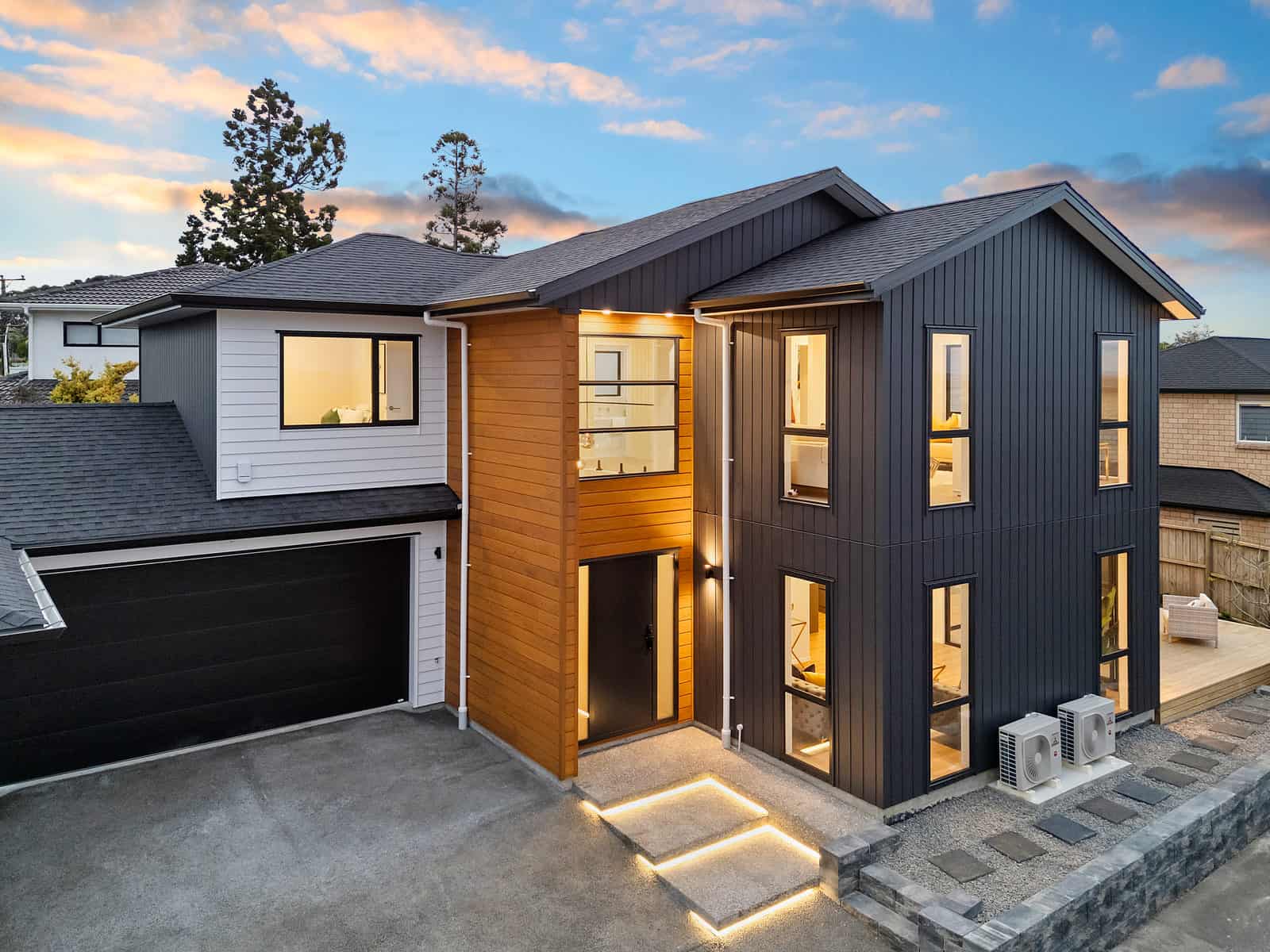
Two dwellings on one site is the same problem in a different shape: Home and Income in New Lynn, West Auckland.
The Plain-English Definition
A duplex is two separate, self-contained dwellings built on the same site, usually sharing one wall (side-by-side) or stacked (one above the other). Each has its own entrance, kitchen, living areas, and bathroom. A duplex is not a minor dwelling or granny flat, which are typically smaller and secondary to the main house, a duplex is two full residences of equal or near-equal size.
Think of it this way: a standard semi-detached house you’d see in Ponsonby or Herne Bay from the 1920s is essentially a duplex. Two homes, one shared wall, separate titles if subdivided. The format is nothing new — Auckland has had them for a century. What’s changed is the regulatory framework that governs whether you can build one, and how easily.
Why a Duplex Stacks Up Financially
The financial logic is straightforward. On a site with an existing house, your land is already purchased and paid for. Building a duplex lets you use that land more efficiently — essentially getting two income-generating or saleable assets from one piece of land.
Here’s a simplified scenario that illustrates the point. Imagine a homeowner in Henderson owns a 650m² Mixed Housing Urban-zoned site worth $800,000. Their existing 1970s home is dated and worth relatively little on its own. They demolish the existing house and build two modern three-bedroom dwellings, each approximately 160m². At a conservative build cost of $3,400/m², that’s roughly $1.09 million in build costs, plus consent, professional fees and site works. Total outlay from land purchase might be $1.9–2.1 million. Similar new duplexes in the area sell for $950,000–$1.1 million per unit. The numbers can work, but they depend entirely on zone, site constraints, build specification, and market conditions.
The other common scenario is the owner-occupier who keeps one unit and sells or rents the other. This is particularly compelling for homeowners on a large section who want to unlock equity, generate income, or future-proof their living situation as family circumstances change.
“The most common question we get from homeowners approaching this is whether the numbers work for their specific site — and that answer depends on so many site-specific factors that a feasibility assessment isn’t optional. It’s where every honest duplex conversation has to start.”
— Sonder Architecture Team
Duplex vs. Minor Dwelling vs. Subdivision: What’s the Difference?
These three options are often confused. A minor dwelling (sometimes called a granny flat) is a secondary, self-contained unit on a site — typically up to 65m² in size, permitted as an accessory to the main house in many zones. A duplex is two primary dwellings of comparable size. Subdivision is the process of splitting a site into two or more separate legal titles, which can happen alongside building a duplex or independently.
| Option | What It Is | Separate Titles? | Typical Use |
|---|---|---|---|
| Minor Dwelling | Secondary unit, max ~65m² | No — stays on same title | Family accommodation, rental income |
| Duplex | Two full dwellings, shared wall | Yes if subdivided | Sell one, rent both, owner-occupy one |
| Subdivision | Process of creating new titles | Yes — that’s the point | Sell land separately, increase value |
💡 Homeowner tip: You can build a duplex without subdividing — both units sit on one title. Many owners choose to subdivide later to sell or mortgage them separately. Subdivision is a separate consent process with its own costs and timeline. Our guide to subdividing in Auckland walks through that process in detail.
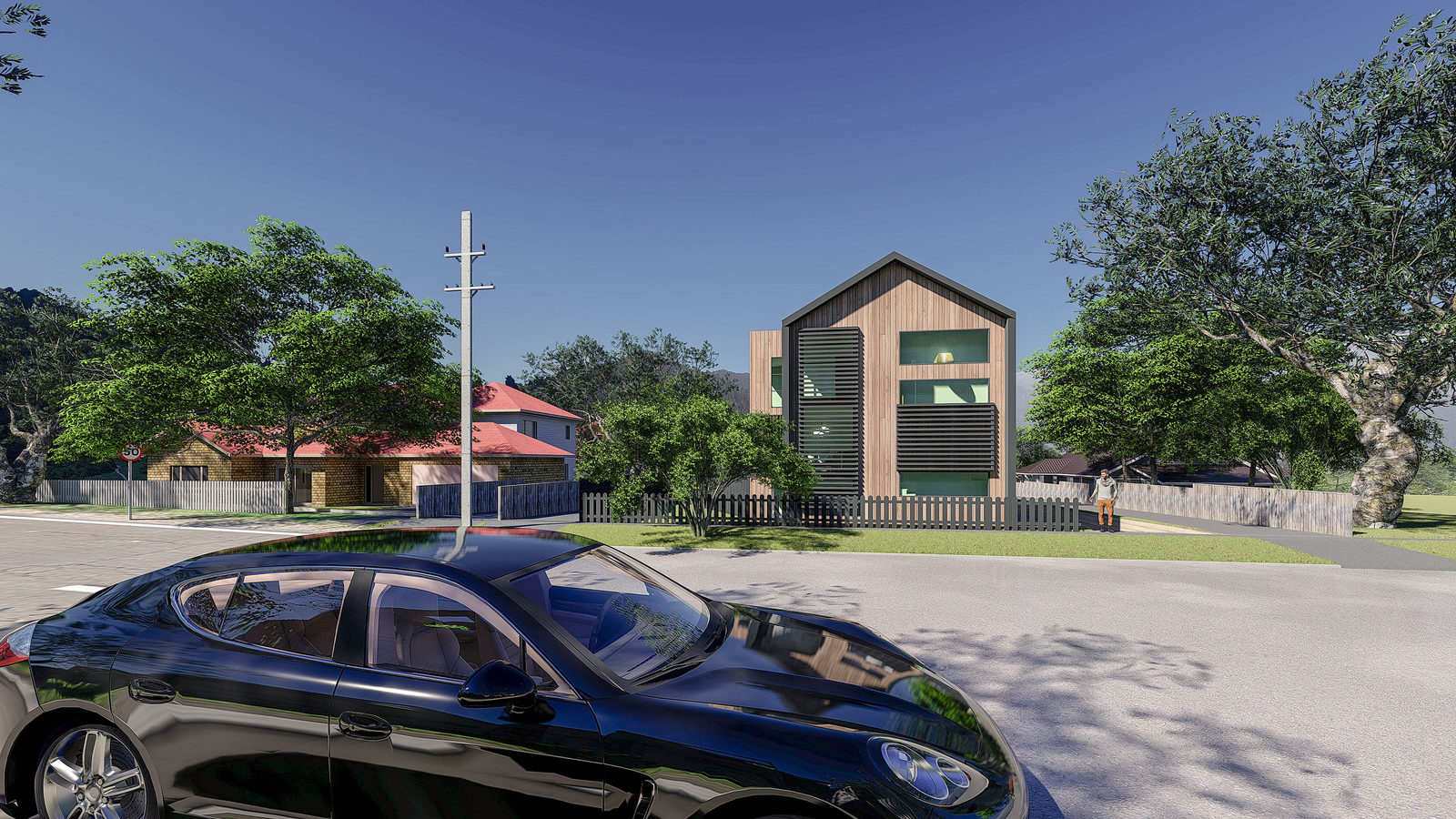
 The site
 From the drive
Auckland Duplex Rules: What the Planning Framework Actually Says
What Homeowners Need to Know Right Now
Auckland’s planning rules for residential density have changed more in the past three years than at any point in the city’s history. Here’s the plain-language version of where things stand right now.
Until October 2025, the Medium Density Residential Standards (MDRS), a set of government-mandated rules, allowed up to three dwellings of up to three storeys to be built on most Auckland residential sites without resource consent. That made duplex development significantly more straightforward in Mixed Housing Urban and Terrace Housing and Apartment Buildings zones. On 9 October 2025, Auckland Council withdrew Plan Change 78, which removed the MDRS as a permitted activity. The council replaced it with Plan Change 120, which was publicly notified on 3 November 2025 and is currently working through a hearings and submission process — with a final decision not expected until around mid-2027.
What this means practically: development rules now revert to the operative Auckland Unitary Plan (AUP). The good news for duplex developers is that the operative AUP already allows duplexes (two dwellings) as a permitted activity in Mixed Housing Urban zones, so building a duplex on a qualifying site does not require resource consent for the dwelling itself, provided all development standards are met. It’s building consents and, if you want separate titles, subdivision resource consent that you’ll need.
Important: Plan Change 120 is currently being heard by an independent panel. If your site is in a high-risk flood or coastal hazard area, more restrictive zoning may apply once PC120 becomes operative. Always check your property’s hazard status on Auckland Council’s GeoMaps viewer before planning a development. Final decisions on PC120 are not expected until 2027.
Your Zone Is Everything: MHU vs. MHS vs. Single House
The first question for any duplex project is always the same: what zone are you in? Your zone is determined by the Auckland Unitary Plan and can be checked in minutes on the Auckland Unitary Plan map viewer.
Mixed Housing Urban (MHU) — most favourable for duplexes. This zone covers large parts of central and inner suburbs including Grey Lynn, Mt Eden, Kingsland, Onehunga, Ellerslie, Pt Chevalier, and many North Shore and West Auckland locations. Under the operative AUP, up to three dwellings are permitted as of right subject to meeting development standards. A duplex fits comfortably within this.
Terrace Housing and Apartment Buildings (THAB): the highest density potential. Found close to town centres and transport corridors, including parts of Ponsonby, Parnell, Newmarket, and areas near train stations. Duplexes are well within what’s permitted. Higher-density configurations are also possible.
Mixed Housing Suburban (MHS) — more restrictive. This zone applies to many outer suburban areas and generally limits buildings to two storeys (up to 9m height). Two dwellings can be permitted under the operative AUP in some configurations, but the rules are tighter. A feasibility assessment is especially important here.
Single House Zone: a duplex is generally not permitted as a new build. However, an existing large house can sometimes be converted into two units (an upstairs/downstairs flat arrangement) subject to meeting all development standards. New standalone duplexes are not typically a permitted activity in Single House zones, which cover areas like Remuera, Epsom, Devonport, and many larger-section suburbs. Resource consent would be required.
| Zone | Duplex Permitted? | Height Limit | Max Coverage |
|---|---|---|---|
| Mixed Housing Urban (MHU) | Yes — as of right (2 dwellings) | 10m (approx. 3 storeys) | 50% of net site area |
| THAB | Yes — and higher density options | 16m+ in walkable catchments | Site-specific |
| Mixed Housing Suburban (MHS) | Possible — check standards | 8–9m (2 storeys) | 40–50% |
| Single House Zone | Not as a new build — conversion only | 8–9m | 35–40% |
The MHU Development Standards That Matter for Duplexes
If your site is in the Mixed Housing Urban zone and you’re building a duplex, these are the operative Auckland Unitary Plan standards that govern what you can build. Every one of these must be met for your development to proceed as a permitted activity — breach any of them, and you’re into resource consent territory.
Maximum building height: 10 metres (approximately three storeys). Height in relation to boundary: 4 metres + 60-degree recession plane from site boundaries (this controls how the building bulk can’t overshadow neighbouring properties). Front yard setback: minimum 1.5 metres from the road boundary. Side and rear yard setbacks: minimum 1 metre. Building coverage: maximum 50% of the net site area. Landscaped area: minimum 20–30% of the site. Outdoor living space: ground-floor units need at least 20m² of outdoor space with a minimum 3m x 3m dimension; upper-floor units need at least 8m².
💡 Homeowner tip: Height in relation to boundary is the rule that trips people up most often. It’s not just about how tall your building is — it’s about the angle at which that height affects your neighbour. A building that’s technically under 10m can still breach this rule if it’s positioned too close to the boundary. Your architectural designer checks this at design stage. We include it in every feasibility assessment.
Duplex Design Auckland: What Makes a Good Design Work
Side-by-Side vs. Stacked: Which Configuration Suits Your Site?
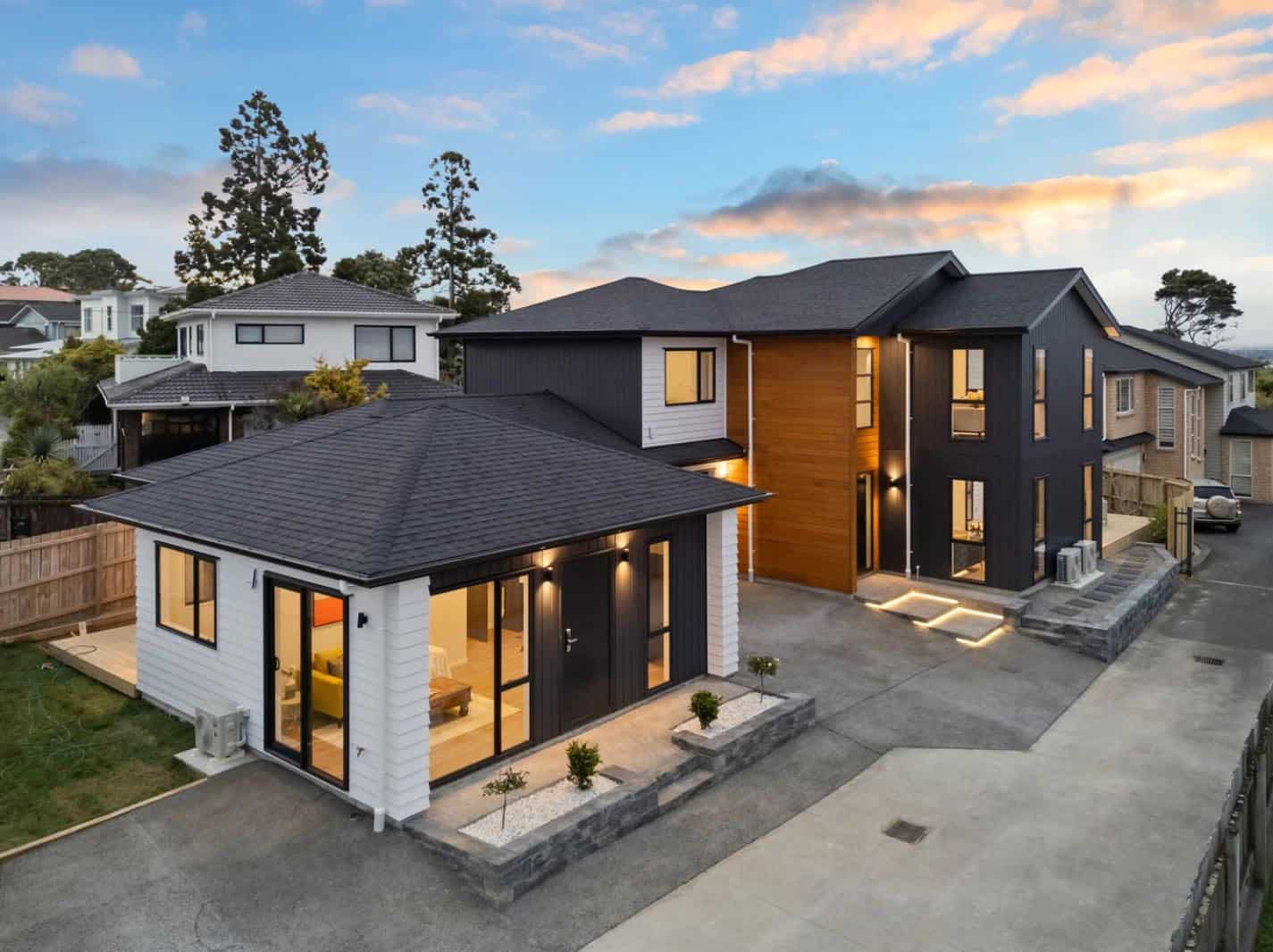
Most duplexes in Auckland fall into one of two configurations. A side-by-side duplex places both units at ground level with a shared wall down the middle — think two terrace homes next to each other on the same site. A stacked duplex puts one unit on the ground floor and the second above it, essentially a two-storey building with completely separate entrances and internal spaces.
Side-by-side designs work best on wider sites — typically those with a street frontage of 12 metres or more. Both units get direct ground-floor access, private outdoor space, and their own garage if the site allows. Families prefer this configuration because neither unit sacrifices outdoor amenity. The trade-off is that each unit has a smaller floorplan per level unless the site is large enough to run them deep rather than wide.
Stacked configurations suit narrower or smaller sites where ground coverage is limited. They’re more common on sites of 400–500m² where a side-by-side design would leave inadequate outdoor space for each unit. The challenge with a stacked duplex is that the upper unit needs its own separate street entrance, often via an external stair, and this affects the design significantly. Upper-level units typically command lower rental or sale prices than ground-floor equivalents, which is worth factoring into the feasibility.
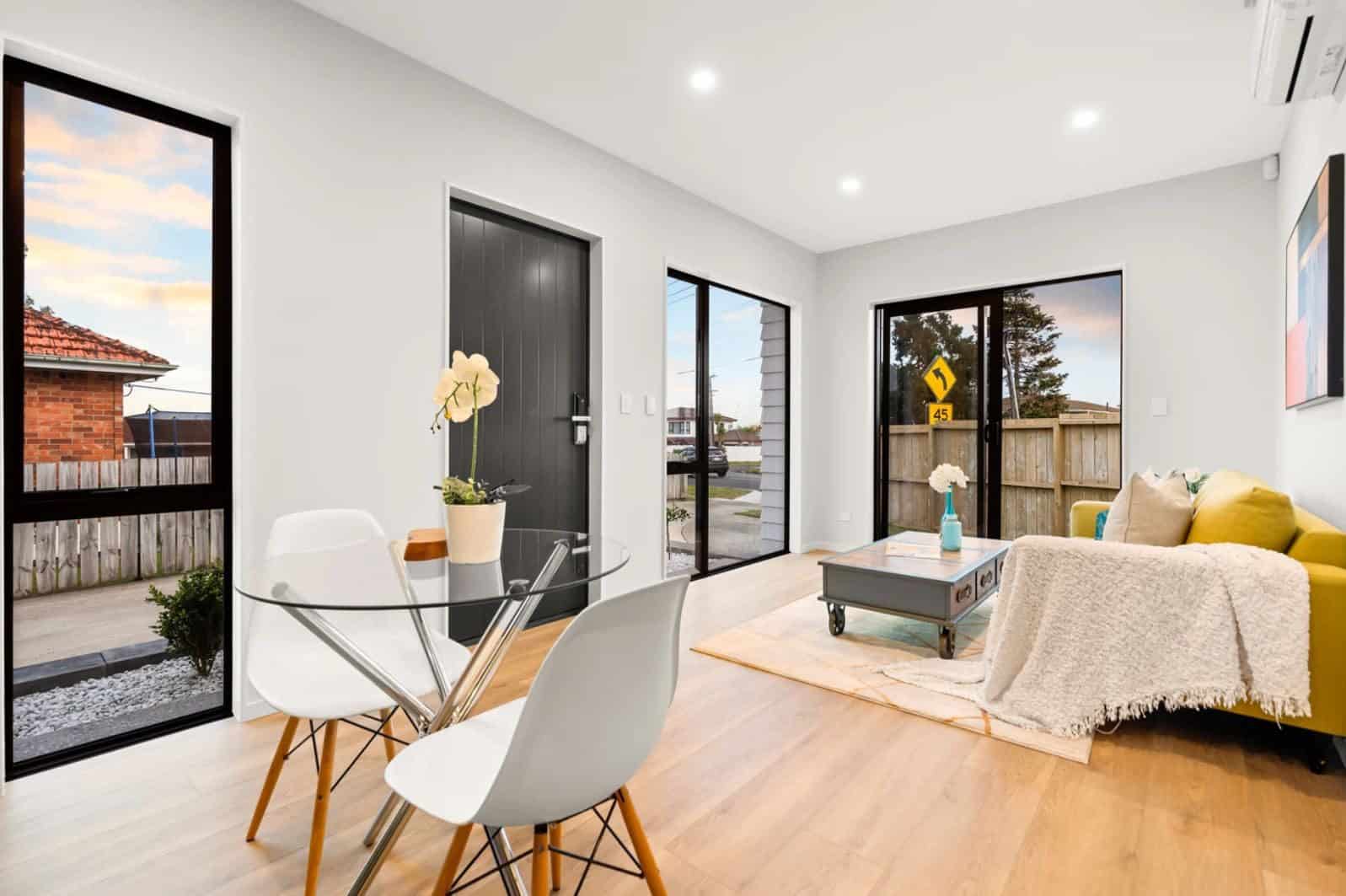
Design Principles That Add Value — and Ones That Add Cost
Good duplex design on a constrained Auckland site is a genuine balancing act. The goal is maximising liveable floor area and private amenity for each unit while staying within the AUP development standards and a budget that makes the project viable.
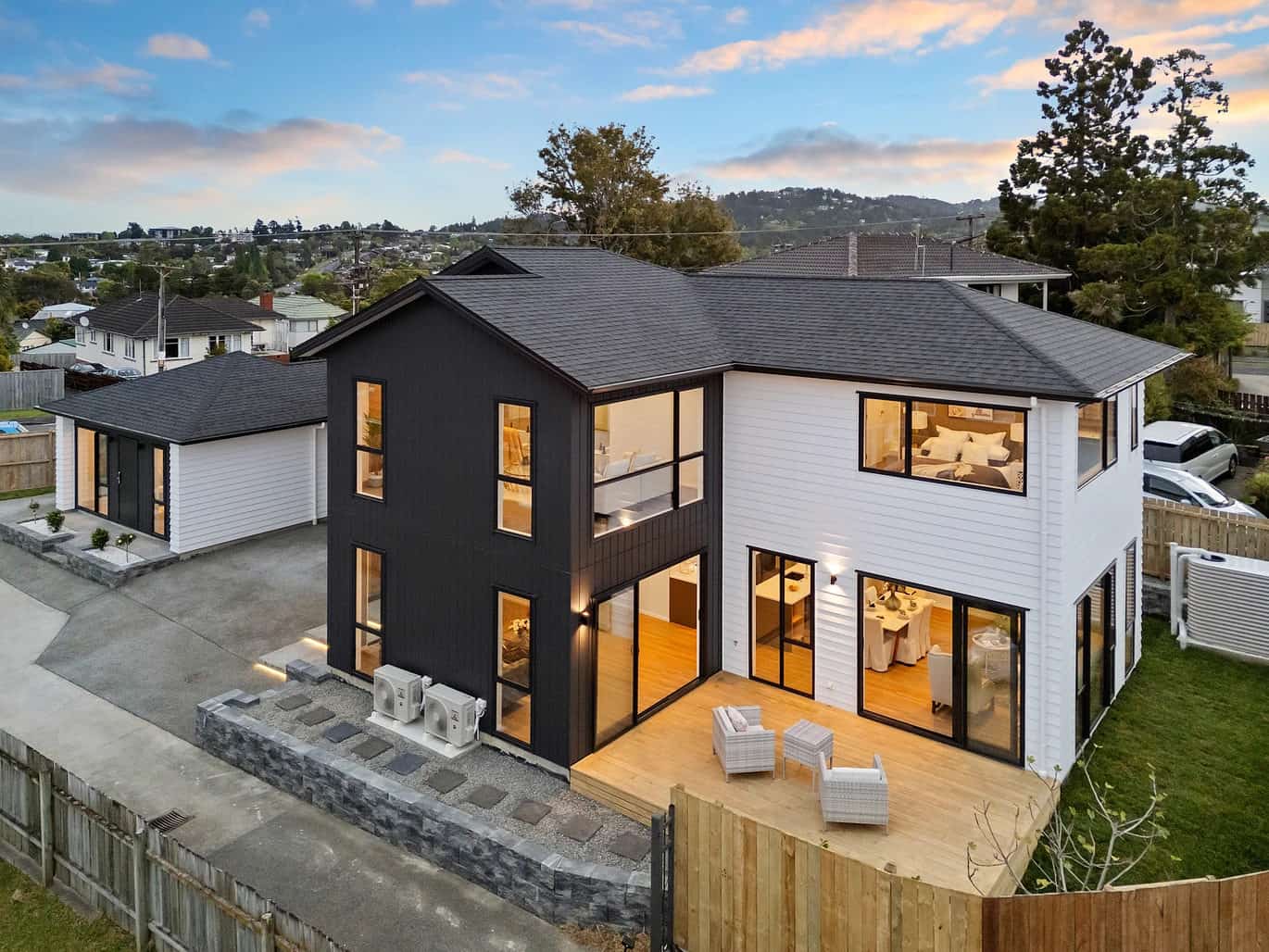
Mirror layouts, where both units are essentially flipped copies of each other, are the most cost-efficient duplex configuration. Shared wet walls (where plumbing stacks for both units are back-to-back) reduce plumbing run costs significantly. Shared rooflines reduce roofing complexity and cost. Simple rectangular forms with minimal junctions and changes in cladding material are measurably cheaper to build than complex forms, and in Auckland’s construction market, every unnecessary complication translates directly to dollars.
That said, design quality matters for resale and rental value. Units with north or north-east facing living areas perform better year-round due to passive solar gain. Full-height glazing opening to private outdoor space dramatically increases perceived size and liveability. Good acoustic separation between units, especially for stacked designs, is worth spending on at design stage rather than retrofitting later.
This trade-off shows up constantly on inner-suburb sites of around 600m². The first instinct is a two-storey side-by-side design, and the site analysis often points the other way. A stacked design with a well-separated upper entrance and generous north-facing glazing can deliver larger per-unit floor areas, better outdoor space for the ground-floor unit, and a lower build cost per square metre, because the roof area is halved. Upper units generally fetch less than ground-floor equivalents, so the number to compare is total project return, not price per unit.
“The configuration question comes before the design question. Get the site analysis right first: orientation, contour, street frontage, neighbours. The right design follows from that. Don’t start with what you like the look of and work backwards.”
— Sonder Architecture Team
Duplex House Plans in NZ: Why Off-the-Plan Rarely Survives Contact With an Auckland Site
Search “duplex house plans NZ” and you will find plenty of ready-made layouts. They are useful for working out what you want. They are much less useful as the thing you actually build, and it is worth understanding why before you fall for one.
A duplex plan is a response to a specific site, not a product. The plan that works on a flat 700m² rectangle in Henderson will not sit on a 600m² site in Mt Eden that falls a metre from front to back, has a legal boundary running at an angle, and sits under a height in relation to boundary control from the neighbour’s side. Change any one of those and the internal layout moves.
Here is what tends to drive the plan on a real Auckland section:
Which way the site faces. On a side-by-side duplex, one unit almost always gets better sun than the other. Good plans deal with that by giving the shaded unit its living space at the rear or upstairs, rather than pretending both units are identical. Mirrored plans are the easy answer and often the wrong one.
Where the outdoor living has to go. The Unitary Plan requires each dwelling to have usable outdoor living space of a minimum size and dimension, accessible from the living area. That single requirement dictates more duplex layouts than any aesthetic preference.
Where the cars and the bins go. Two dwellings means two sets of parking, two sets of bins, and usually a shared or duplicated crossing. Plans that ignore this end up with a driveway eating the north-facing yard.
Where the services run. Two kitchens and up to four bathrooms need drainage that reaches the existing connection, and if the units will ever be on separate titles they need separate connections. This is where a plan that looked efficient turns expensive.
The party wall. Two dwellings sharing a wall need fire separation and acoustic separation between them under the Building Code. That wall is thicker than an internal wall, it usually cannot carry openings, and it sets the structural grid for both halves of the building.
Our practical advice: use a plan you like as a brief, not a blueprint. Bring it to the feasibility stage and let the site edit it. Our guide to what architectural plans cost in NZ sets out what each stage of drawings actually buys you.
Architectural Drawings and the Consent Package
A duplex requires a full set of architectural drawings for building consent. Not a sketch, not a concept, not a CAD file from a builder. The consent package for a duplex typically includes: site plan, floor plans for both units at every level, all elevations (north, south, east, west), cross-sections showing floor-to-ceiling heights and structure, a schedule of materials and finishes, and engineering drawings for structure and foundations.
If your site has specific constraints (a sloping section, proximity to a heritage character area, flood or coastal hazard overlays) additional reports are required. These might include a geotechnical assessment (soil and slope stability), a stormwater management plan, a traffic impact assessment if the development affects site access, and potentially an assessment of environmental effects if any resource consent is required. If the site is mapped in a flood plain or overland flow path, our guide to building in a flood plain or overland flow path covers what you can still do there.
At Sonder Architecture, we handle the full package. Our restricted building work is designed or supervised by a Licensed Building Practitioner (LBP) in the Design Class — certified by the New Zealand Building Practitioners Board to design and oversee restricted building work (RBW), including the structural and weathertightness elements that matter most on a multi-dwelling project. For more on what good architectural drawings cover, our architectural design process guide walks through each stage in plain language.
💡 Homeowner tip: The building consent package for a duplex is significantly more complex than for a single dwelling renovation. Allow 6–10 weeks for architectural drawings to be completed and a further 20 working days (Auckland Council’s standard statutory timeframe) for building consent processing. Complex or non-standard applications take longer. Budget time, not just money.
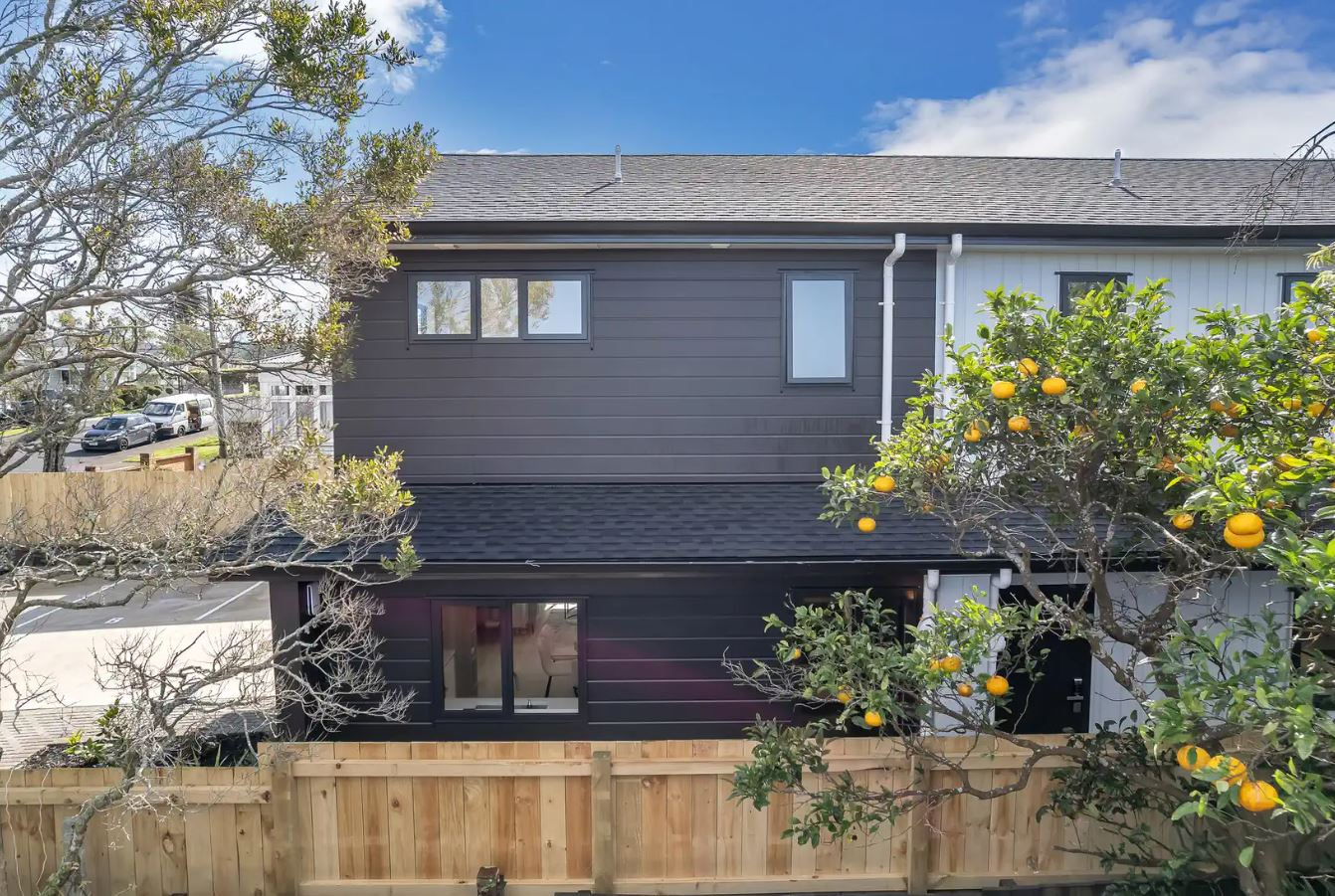
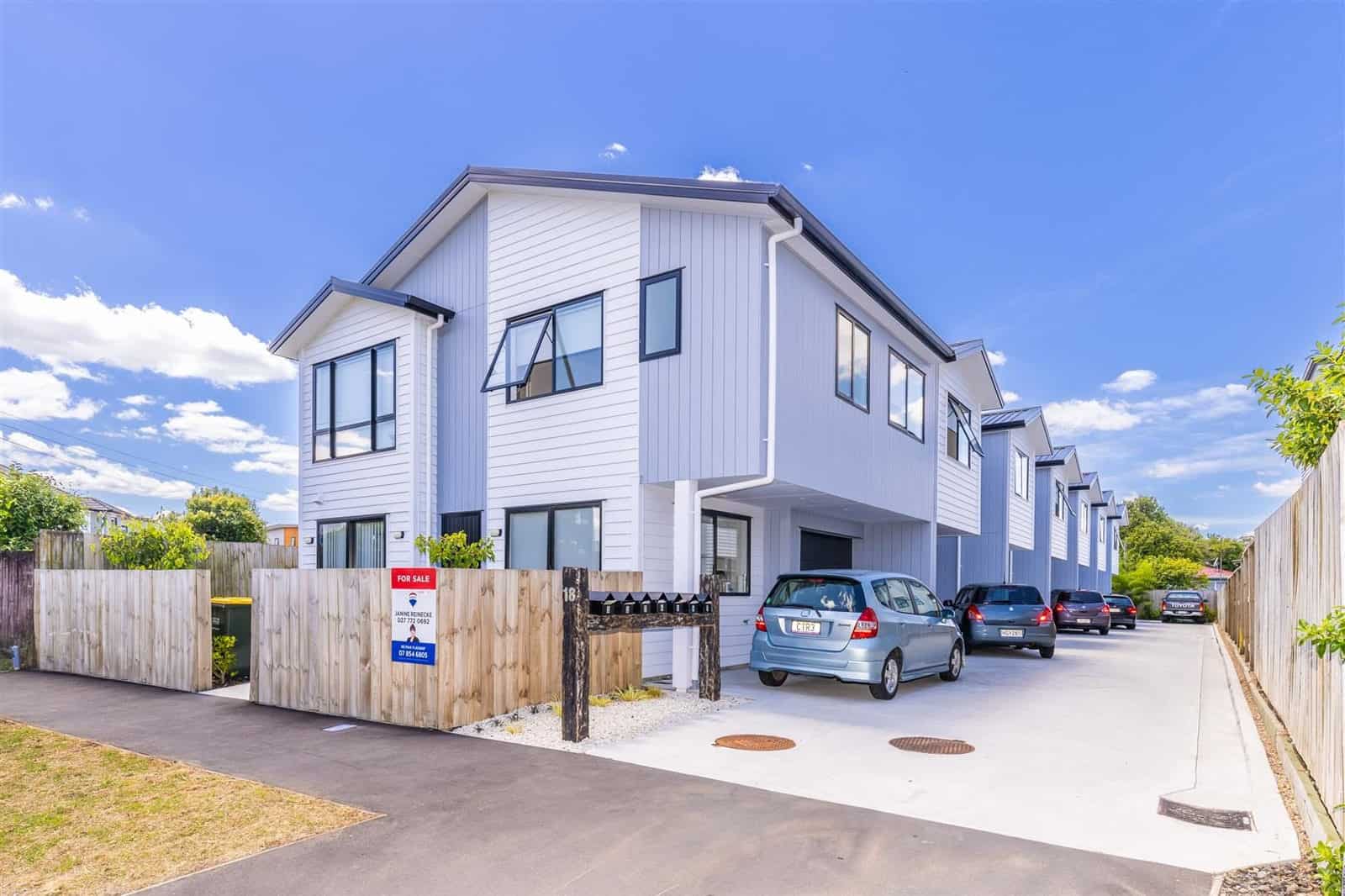 The row
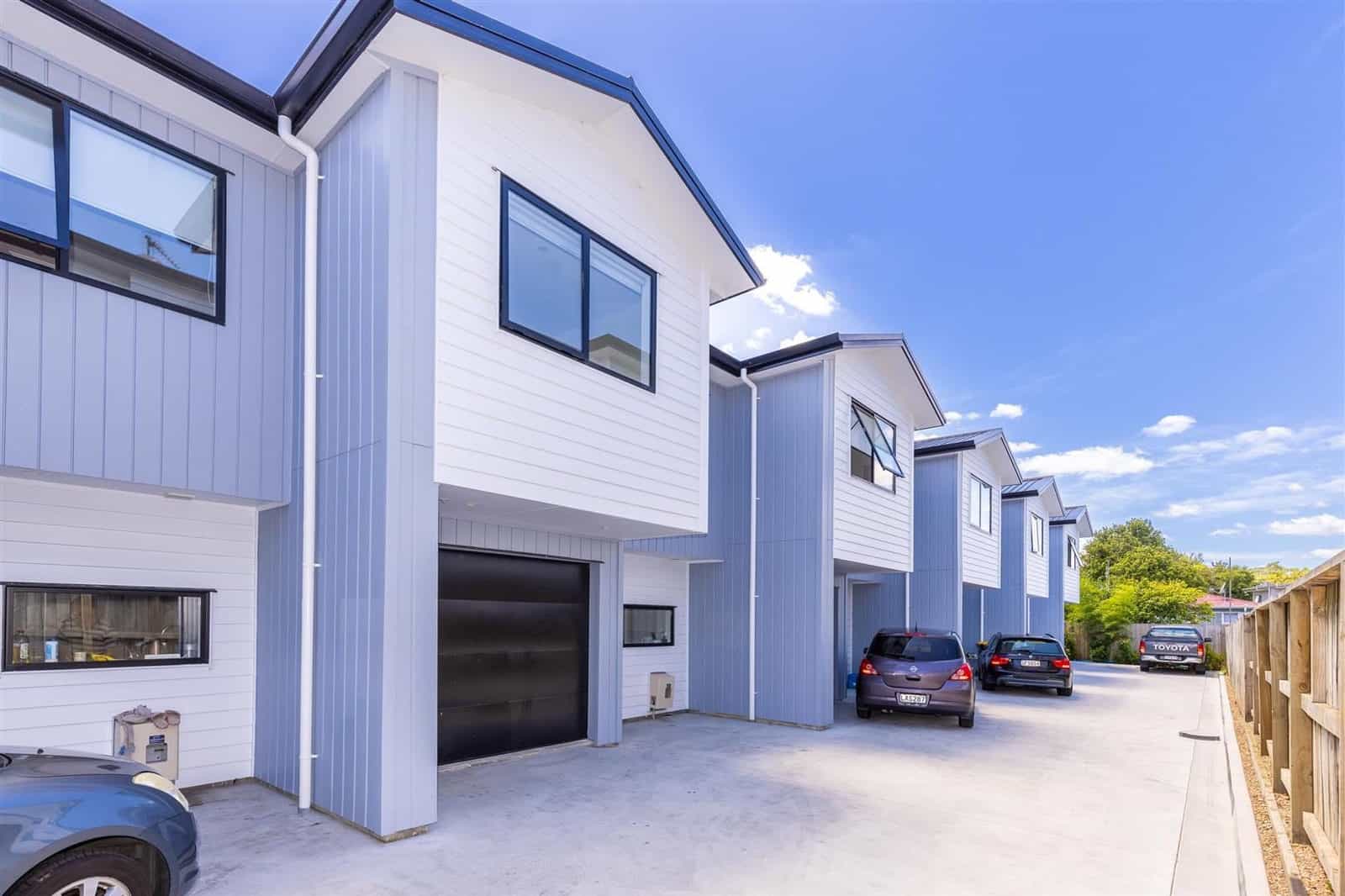 End unit
How Much Does It Cost to Build a Duplex in Auckland?
Build Cost Per Square Metre — What the NZ Data Shows
This is the question every homeowner asks first, and it deserves a direct answer, with the caveat that build costs vary substantially depending on specification, site conditions, and contractor.
According to data from Stats NZ published by interest.co.nz in February 2025, the average cost per square metre for new residential construction in New Zealand is approximately $3,245, with North Island figures (including Auckland) averaging around $3,394. MoneyHub NZ, citing the same Stats NZ data sourced through BRANZ levy calculations, notes that Auckland builds sit at the higher end of this national range due to labour demand and site complexity. Architectural and medium-density builds, which duplexes typically are, sit higher still.
For a well-designed Auckland duplex, expect these build cost ranges (excluding land, consent fees, professional fees, landscaping, and earthworks):
| Build Specification | Cost per m² (Auckland) | Example: 2 x 160m² Units |
|---|---|---|
| Standard group builder / volume build | $2,800–$3,200/m² | $896k–$1.02m |
| Mid-spec residential build | $3,200–$3,800/m² | $1.02m–$1.22m |
| Architect-led / quality spec build | $3,800–$4,500/m² | $1.22m–$1.44m |
| Premium / complex build | $4,500–$5,500/m²+ | $1.44m–$1.76m+ |
Sources: Stats NZ building consent data (via interest.co.nz, February 2025) and the MoneyHub NZ build cost guide (2025). These are national and regional averages published in 2025, so treat them as a starting point rather than a current quote, and get contractor pricing before you budget.
Important: These cost-per-square-metre figures are for the building structure only. They exclude land, earthworks, retaining walls, stormwater management, driveways, landscaping, consent fees, professional fees (architect, engineer, surveyor), development contributions, and GST. Industry experts note that external items can add 30–50% to the completed build cost depending on site conditions. Budget these separately and upfront.
The Full Cost Breakdown: What You Actually Need to Budget
Beyond the build itself, duplex development in Auckland involves several layers of cost that catch homeowners off-guard. Here’s a realistic picture of what to plan for.
Architectural and engineering fees: For a full-service duplex (feasibility, design, consent drawings, construction observation) architectural fees typically range from 8–12% of the build cost for a residential project of this scale. For a $1.2 million build, that’s $96,000–$144,000. Engineering fees (structural, geotechnical, civil) are additional, typically $15,000–$40,000 depending on site complexity.
Building consent fees: Auckland Council’s building consent fees are calculated based on construction value. The application starts with a deposit set by value band, and Auckland Council then charges processing and inspection time at its published hourly rates. Two levies sit on top and they are separate charges, not one combined fee. The MBIE building levy is $1.75 (including GST) per $1,000 of work, and it applies to any project valued at $65,000 or more, so a $1.5 million duplex carries roughly $2,625 of MBIE levy. The BRANZ building research levy is collected alongside it at a rate BRANZ sets. For a project of this size, expect the total council bill to run to five figures once processing time and inspections are counted. Our detailed guide to building consent costs in Auckland breaks these down by project type.
Resource consent for subdivision: If you want to subdivide the duplex into two separate titles, you’ll need a resource consent. Auckland Council publishes its resource consent deposits by application type. A subdivision consent takes a $5,000 deposit, dropping to $2,000 for a cross-lease, unit title or boundary adjustment. The deposit is not the fee: council draws down against it at $204 an hour for planning work, $237 for senior engineering and subdivision work, and $246 at manager level, and invoices the balance. Professional planner fees for preparing the application and Assessment of Environmental Effects range from $3,500–$6,500. Surveyor fees for the scheme plan and land transfer survey can total $13,000–$17,000. Development contributions, the charges Auckland Council levies for infrastructure pressure from additional dwellings, typically range from $17,000–$35,000 per additional lot in residential areas, per Planning Plus guidance.
Earthworks and site preparation: A flat, accessible Auckland section with good soil bearing capacity is the best-case scenario. Sloping sites, poor soil conditions, high groundwater, or proximity to a stream or watercourse can add $50,000 to $150,000 in earthworks and engineering. Servicing is the other budget line people miss entirely: Watercare connection charges and infrastructure growth charges sit outside your building consent and are charged per additional dwelling. This is where a geotechnical assessment, which we include as part of our feasibility process, is worth its cost many times over.
Demolition: If an existing house needs to come down first, budget $20,000–$40,000 for demolition and disposal, more if there are hazardous materials such as asbestos (common in pre-1990 Auckland homes, particularly in textured ceiling coatings and vinyl floor coverings).
💡 Homeowner tip: Always build a contingency of 10–15% into your total project budget. Unexpected ground conditions, material cost movements, and design variations during construction happen on most projects. A contingency that never gets used is a pleasant outcome. One that didn’t exist is a crisis.
Duplex vs. Single New Build vs. Subdivision: A Comparison
| Scenario | Total Outlay (est.) | Potential Outcome | Best For |
|---|---|---|---|
| Single new build on existing site | $700k–$1.2m (build + fees) | 1 saleable or rentable home | Family home upgrade, no complexity |
| Duplex (no subdivision) | $1.2m–$1.8m (build + fees) | 2 rentable units, 1 title | Long-term investment / live + rent |
| Duplex + subdivision | $1.4m–$2.2m (build + all fees) | 2 saleable units on 2 titles | Maximise equity, sell one or both |
| Land subdivision (no build) | $180k–$250k+ per new lot | 1 new section to sell or develop | Release equity without building |
The Consent Process for a Duplex in Auckland: Step by Step
Building Consent: Your Non-Negotiable First Step
Every duplex in Auckland needs a building consent before a single stake goes in the ground. A building consent, issued under the Building Act 2004 and assessed against the New Zealand Building Code (NZBC), is Auckland Council’s confirmation that your plans meet the national performance standards for structure, weathertightness, fire safety, plumbing, drainage, and accessibility. Think of it as the construction permission slip: without it, you’re building illegally.
The building consent application is submitted through Auckland Council’s e-consent portal along with the full set of architectural and engineering drawings. Auckland Council’s statutory timeframe for processing a building consent is 20 working days — but that clock only runs when the application is complete. Incomplete applications get put on hold while additional information is requested, which is why the quality of the initial submission matters enormously. Complex duplex applications with unusual structural solutions or tight site constraints regularly take 30–40 working days or more.
Once building consent is granted, construction can begin. Auckland Council building inspectors will visit the site at key stages (foundation, framing, pre-line before the plasterboard goes up, and final inspection) to check that work matches the consented plans. When all inspections pass, you’ll receive a Code of Compliance Certificate (CCC) — the document that confirms your finished duplex meets the New Zealand Building Code and is legally habitable.
Important: Without a CCC, your duplex cannot legally be sold or occupied. Banks won’t lend against it, insurers won’t fully cover it, and any future buyer will inherit the problem. Getting the CCC is not optional — it’s the end-point every building consent project must reach. For more on what’s involved, see our guide to building consent for Auckland projects.
Resource Consent: When Do You Need It for a Duplex?
This is where many homeowners get confused — and understandably so, given how much Auckland’s planning rules have changed recently.
Under the operative Auckland Unitary Plan, a duplex on an MHU-zoned site is a permitted activity if it complies with all development standards (height, setbacks, coverage, etc.). A permitted activity does not require resource consent — the dwelling itself is approved through the building consent process.
Resource consent for a duplex project is required in these situations: if any development standard is breached (for example, if the proposed building is too close to a boundary or exceeds 50% site coverage); if the site is subject to a qualifying matter or overlay that limits density; if you’re in a Single House zone and want to build a new duplex; or if you want to subdivide the site into two separate titles. Subdivision resource consent is a separate process from the building consent and runs on its own timeline.
Subdivision Resource Consent: What It Involves
If your goal is to sell or mortgage each duplex unit independently, you need them on separate titles. That requires a subdivision resource consent — a separate application to Auckland Council under the Resource Management Act 1991 (RMA), which is the law governing land use in New Zealand.
A subdivision resource consent for a duplex site involves a planner preparing an Assessment of Environmental Effects (AEE), a surveyor producing a scheme plan, and the application being assessed by Auckland Council against the AUP subdivision rules. The deposit for a subdivision consent in Auckland is $5,000, or $2,000 where it is a cross-lease, unit title or boundary adjustment, and council then charges its time against that deposit. Professional fees on top of that (planner, surveyor, civil engineer for services) typically add $15,000 to $25,000.
Processing time for a non-notified subdivision resource consent is 20 working days per the RMA. However, many applications are more complex and take 40–60 working days. Public notification, which can occur if the application doesn’t meet certain standards and affects third parties, can extend this substantially, adding months and cost.
💡 Homeowner tip: Start your subdivision consent application early — ideally while the building consent is being processed or construction is underway. The two processes are independent of each other and can run in parallel. Waiting until the duplex is built to apply for subdivision is a common and avoidable delay. Our team coordinates both as part of the full project management process.
Is Your Site Right for a Duplex? Running a Feasibility
The Five Questions Every Site Assessment Answers
Before spending money on design or consents, a structured feasibility assessment tells you whether duplex development is actually viable on your site. This isn’t a box-ticking exercise — it’s the single most valuable piece of work you can do at the start of a project. A thorough feasibility can save you from committing a million dollars to a project that was never going to work, or it can give you the confidence to proceed knowing the numbers make sense.
At Sonder Architecture, our free feasibility report addresses five core questions for any duplex inquiry.
1. What does your zone allow? Checking your AUP zone, identifying any overlays (heritage, flood, coastal, special character), and confirming whether a duplex is a permitted activity or requires resource consent.
2. Does your site meet the physical requirements? Site area, frontage width, slope, orientation, existing structures, and service connections all influence what’s buildable. A 400m² site with a 9m frontage has very different options to a 700m² site with a 20m frontage.
3. What can you actually build within the development standards? Running the height, setback, coverage, and outlook space rules against your specific site to understand the real development envelope — how big the buildings can be, where they can sit on the site, and what configuration makes sense.
4. What will it cost and what is the likely return? A realistic cost estimate including build, consent, professional fees, development contributions, earthworks, and demolition — compared against comparable duplex sales in your suburb. This is where the project either stacks up or doesn’t.
5. Are there any deal-breakers? Hazard overlays, heritage constraints, contaminated land, restrictive covenants on the title, shared driveways or cross-lease complications — any of these can fundamentally change what’s possible. Finding them early is the difference between a project that proceeds smoothly and one that unravels after significant cost.
What to Watch Out For on Auckland Sites
Several factors specific to Auckland’s housing stock and geography create complications that don’t show up in a simple zone check.
Special character overlays. Parts of Grey Lynn, Ponsonby, Mt Eden, Devonport, and other inner suburbs with pre-1940 housing stock are subject to Special Character Area overlays. These rules protect the streetscape character of older residential areas. Demolishing a character home in these areas, even if the site is MHU-zoned, requires resource consent and can be declined. This is a significant trap for developers who assume zone alone determines what’s possible.
Cross-lease titles. Auckland has a large number of cross-lease properties, particularly in inner suburbs developed during the 1960s–80s. A cross-lease title is a shared ownership arrangement — not a standard fee simple (freehold) title. Building a duplex on a cross-lease site requires updating the cross-lease plan and may involve the consent of neighbouring cross-lease owners. This adds cost and complexity, and occasionally makes a project impractical without converting the cross-lease to fee simple first.
Flood and hazard overlays. Auckland’s 2023 weather events exposed the extent of flood-prone land across the city, particularly in West Auckland suburbs like Henderson, Massey, and Te Atatu, and in areas bordering streams and watercourses. Auckland Council’s revised flood maps now apply more restrictive rules in many of these areas. Under Plan Change 120 (currently being heard), these restrictions are set to tighten further. Check your property’s flood status at the Auckland Council GIS Viewer before planning anything.
Pre-1990 homes and weathertightness. If your site has an existing home you plan to demolish, check for hazardous materials, particularly asbestos-containing materials in ceiling and floor products, and lead paint in pre-1980 homes. Licensed removal is required and adds cost. Homes built between 1994 and 2004 may also have weathertightness issues (the so-called “leaky building” era), if there’s any chance the existing structure might be retained or converted rather than demolished, get a weathertightness assessment first.
“We’ve had clients come to us having already spent money on concept drawings from a drafter — only to find out at feasibility stage that their site has a stream setback that takes out 30% of the buildable area. Running feasibility first costs a fraction of what fixing a late-stage problem does.”
— Sonder Architecture Team
Starting the Process: What to Bring to Your First Consultation
If you’re at the “I’m wondering whether this could work” stage, a free feasibility conversation with our team is the right first step. We design two-dwelling and multi-unit projects across Auckland, and the conversation is not a commitment. Bring your property address, any information you have about the current title (LIM report, certificate of title if you have it), and a rough sense of your goals and budget range.
We’ll tell you what the zone allows, flag any obvious constraints, and give you an honest view of whether the project is worth pursuing. If it is, the next step is a formal feasibility report that goes into the full detail. If it isn’t, whether because of zone rules, site constraints, or financials that don’t work, you’ll find out before spending significant money on design.
Sound like the right approach? Request a free feasibility report here. No pressure, no obligation — just a straight answer about what’s possible on your section.
💡 Homeowner tip: Your property’s LIM report (Land Information Memorandum — a council-issued document summarising everything officially recorded about your property) is one of the most useful documents to have at feasibility stage. It contains zoning, overlays, consenting history, and any known hazards. If you don’t have one, you can order it from Auckland Council, which publishes the current LIM fee and turnaround on its website. Order it early: it is the cheapest thing you will buy in the whole project and it settles more questions than anything else at this stage.
If a duplex is genuinely viable on your Auckland section, the next move is getting a proper feasibility done — not more research. We help Auckland homeowners work through exactly this kind of decision every week. When the numbers work, a duplex is one of the most effective ways to use existing land. When they don’t, you want to know that before the design fees start.
➡ Book a free consultation with Sonder Architecture
➡ Request your free feasibility report
➡ Read our guide to subdividing in Auckland 2025
➡ See recent projects we’ve done across Auckland
Duplexes are permitted as of right in Mixed Housing Urban (MHU) and Terrace Housing and Apartment Buildings (THAB) zones under the operative Auckland Unitary Plan, provided all development standards are met. Mixed Housing Suburban zones allow two dwellings in some configurations but with stricter limits. Single House zones generally don't permit new duplexes — only conversion of an existing house into two units in limited circumstances. Check your zone at aucklandcouncil.govt.nz before planning anything. Not necessarily. If your site is in a Mixed Housing Urban zone and your duplex design complies with all Auckland Unitary Plan development standards (height, setbacks, building coverage, outdoor living space) it's a permitted activity and only needs building consent. Resource consent is required if any standard is breached, if your site has overlays or qualifying matters, or if you want to subdivide the site into two separate titles (which is a separate resource consent process). The Medium Density Residential Standards (MDRS) were removed as a permitted activity in Auckland on 9 October 2025 when Auckland Council withdrew Plan Change 78. However, the operative Auckland Unitary Plan already allowed duplexes in Mixed Housing Urban and THAB zones before the MDRS existed. So building a duplex on a qualifying MHU-zoned site is still permitted — the rules just revert to the operative Unitary Plan rather than the MDRS. Always verify your site's current status with a planning professional or through Auckland Council. Based on 2025 NZ build cost data from Stats NZ (via interest.co.nz and MoneyHub NZ), Auckland residential construction averages around $3,200–$3,600 per square metre for mid-spec builds. For an architect-led duplex, expect $3,800–$4,500/m². Two units totalling 320m² might cost $1.0–$1.4 million in build costs alone. Add consent fees, professional fees, earthworks, development contributions, and site preparation — total project costs typically range from $1.4 million to $2.2 million depending on site and specification. Always get fixed-price quotes from at least three builders. No, you can build a duplex and keep both units on one title. Many homeowners do this if they plan to rent both units long-term. Subdivision creates two separate certificates of title, which allows you to sell or mortgage each unit independently. It's a separate resource consent process with its own costs (typically $30,000–$60,000 total including planner, surveyor, council fees, and development contributions) and timeline. Whether to subdivide depends on your goals, we discuss this as part of the feasibility process. From feasibility to completed Code of Compliance Certificate, expect 18–36 months for a duplex project in Auckland. Architectural design and documentation: 2–4 months. Building consent processing: 20+ working days (longer for complex applications). Construction: 9–14 months for a standard timber-framed duplex. If subdivision is required, that runs in parallel and adds 4–6 months. Delays from ground conditions, consent queries, or material lead times are common — build a buffer into your timeline. Technically yes, but it's more complex than a fee simple (freehold) title. A cross-lease property involves shared ownership with other cross-lease holders on the site — any development that changes the building footprint requires updating the cross-lease plan and may need consent from other cross-lease owners. Many homeowners convert their cross-lease to fee simple before developing. We can advise on this at feasibility stage. A surveyor and potentially a lawyer should be involved early in any cross-lease development inquiry. A Code of Compliance Certificate (CCC) is the document Auckland Council issues once your completed building has passed all inspections and is confirmed to meet the New Zealand Building Code. Without a CCC, your duplex cannot legally be occupied or sold. Banks won't mortgage it, insurers won't fully cover it, and any buyer inherits the non-compliance problem. Getting your CCC is the final step in every building consent project — it's not optional. The CCC process involves Auckland Council inspectors signing off on each stage of construction, with a final inspection at completion. Plan Change 120 is Auckland Council's replacement for Plan Change 78 (which included the MDRS). PC120 was publicly notified on 3 November 2025 and focuses development near transport corridors and town centres while introducing stronger rules in high flood and natural hazard risk areas. It's currently working through hearings, with a final decision expected around mid-2027. Until PC120 becomes operative, the operative Auckland Unitary Plan rules apply. If your site is in a flood-prone or coastal hazard area, PC120 may impose more restrictive rules once operative — get advice before committing to a project. For a duplex, you need someone qualified to sign off on restricted building work — which includes structural and weathertightness elements. A Licensed Building Practitioner (LBP) in the Design Class is authorised to do this. A drafter without LBP Design Class credentials cannot legally produce and sign off these drawings. At Sonder Architecture, our restricted design work is carried out or supervised by a Licensed Building Practitioner (Design Class), which means we manage the full consent package from design through to Code of Compliance Certificate. Get the right credentials in place from day one.
What zones in Auckland allow duplex development?
Do I need resource consent to build a duplex in Auckland?
What happened to the MDRS rules — can I still build a duplex?
How much does it cost to build a duplex in Auckland?
Do I need to subdivide my duplex into two titles?
How long does it take to get a duplex built in Auckland?
Can I build a duplex on a cross-lease property?
What is a Code of Compliance Certificate and why do I need one for a duplex?
What is Plan Change 120 and how does it affect duplex development?
Do I need an architect for a duplex or can I use a drafter?