
Last updated:
Quick answer: A building consent is your council’s approval to start construction work that affects the structure, plumbing, weathertightness or fire safety of a building. Most renovations, new builds and extensions in New Zealand need one. The exception got a lot wider on 15 January 2026: new single-storey standalone dwellings up to 70m² are now consent-exempt under Schedule 1A of the Building Act, provided a Licensed Building Practitioner designs or supervises the build and the council issues a Project Information Memorandum first. Outside that exemption, section 48 of the Building Act gives the council 20 working days to decide, and Auckland Council’s lodgement deposits run from $1,282 on work under $5,000 to $10,665 on work over $1 million.
Below: what a building consent actually is, when you need one in 2026, how the process works, what Auckland Council actually charges, how long a consent stays alive once it is granted, and how all of it differs from a resource consent.
What a Building Consent Is
A building consent is a formal approval issued by your local council under the Building Act 2004. It confirms that the work you’re planning meets the New Zealand Building Code — the technical standard covering structural integrity, fire safety, weathertightness, drainage, sanitation, and accessibility.
The consent isn’t optional for most work. As the property owner you’re legally responsible for ensuring consented work happens before you start, and a Code Compliance Certificate (CCC) gets issued at the end. Skip it and the consequences are real: fines, enforcement notices, insurance refusals, and complications when you eventually sell the property.
One important distinction up front. A building consent covers how you build, the construction methods, materials, and safety standards. A resource consent covers where you build, site coverage, height, setbacks, heritage rules, environmental effects. They’re issued under separate Acts (Building Act 2004 for building consents, Resource Management Act 1991 for resource consents) and they’re often required together. More on that further down.
When You Actually Need One (2026)
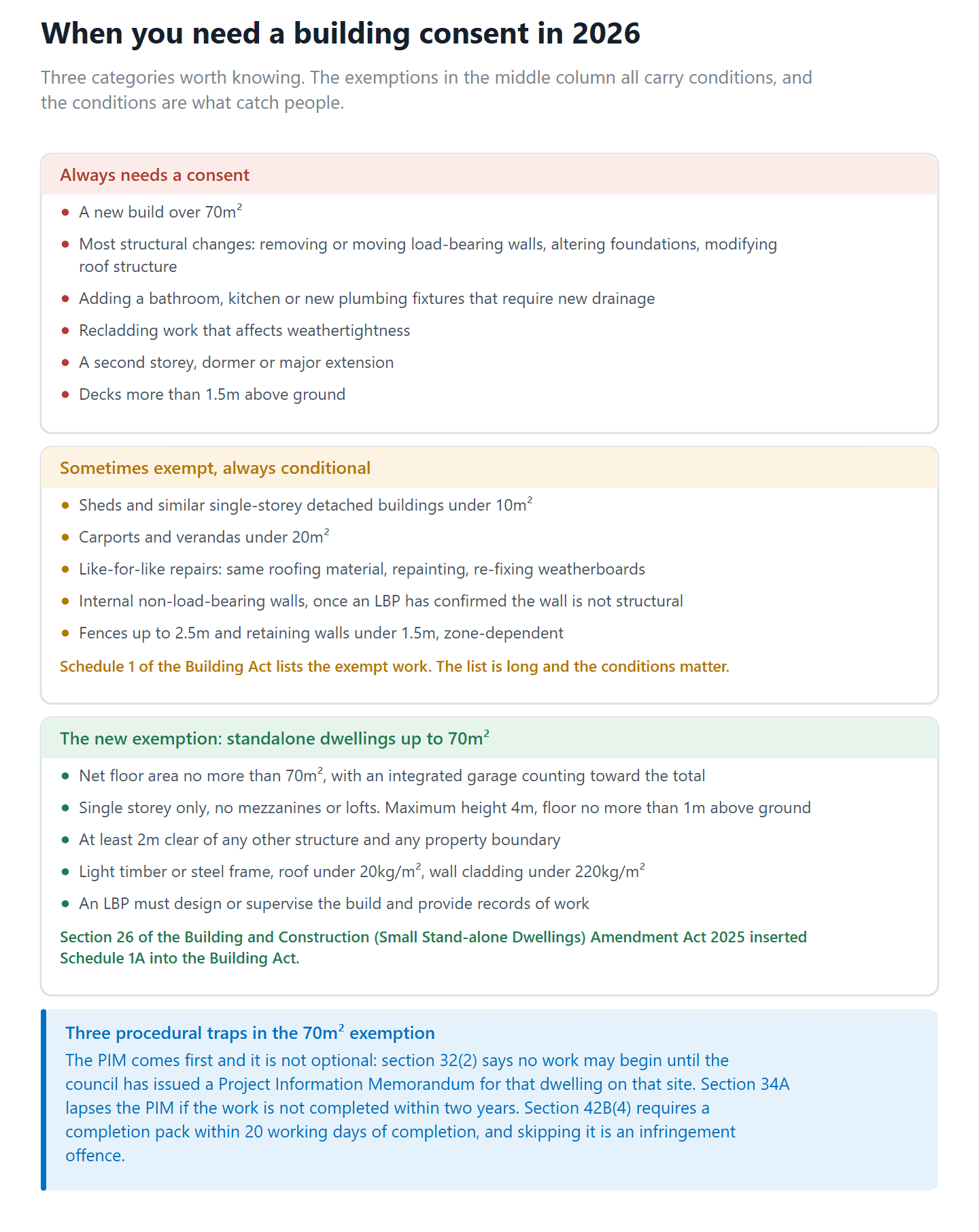
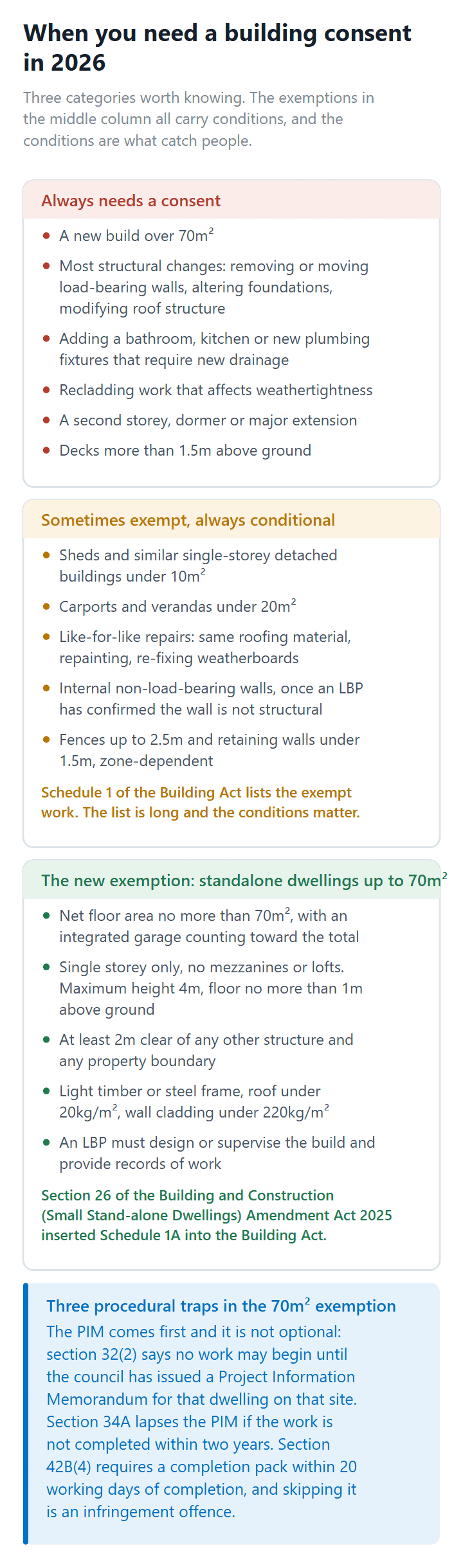
The 2026 rules are simpler than they were two years ago. Three categories worth knowing:
Always needs a consent
- A new build over 70m²
- Most structural changes — removing or moving load-bearing walls, altering foundations, modifying roof structure
- Adding a bathroom, kitchen, or new plumbing fixtures that require new drainage
- Recladding work that affects weathertightness
- A second storey, dormer, or major extension
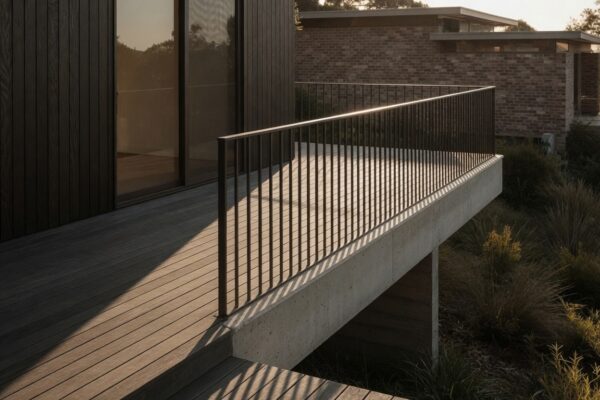
- Decks more than 1.5m above ground
For renovations specifically, we’ve written a separate guide that goes deeper on what triggers a consent during a renovation — including the awkward middle ground where homeowners aren’t sure whether their project crosses the line.
Sometimes needs a consent
Schedule 1 of the Building Act lists work that’s exempt from consent. The list is long and the conditions matter. We’ve covered the exemptions in detail here, but the most-asked ones:
- Sheds and similar single-storey detached buildings under 10m² (with conditions)
- Carports and verandas under 20m² (with conditions)
- Like-for-like repairs and maintenance — replacing a roof with the same material, repainting, re-fixing weatherboards
- Internal non-load-bearing walls — though you should have an LBP confirm the wall isn’t structural before removing it
- Fences up to 2.5m and retaining walls under 1.5m (zone-dependent)
The new exemption — small standalone dwellings up to 70m²
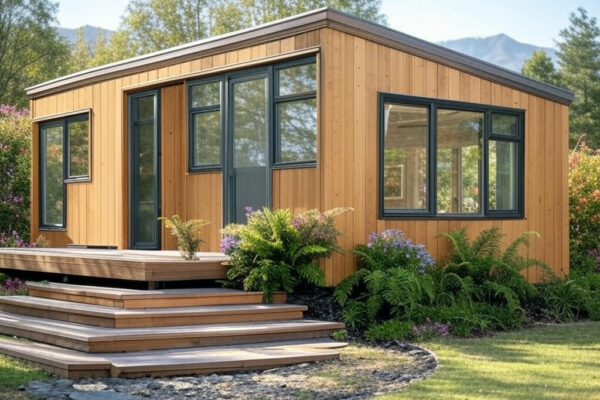
This is the biggest change to consent exemptions in over a decade. Section 26 of the Building and Construction (Small Stand-alone Dwellings) Amendment Act 2025 inserted a whole new Schedule 1A into the Building Act on 15 January 2026. A new, single-storey, self-contained dwelling up to 70m² can now be built without a building consent. The Schedule 1A conditions are strict, and there is no partial credit: miss one and the whole build goes back inside the consent system.
- Net floor area no more than 70m² (an integrated garage counts toward the total)
- Single storey only — no mezzanines or lofts
- Maximum height 4m, floor level no more than 1m above ground
- At least 2m clear of any other residential building and any legal boundary
- Light timber or steel frame or, since 8 October 2026 under the Building (Exempt Small Stand-alone Dwellings) Order 2026, a certified composite structural building product (a CodeMark-certified product, such as some structural insulated panel or solid timber systems); roof under 20kg/m², wall cladding under 220kg/m²
- Simple plumbing and drainage, tied into existing services where available
- An LBP must design or supervise the build, and provide records of work
- You cannot start until the council has issued a Project Information Memorandum for the final site, and you must send the council a completion pack afterwards
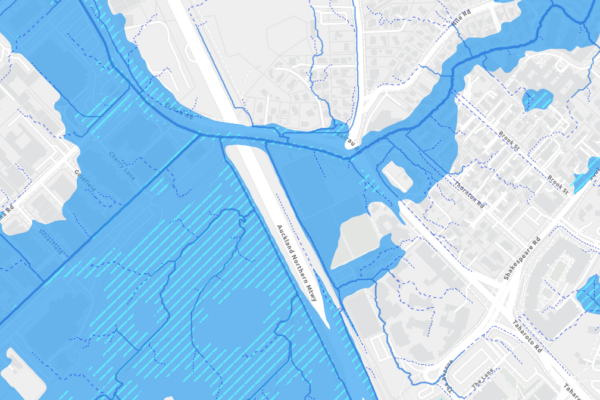
Resource consent requirements were dialled back at the same time, through the Resource Management (National Environmental Standards for Detached Minor Residential Units) Regulations 2025. In residential and rural zones one small standalone dwelling per site is generally permitted, but only where the site is clear of the overlays that override it: heritage and special character, flood plains and overland flow paths, other natural hazard areas, and the coastal environment. Servicing is a separate question again, and the one that catches people latest. Check what a Watercare connection actually costs and how a new power connection is priced before you assume a site is straightforward.
The exemption shifts responsibility from the council inspector to the LBP designer and builder. The Building Code still applies in full, and development contributions are still charged. Three procedural points catch people out, and all three sit in the Act itself rather than in any council brochure.
- The PIM comes first, and it is not optional. Section 32(2) says no building work may begin on a non-consented small stand-alone dwelling until a Project Information Memorandum for that dwelling on its final site has been issued. A PIM is the council’s written summary of what it knows about your site: zoning, overlays, hazards, drainage, and any bylaws affecting the build. Section 34(1)(a) gives the council 10 working days to issue it, half the 20 working days a standard PIM gets. In Auckland the base fee is $537 and it is non-refundable. You apply by emailing forms 2AA and 2A, your plans, the building’s location and external dimensions, and drainage details to the Council’s granny flat exemption address.
- The PIM expires on completion, not on commencement. Section 34A lapses the PIM if the building work is not completed within two years of issue, unless the council allows a longer period. That is a tighter clock than a building consent, which only asks you to start within 12 months.
- There is a completion pack, and skipping it is an infringement offence. Section 42B(4) requires the owner to send the council, within 20 working days of completion, all records of work, the electrical and gas certificates, the final design plans, and a certificate of work from the LBP who did the design. Section 42B(5) makes failing to do that an infringement offence with a fine of up to $1,000. “Complete” has its own statutory meaning here: the work is complete when you have received all of those records from your trades, not when the last tradesperson drives away.
We’ve written a separate piece on what a 70m² minor dwelling actually costs to build in 2026, and a companion guide to how the granny flat rules work in practice. If what you are picturing is a sleepout rather than a self-contained dwelling, the rules are different again, and we’ve covered where a sleepout stops being a sleepout separately.

The Building Consent Process
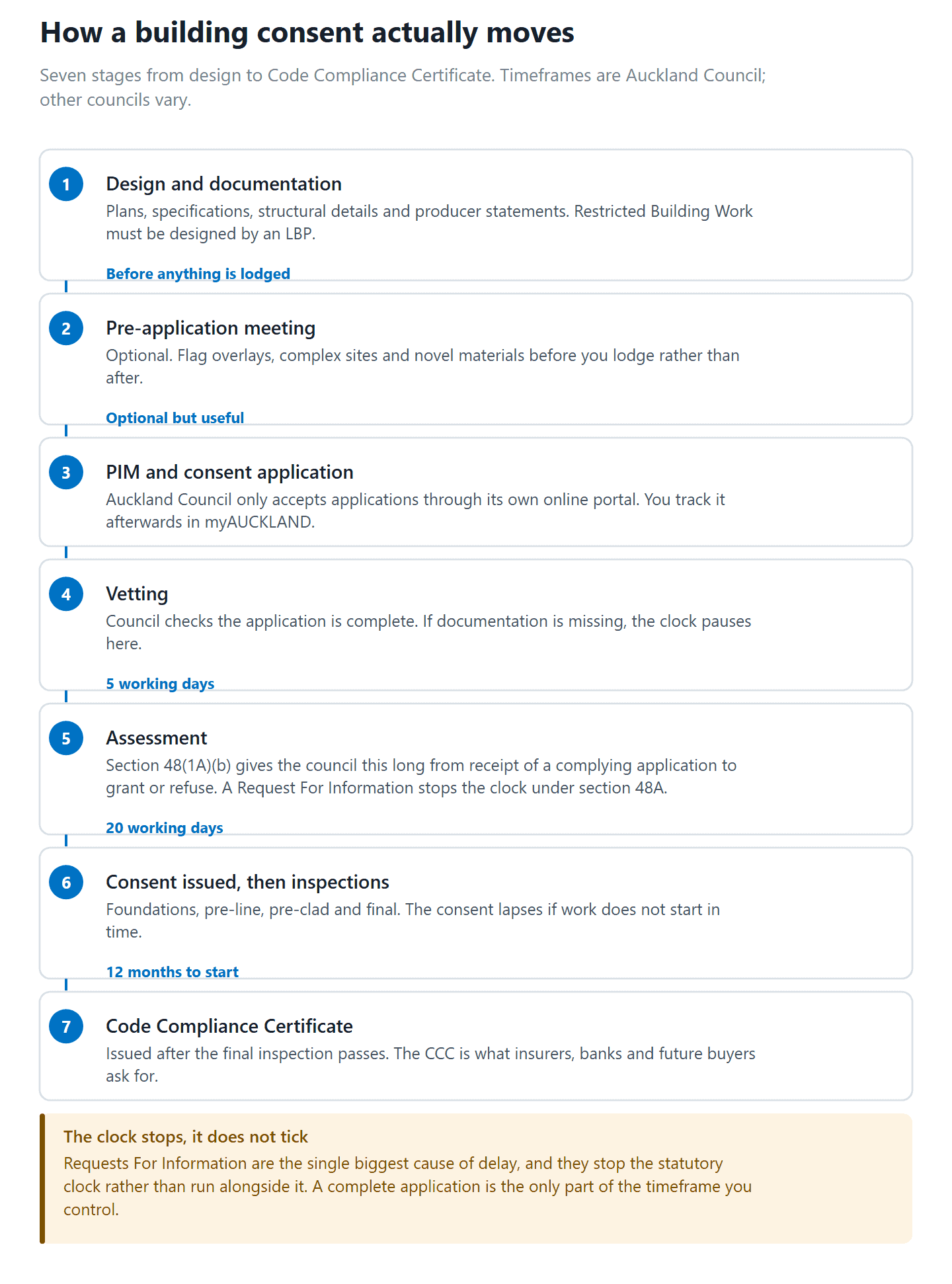
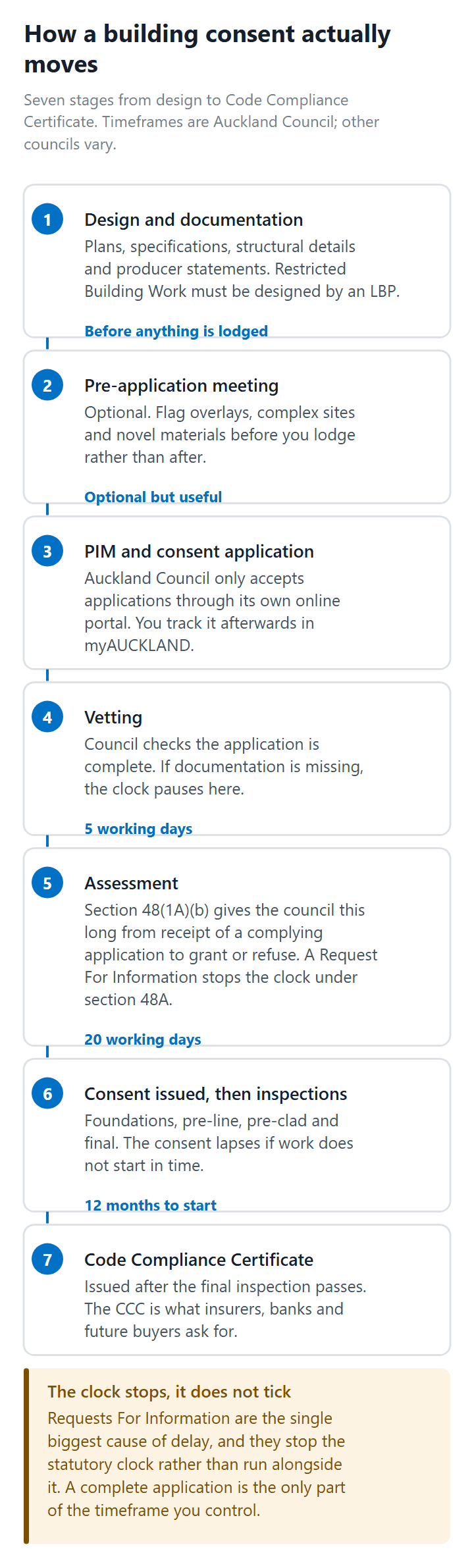
From design through CCC, the process runs in seven stages. Timeframes assume Auckland Council; other councils vary.
- Design and documentation. Plans, specifications, structural details, and producer statements. For Restricted Building Work (most structural work on residential buildings) this must be done by an LBP. Sonder’s design team holds LBP Design Class licences, which means we can sign off the documentation councils require.
- Pre-application discussions (optional but useful). Auckland Council offers a pre-application meeting that lets you flag tricky elements (overlays, complex sites, novel materials) before you lodge. Worth doing for anything beyond a straightforward extension.
- PIM and consent application. Auckland Council only accepts building consent applications online, through its own consenting portal, and you track the application afterwards in myAUCKLAND. The full deposit is payable at lodgement, not on approval.
- Vetting and processing. Council vets your application within five working days. If documentation is incomplete, the clock pauses while they request more information. This is the single biggest cause of delay — incomplete applications can push the actual timeline out by weeks.
- Assessment. Section 48(1A)(b) of the Building Act gives the council 20 working days from receipt of a complying application to grant or refuse it. Requests For Information stop that clock under section 48(2), and the clock does not restart until the council has what it asked for, so every RFI you trigger adds elapsed weeks rather than days. Auckland Council states a 20 working day assessment target; complex applications run longer.
There are two faster statutory paths most homeowners never hear about. If your plans carry a national multiple-use approval (a design MBIE has already certified as Code-compliant, often called MultiProof), section 48(1A)(a) cuts the council’s decision window to 10 working days. Auckland Council charges $1,390 to process one of those applications up to $499,999 of project value, and $2,900 at $500,000 and over. The second path is a certified single modular component build, which gets the same 10 working days under section 48(1A)(aa). Neither is right for a one-off design, and both are worth knowing about if you are choosing between a standard plan and a one-off design.
- Consent issued. Once approved, the consent lapses if you do not start work within 12 months. Building inspections then happen at key stages: foundations, pre-line, pre-clad and final. More on the two deadlines that follow in the next section.
- Code Compliance Certificate (CCC). After the final inspection passes, the council issues a CCC confirming the work meets the Building Code. The CCC is what insurers, banks, and future buyers want to see. You can technically sell a house without a CCC, but it complicates things significantly.
What It Costs
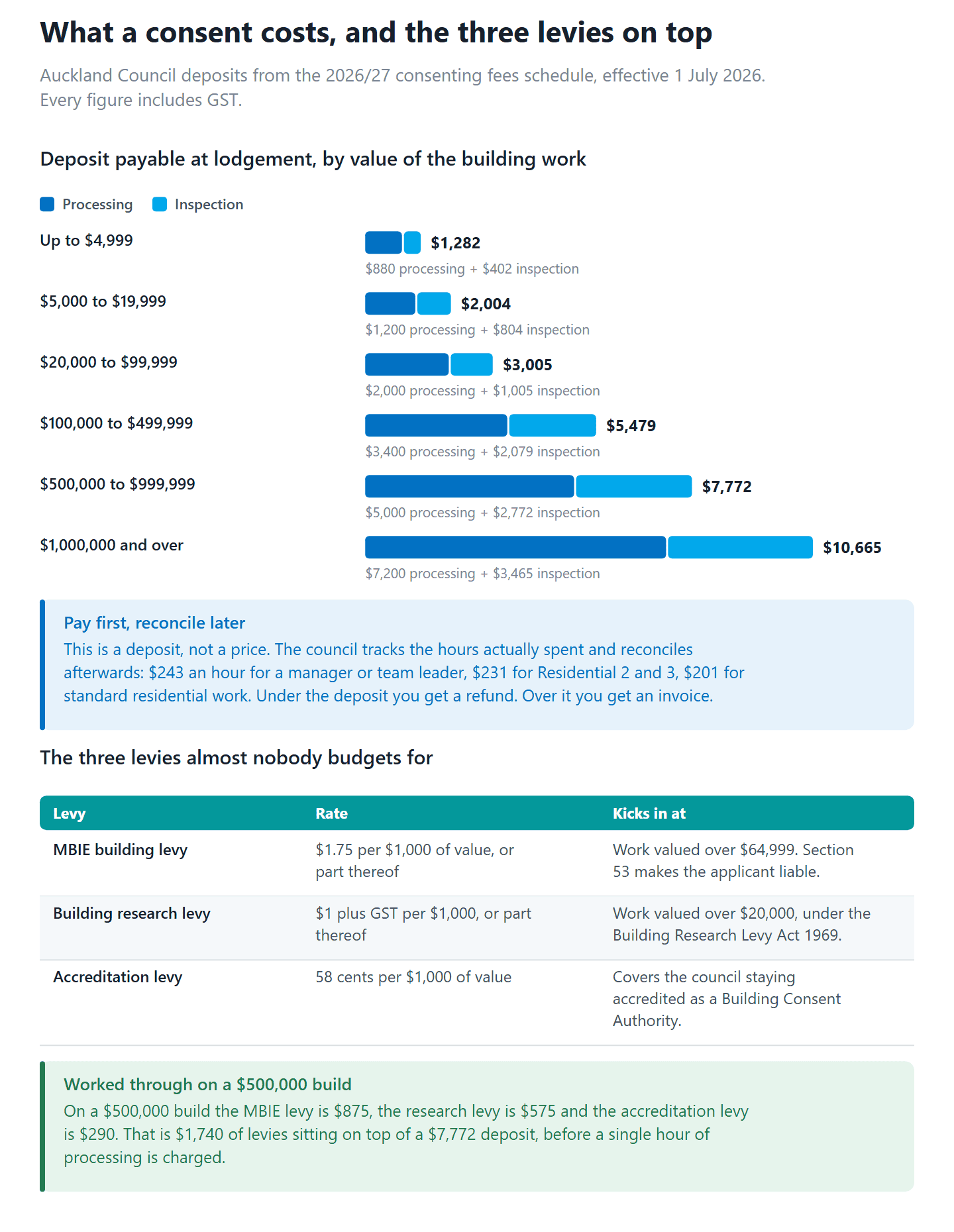
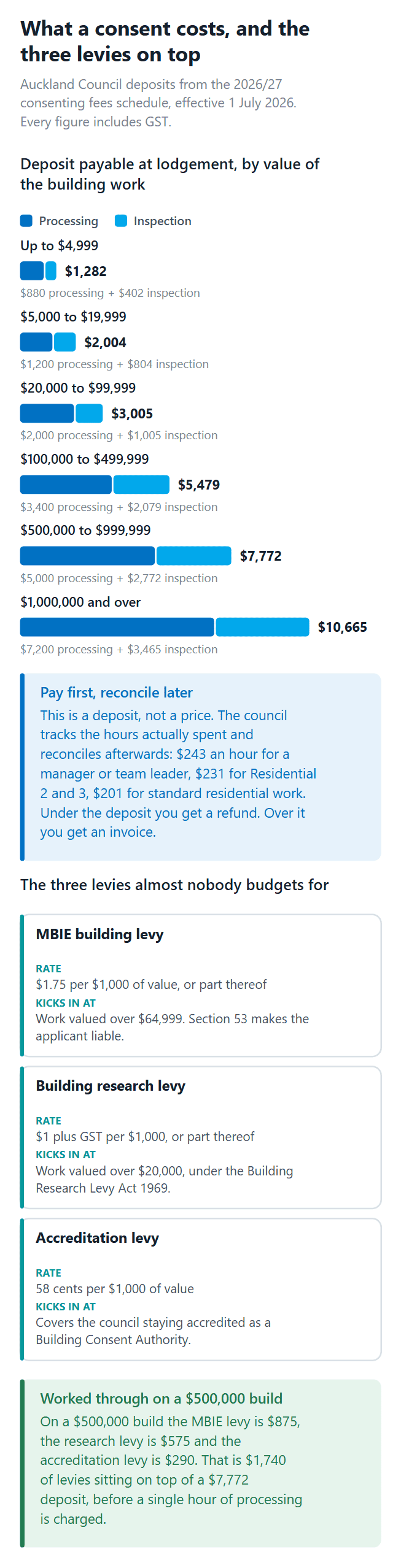
Most cost guides quote a single “consent fee” figure. Auckland Council does not charge one. It charges a deposit at lodgement, banded by the value of the building work, then invoices the balance based on the hours actually spent assessing and inspecting. If the hours come in under the deposit you get a refund. In most cases they do not, and you get an invoice.
These are the deposits published in Auckland Council’s 2026/27 consenting fees schedule, effective 1 July 2026. Every figure includes GST.
| Value of the building work | Deposit payable at lodgement | What the deposit is made of |
|---|---|---|
| Up to $4,999 | $1,282 | $880 base fee + $402 inspection deposit |
| $5,000 to $19,999 | $2,004 | $1,200 processing + $804 inspection |
| $20,000 to $99,999 | $3,005 | $2,000 processing + $1,005 inspection |
| $100,000 to $499,999 | $5,479 | $3,400 processing + $2,079 inspection |
| $500,000 to $999,999 | $7,772 | $5,000 processing + $2,772 inspection |
| $1,000,000 and over | $10,665 | $7,200 processing + $3,465 inspection |
Anything the deposit does not cover is billed at the Council’s building consent hourly rates: $243 for a manager or team leader, $231 for Residential 2 and 3 and Commercial 1 work, $201 for standard Residential 1 work, and $126 for administration. A pre-application meeting is $331. At the other end, the Code Compliance Certificate carries its own fee of $258 on work under $20,000 and $722 at $20,000 and over. Amended plans cost $800, $1,100 or $1,500 depending on project value, which is why a mid-build change of mind is rarely as cheap as it sounds.
The Three Levies Almost Nobody Budgets For
Ask most homeowners what sits on top of the consent fee and they will name one levy. There are three, they are all collected by the council on someone else’s behalf, and on a large project they add up to real money.
- MBIE building levy. $1.75 per $1,000 of the value of the work, or part thereof, on work valued over $64,999. Section 53 of the Building Act makes the applicant liable for it, and it is payable at the point the consent is granted.
- Building research levy. $1 plus GST per $1,000 of value, or part thereof, on work valued over $20,000. This one is collected under the Building Research Levy Act 1969 and it kicks in at a much lower threshold than the MBIE levy, so a $40,000 bathroom renovation pays the research levy and not the MBIE one.
- Accreditation levy. 58 cents per $1,000 of the value of the work. This covers the council’s own cost of staying accredited as a Building Consent Authority. It appears on almost no cost guide anywhere.
Worked through on a $500,000 build: the MBIE levy is $875, the research levy is $575, and the accreditation levy is $290. That is $1,740 of levies on top of a $7,772 deposit, before a single hour of processing is invoiced. On a $40,000 bathroom the levies come to $23.20 plus a $46 research levy, which is negligible. The levies matter at scale and are noise at the small end, and the threshold difference between them is the reason.
The other cost the fee schedule does not show is delay. A consent that sits in Request For Information for six weeks while a builder holds a slot open costs far more than the consent fee itself. Lodging a complete application the first time is the cheapest thing you can do. We’ve broken down the full Auckland consent cost picture, including development contributions, in a separate guide.
How Long a Building Consent Lasts: the Two Deadlines That Catch People Out
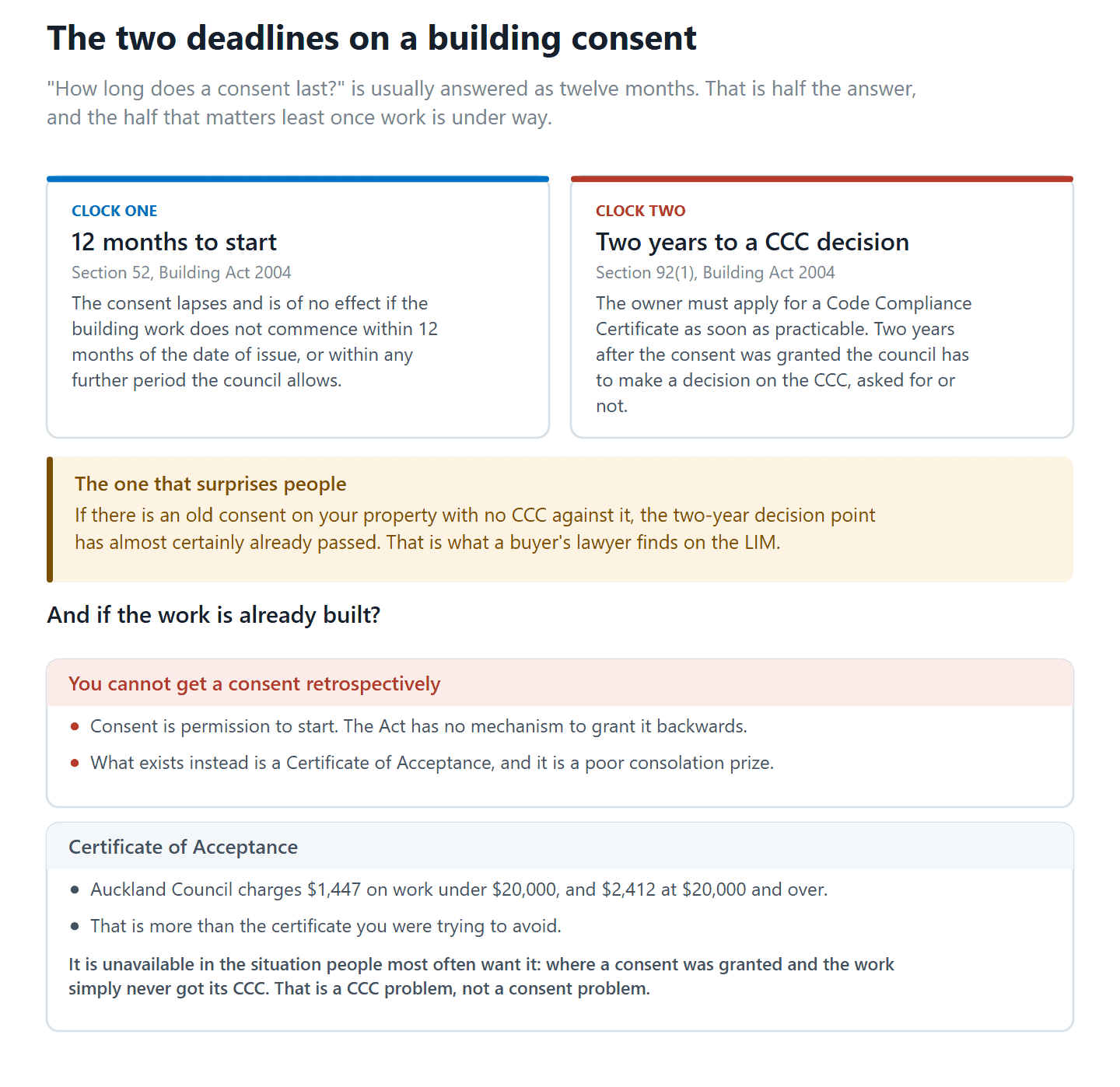
“How long does a building consent last?” gets answered as “12 months” almost everywhere. That is half the answer, and it is the half that matters least once the work is under way. There are two separate statutory clocks, they run off different events, and the second one runs whether you act or not.
Clock one: 12 months to start. Section 52 of the Building Act says a consent lapses and is of no effect if the building work does not commence within 12 months of the date of issue, or within any further period the council allows. Note the wording: commence, not finish. Once you have genuinely started, section 52 stops being your problem. Auckland Council charges a fee to extend the period to commence or complete work under a consent, so if a build is going to slip past the anniversary, ask before the date rather than after it.
Clock two: two years to a decision on the CCC, asked for or not. This is the one that surprises people. Section 92(1) obliges the owner to apply for a Code Compliance Certificate as soon as practicable after the work is finished. Section 93 then requires the council to decide whether to issue that certificate within 20 working days of the application. And section 93(2)(b) adds the part almost no guide mentions: if no application is ever made, the council must still decide at the expiry of two years after the consent was granted, unless a longer period is agreed. In other words, your file does not quietly go dormant. At the two-year mark the council makes a call on it, and if the work is incomplete or uninspected, that call is a refusal that sits on the property record. Under section 93(4) a Request For Information suspends that clock too.
Retrospective Consent, and Why a Certificate of Acceptance Is Not a Substitute
You cannot get a building consent for work that is already built. Consent is permission to start, and the Act has no mechanism to grant it backwards. What exists instead is a Certificate of Acceptance, which is a council’s statement that, on the evidence available, the completed work appears to comply with the Building Code to the extent the council could inspect it.
Three things make a Certificate of Acceptance a poor consolation prize. It costs more than the certificate you were trying to avoid: Auckland Council charges $1,447 on work under $20,000 and $2,412 at $20,000 and over, against $258 and $722 for a CCC. It is qualified rather than clean, because the council can only certify what it can still see, and by definition the framing is closed up. And Auckland Council’s own fee schedule notes that prosecution and infringements may also apply for work undertaken without consent, so applying for one is a disclosure.
A Certificate of Acceptance is also unavailable in the situation people most often want it: you cannot use one where a building consent was granted and the work simply never got its CCC. That is a CCC problem, not a CoA problem, and it goes back through inspection and remediation.
Building Permit or Building Consent? And Where Resource Consent Fits
“Building permit” is not a New Zealand term. Permits were what councils issued under the Building Act 1991 and its predecessors. Since the Building Act 2004 the instrument is a building consent, issued by a Building Consent Authority, and the closing document is a Code Compliance Certificate rather than a final inspection sign-off. If you are reading advice that talks about permits, check its date and its country before you rely on it.
The distinction that actually costs people money is building consent versus resource consent. They are different Acts, different teams, different tests and different fees.
| Building consent | Resource consent | |
|---|---|---|
| Governing Act | Building Act 2004 | Resource Management Act 1991 |
| The question it answers | Is it built safely and to the Building Code? | Is it allowed here, at this size, with these effects? |
| What triggers it | Structure, weathertightness, plumbing, drainage, fire | Breaching a district or unitary plan rule |
| Auckland deposit at lodgement | $1,282 to $10,665 by project value | $6,500 residential land use; $3,000 for a specified consent; $10,000 limited notified; $20,000 fully notified |
| Statutory decision window | 20 working days (10 with a national multiple-use approval) | 20 working days non-notified (RMA s115(3)); 10 working days for a fast-track application (s115(4A)); 20 working days after submissions close where notified without a hearing (s115(4)); 15 working days after a hearing ends (s115(2)) |
| Closing document | Code Compliance Certificate | Conditions of consent, monitored by the council |
The two do not talk to each other. A resource consent does not mean your design meets the Building Code, and a building consent does not mean you were allowed to build there. Plenty of Auckland projects have sailed through one and stalled on the other.
Resource Consent — When Building Consent Isn’t Enough
Building consents cover construction standards. Resource consents cover land use, environmental effects, and how the work sits within your district’s planning rules.
You need a resource consent when your project breaches the rules in Auckland’s Unitary Plan or the relevant district plan. The most common triggers:
- Exceeding site coverage (typically 35–45%, depending on zone)
- Building closer to a boundary than the setback allows
- Exceeding height-in-relation-to-boundary rules
- Earthworks beyond permitted volumes
- Work in a heritage overlay, character area, or special character zone — we’ve covered the heritage overlay rules in Auckland in detail
- Subdivision, meaning splitting one title into two or more, which is a separate consent process with its own costs and timeline
- Sites in flood plains, coastal hazard zones, or volcanic viewshafts
When the Only Problem Is a Boundary
Two of the triggers above — building closer to a boundary than the setback allows, and exceeding height-in-relation-to-boundary — can have a different answer from the rest. Where a boundary rule is the only district rule infringed and no infringed boundary is a public one, sections 87AAB and 87BA of the Resource Management Act 1991 treat the work as a permitted activity once every owner of an infringed boundary gives written approval and signs the plan.
The conditions are strict and cumulative, and the cost and timeframe are materially different from a full consent. We have set the whole route out, including what the council does with a written approval and what happens if a neighbour says no, in our guide to whether you need your neighbour’s approval to build in Auckland.
The Most Common Consent Mistakes
Five things go wrong more often than they should:
Lodging an incomplete application. The biggest cause of delay isn’t council processing — it’s the back-and-forth on missing information. Engineering details, producer statements, fire reports, energy calculations, drainage layouts. If any of these are missing or vague, you’re in RFI territory before the assessment even starts.
Treating the rules as static. The Building Act has had four significant amendments since 2023, plus the 70m² exemption in early 2026. Auckland’s Unitary Plan has been amended multiple times. Plan Change 120 (MDRS density rules) affects what you can build in many Auckland zones. Old advice goes stale fast.
Assuming overlays don’t apply. Auckland’s heritage and special character overlays run street by street, not suburb by suburb, and they cover plenty of streets that look entirely ordinary. Flood plains and overland flow paths do the same thing. Check the overlays on GeoMaps before you design, not after, and if the site is affected read up on what an overland flow path does to a footprint first.
Confusing the 70m² exemption with “anything goes.” The new granny flat rules remove the consent. They do not remove the Building Code, the LBP requirement, district plan overlays, or development contributions. A non-compliant exempt build is still illegal — just harder to catch until it goes wrong.
Mid-build variations without paperwork. Small changes to material specifications, junction details or window positions during construction can become consent issues at CCC. Document every variation and confirm with your LBP whether it needs a minor variation, an amended plans application (which Auckland Council prices at $800 to $1,500 by project value), or a fresh consent.
Forgetting the approvals that sit outside the Building Act entirely. A consented design can still be stopped by a separate authority. A new or widened driveway needs a vehicle crossing permit. A second dwelling needs a Watercare connection and, usually, an infrastructure growth charge. Weathertightness detailing is assessed against clause E2 of the Building Code, and even something as contained as a tiled shower can pull a bathroom into the consent system. None of these appear in the building consent fee, and all of them appear in the programme.
How Sonder Architecture Handles Consent Work
Sonder’s design team holds LBP Design Class licences, which means we can produce consent-ready documentation and sign the Records of Work councils require for Restricted Building Work. On most projects we run the consent documentation and lodgement in-house, from pre-application discussions through to inspections and CCC. Where the work is a renovation or extension rather than a new build, the consent scope is usually set by two things: whether a wall is structural, and whether the property carries an overlay. We’ve covered both in detail, on removing an internal wall and on designing inside a heritage or special character overlay.
The starting point for any project is our Free Feasibility Report. We check the zoning, overlays, and consent pathway for your specific site before you commit to a design — so the consent strategy is clear from the start, not a surprise halfway through the design process.
If you’re at the early thinking stage on a new build, renovation, or minor dwelling, the feasibility report is the right first step.
➡ See recent projects we’ve done across Auckland
A building consent is council approval issued under the Building Act 2004 confirming that planned construction work meets the New Zealand Building Code. It's required for most renovations, new builds, and extensions — though Schedule 1 exempts small standalone dwellings up to 70m² (from 15 January 2026) and other minor work. Most renovations involving structural change, plumbing alterations, new bathrooms or kitchens, or changes to weathertightness need a building consent. Like-for-like repairs and maintenance are usually exempt under Schedule 1. The detail matters — an LBP should confirm before work starts. Statutory processing is 20 working days from acceptance, but Auckland Council averages closer to 30 working days in 2025-26 for residential work. Requests for Information (RFIs) stop the clock — incomplete applications can push timelines out by weeks. A building consent covers how you build: Building Code compliance, under the Building Act 2004. A resource consent covers where you build: district plan rules on site coverage, height, setbacks, heritage and environmental effects, under the Resource Management Act 1991. Many projects need both, and they can be lodged in parallel. Neither one implies the other, so a project can clear its resource consent and still fail its building consent. Typical 2026 ranges: $2,000–$4,000 for internal renovations, $5,000–$8,000 for single-storey extensions, $8,000–$15,000+ for new builds. On top of council fees, expect development contributions, levies, design fees, and engineering reports. From 15 January 2026, yes — a new single-storey standalone dwelling up to 70m² is exempt from building consent under Schedule 1, provided an LBP designs or supervises the build and strict conditions are met (height, setbacks, services, materials). Resource consent and Building Code compliance still apply. Unconsented work creates enforcement risk (fines, notices to fix, removal orders), invalidates insurance for the affected work, and complicates resale — buyers and banks require a CCC. Retrospective consent is sometimes possible but more expensive and slower than getting it right the first time. Two clocks run. Section 52 of the Building Act lapses the consent if the building work does not commence within 12 months of issue, unless the council allows a longer period. Separately, section 93(2)(b) requires the council to decide whether to issue a Code Compliance Certificate at the expiry of two years after the consent was granted, even if you never apply for one. So a consent does not go dormant: at the two-year mark the council makes a decision on your file either way. Three. The MBIE building levy at $1.75 per $1,000 of value on work over $64,999; the building research levy at $1 plus GST per $1,000 on work over $20,000, collected under the Building Research Levy Act 1969; and the council's accreditation levy at 58 cents per $1,000. On a $500,000 build that is $875, $575 and $290, so $1,740 of levies on top of a $7,772 lodgement deposit. Figures from Auckland Council's 2026/27 consenting fees schedule. No. A building consent is permission to start, and it cannot be granted after the fact. The alternative is a Certificate of Acceptance, which Auckland Council prices at $1,447 on work under $20,000 and $2,412 at $20,000 and over, against $258 and $722 for a Code Compliance Certificate. A Certificate of Acceptance only covers what the council can still inspect, and it cannot be used where a consent was granted but no CCC was ever issued.
What is a building consent in NZ?
Do I need a building consent for a renovation in 2026?
How long does a building consent take in NZ?
What's the difference between a building consent and a resource consent?
How much does a building consent cost in Auckland?
Can I build a granny flat without consent in 2026?
What happens if I build without consent?
How long does a building consent last in NZ?
What levies are charged on top of an Auckland building consent?
Can I get a building consent retrospectively for work already done?
References
- Building Act 2004, sections 32, 34, 34A, 42B, 45AA, 48, 52, 53, 92 and 93 — New Zealand Legislation
- Building consent fees and charges — Auckland Council
- Resource consent fees and deposits — Auckland Council
- Resource Management Act 1991, sections 87AAB, 87AAC, 87BA and 115 — New Zealand Legislation
- Apply for a building consent — Auckland Council
- Granny flats building consent exemption — Auckland Council
- Changes to the granny flats building consent exemption from 8 October 2026 — Building Performance (MBIE)
- Building levy — Ministry of Business, Innovation and Employment
Current as at 21 Sep 2026. Sources are linked throughout.