
How Much Does a Building Consent Cost in Auckland? Your Complete 2025 Guide
If you’re planning a renovation, extension, or new build in Auckland, one of the first questions that hits you is: “Do I need a building consent — and if so, how much is this going to cost me?” It’s a fair question, and one that deserves a straight answer rather than another vague “it depends.” This guide gives you that straight answer.
Picture this: you’ve been living in your 1970s Papakura bungalow for six years. The kitchen is dark, the layout makes no sense, and you’ve promised yourself — and your long-suffering partner — that this is the year you actually do something about it. You’ve got a builder in mind, you’ve got Pinterest boards full of ideas, and you’ve even had a casual chat with a friend who did their own kitchen reno last year.
Then someone mentions “building consent” and the excitement drains out of the room.
Nobody quite knows how much it costs. Your friend thinks he paid “a few thousand.” Your builder says it “depends.” The Auckland Council website has a fee schedule that looks like a tax return.
We think Auckland homeowners deserve better than that. So we’ve done the research, pulled together the actual numbers, and written the guide we wish existed when our own clients were starting out.
This series covers everything you need to know about building consent costs in Auckland for 2025. Use the links below to jump straight to the section most relevant to you — or read the whole thing if you like knowing exactly what you’re getting into (we respect that).
We’ve drawn on Auckland Council’s published fee schedules, MBIE’s building guidance, and years of experience submitting consent applications on behalf of Auckland homeowners across the city — from Devonport to Flat Bush, Hobsonville to Herne Bay. What you’ll read here is practical, current, and grounded in how the process actually works in 2025.
Ready? Let’s get into it.
1. What Is a Building Consent — and Why Does Auckland Make You Pay for One?
The short version: a building consent is Auckland Council’s formal tick of approval that says your planned building work meets New Zealand’s Building Code. Without it, you could be fined, forced to demolish work, or hit with nasty surprises when you try to sell your home. Here’s everything you need to know before you touch a single wall.
Picture this: your Remuera villa has sat untouched for 30 years. You’ve finally decided to open up that dark, poky kitchen into the living area — knock out a wall, flood the space with natural light, the works. Your brother-in-law swears his mate’s a great builder and you won’t need to worry about “all that council paperwork.” Fast forward six months and you discover, during a sale, that your home has unconsented structural work. Suddenly buyers are running scared and your solicitor is handing you a very big bill.
Sound dramatic? Unfortunately, it’s more common than you’d think across Auckland’s older housing stock — particularly in suburbs like Grey Lynn, Ponsonby, Sandringham, and Mount Eden, where character homes have changed hands many times and DIY renovations have quietly stacked up over the decades.
A building consent is not bureaucratic red tape for its own sake. It’s a legal safeguard — for your family’s safety, your home’s value, and your peace of mind.
So What Exactly Is a Building Consent?
In plain language, a building consent is written approval from Auckland Council (your local Building Consent Authority, or BCA) confirming that your proposed construction or alteration plans comply with the New Zealand Building Code. The Code itself sets the minimum standards your building must meet — covering everything from structural strength and weathertightness to fire safety, insulation, plumbing, and accessibility.
Think of it like this: the Building Code is the rulebook, your architectural plans are the answer sheet, and the building consent is the teacher marking it correct before you’re allowed to build.
The legal principle is simple: all building work in New Zealand requires a building consent, unless it is specifically listed as exempt under Schedule 1 of the Building Act 2004. We’ll get into exemptions in Section 4 of this series — because yes, some work genuinely doesn’t need consent, and knowing that upfront can save you time and money.
“Building consents ensure your construction meets the New Zealand Building Code, keeping your property durable, healthy, and secure for everyone who uses it.” — Sonder Architects, Building Consents Explained: NZ 2025 Guide
Building Consent vs Resource Consent: What’s the Difference?
This trips up a lot of Auckland homeowners. They’re two completely different approvals, and sometimes you need both.
| Feature | Building Consent | Resource Consent |
|---|---|---|
| What it governs | How you build (safety, structure, Building Code) | What and where you build (land use, zoning, environment) |
| Governing legislation | Building Act 2004 | Resource Management Act 1991 |
| Who issues it | Auckland Council (Building team) | Auckland Council (Planning team) |
| Typical trigger | New build, extension, structural alteration | Breach of Auckland Unitary Plan rules (e.g. height, coverage) |
| Processing time | 20 working days (statutory target) | 20–60 working days (longer with public notification) |
| Cost range | ~$1,270 to $10,530+ depending on project value | ~$1,000 to $10,000+ depending on complexity |
The key takeaway: a resource consent is about whether your project is allowed on your land under the Auckland Unitary Plan. If your extension is too tall, breaches setbacks, or sits on a notable tree overlay, you’ll need a resource consent before — or alongside — your building consent. About 30% of building projects require both, so it pays to check early. (Auckland Council: Resource Consent Fees and Deposits)
What Projects Always Need a Building Consent in Auckland?
Here are the most common projects Auckland homeowners tackle that will almost certainly require a building consent:
- Structural changes — removing or altering load-bearing walls, changing foundations, adding a second storey
- Home extensions — adding a new room, extending a living area, building a deck over 1.5 metres above ground
- New kitchens or bathrooms — when plumbing fixtures are added or relocated with significant drainage changes
- Adding a toilet or bathroom — any increase in sanitary fixtures almost always triggers consent
- Garage conversions — converting a garage into a habitable room or minor dwelling
- Recladding — replacing a home’s exterior cladding, which affects weathertightness (a significant Building Code clause)
- New builds — every new residential build requires a full building consent
- Retaining walls over 1.5m — anything taller than this generally needs consent
- Swimming pools — including fencing requirements under the Fencing of Swimming Pools Act
If you’ve been eyeing up our guide on building consent for renovations, you’ll know this list isn’t exhaustive — and that’s exactly why getting professional advice early is so important.
What Happens If You Build Without Consent?
This is where things get ugly. Building without a required consent is an offence under the Building Act 2004. Auckland Council can:
- Issue an infringement notice — currently up to $1,000 per offence for individuals
- Issue a Notice to Fix — requiring you to either get consent retroactively (via a Certificate of Acceptance, which is more expensive and harder to obtain) or demolish the work
- Pursue prosecution — with potential fines up to $200,000 for serious cases
And then there’s the real-world property problem. Unconsented building work shows up on your LIM (Land Information Memorandum) report — or notably, in its absence. Savvy buyers and their lawyers check these reports carefully. Unconsented work can result in banks refusing to lend against the property, insurers declining claims related to the work, and buyers demanding significant price reductions or walking away entirely.
“Without a consent, you risk fines, delays, or even demolition orders from councils like Auckland Council. Plus, unconsented work can void insurance or complicate property sales.” — Sonder Architects, Building Consents Explained: NZ 2025 Guide
The Certificate of Acceptance: The Expensive Way to Fix Unconsented Work
If you’ve bought a home with unconsented work — or if you’ve done work without realising you needed consent — all is not entirely lost. You can apply to Auckland Council for a Certificate of Acceptance (CoA). But it’s not cheap and it’s not guaranteed. Auckland Council’s base fee alone starts at $1,403 for projects under $20,000, and $2,339 for projects valued over $20,000 — on top of any additional processing charges. (Auckland Council: Building Consent Fees and Charges)
The council can only issue a CoA if it can physically inspect the work to confirm compliance. If walls are closed in, or you can’t prove what’s inside those framing cavities, they simply can’t sign it off — leaving you with a property that has a permanent compliance question mark hanging over it.
Why Auckland Is Different From Other Councils
Worth knowing: Auckland Council is the country’s largest building consent authority, processing thousands of consents each year. Its fee structure is based on cost-recovery at published hourly rates — meaning you’re essentially paying for the actual time it takes council engineers and specialists to review your plans. This is why complex projects cost more: more specialist review hours equals higher fees.
Research published by PlaceMakers found that a consent for a $350,000 project costs approximately $4,982 in Auckland — noticeably higher than Wellington ($1,253) or Christchurch ($1,900) for a comparable project. Auckland Council itself has noted its deposits are a reasonable indicator of likely final costs, though the actual figure can shift up or down once all processing and inspections are complete. (PlaceMakers: Huge Variation in Consent Fees)
💡 Tip for skimmers: Auckland consent fees are higher than most NZ councils because they’re based on actual hourly costs of specialist review. Budget conservatively — and make sure your application is complete upfront to avoid costly Requests for Information (RFIs).
A Quick Note on the 2024 Building Levy Changes
Good news landed for smaller renovation projects in 2024. The MBIE building levy threshold was raised significantly — meaning projects under $65,000 (including GST) are no longer required to pay the MBIE building levy. Previously, this levy applied to all work over about $20,000. For smaller bathroom renovations, kitchen upgrades, and minor structural changes, this is a welcome saving. (MBIE: Building Levy Information)
There’s also reform on the horizon: in 2026, the MBIE building levy and BRANZ research levy will be combined into a single levy, with the government aiming to reduce duplication and save consent applicants around $65 per consent. Small wins, but worth knowing about.
The Bottom Line for Auckland Homeowners
Building consents aren’t the enemy. They’re the system that ensures your home — and your neighbours’ — is built safely and durably. Yes, they cost money. Yes, they take time. But the cost of not getting consent is almost always higher. Whether it’s a $2,975 consent for a $50,000 bathroom renovation or a $5,398 consent for a $200,000 extension, you’re investing in legal protection, insurability, and future resale value.
In the next section, we break down exactly how Auckland Council calculates your building consent fee — because once you understand the formula, the numbers stop feeling random and start making sense.
↓ Jump to Section 2: How Auckland Council Calculates Your Fee

2. How Auckland Council Calculates Your Building Consent Fee: The Breakdown You Actually Need
Spoiler: it’s not a flat fee. Auckland Council uses a cost-recovery model, which means the more complex your project, the more you’ll pay. But the fee structure is actually transparent — once you know where to look. Here’s a plain-English breakdown of every charge you might encounter.
One of the most common questions we hear from Auckland homeowners — right up there with “how long will it take?” — is: “How on earth did the council come up with that number?”
It’s a fair question. You lodge your plans, hand over a deposit, and weeks later receive an invoice that seems to have been generated by some mysterious algorithm deep within the civic centre. But here’s the thing: Auckland Council’s fee structure is actually well-documented. It’s just that nobody ever sits down and explains it in terms that don’t require a law degree.
Let’s fix that.
The Core Principle: Cost Recovery at Hourly Rates
Auckland Council doesn’t charge a single flat fee for building consent. Instead, it recovers the actual cost of assessing your application — based on the time its engineers, specialists, and building officers spend reviewing your plans and conducting inspections.
The council publishes its hourly rates for each type of specialist, so at least in theory, you can work backwards from your project’s complexity to estimate your costs. As of the current fee schedule, these rates are:
| Staff Level | Role Type | Hourly Rate (incl. GST) |
|---|---|---|
| Technical Level 1 | Residential building officers (simple residential) | $195/hr |
| Technical Level 2 | Residential building (more complex), Commercial 1 | $222/hr |
| Technical Level 3 | Managers, fire engineers, commercial (complex) | $234/hr |
| Administration | Admin support across all areas | $123/hr |
(Auckland Council: Building Consent Fees and Charges)
In practice, a straightforward bathroom addition might only need a Level 1 officer for a few hours. A complex two-storey extension with structural engineering considerations might involve multiple Level 2 and Level 3 reviewers across several review cycles — particularly if the council sends a Request for Information (RFI) requiring you to supply additional documentation.
The Deposit System: Pay First, Reconcile Later
Here’s how it actually works in practice. When you lodge your application, you pay a deposit upfront — broken into a processing component and an inspection component. This deposit is Auckland Council’s best estimate of the likely cost based on your project’s declared value.
The council then tracks the actual hours spent. If the actual cost is less than your deposit, they refund the difference. If (more commonly) the actual cost exceeds the deposit, they invoice you for the balance. Auckland Council’s own documentation acknowledges that actual costs exceeding the initial deposit “happens in most cases.” So always budget for more than the deposit amount.
Here’s a summary of Auckland Council’s current deposit structure by project value:
| Declared Project Value | Processing Deposit | Inspection Deposit | Total Initial Deposit |
|---|---|---|---|
| Up to $4,999 | $880 (fixed fee) | $390 | $1,270 |
| $5,000 – $19,999 | $1,200 | $780 | $1,980 |
| $20,000 – $99,999 | $2,000 | $975 | $2,975 |
| $100,000 – $499,999 | $3,400 | $1,998 | $5,398 |
| $500,000 – $999,999 | $5,000 | $2,664 | $7,664 |
| $1,000,000 and over | $7,200 | $3,330 | $10,530 |
(Auckland Council: Building Consent Fees and Charges)
💡 Tip for skimmers: These are deposits, not final fees. The real cost of your building consent will typically be higher than these figures. Use them as a baseline minimum, not a ceiling.
The Government Levies: MBIE and BRANZ
On top of Auckland Council’s processing and inspection fees, two national government levies are added to your consent. These aren’t council charges — they’re collected by the council on behalf of central government bodies.
MBIE Building Levy: $1.75 per $1,000 of project value
This levy funds the Ministry of Business, Innovation and Employment’s building sector functions — including the development of the Building Code, compliance guidance, and enforcement. As of 1 July 2024, this levy only applies to projects with a declared value of $65,000 (including GST) or more. Previously the threshold was around $20,000, so smaller renovation projects now get a meaningful saving. (MBIE: Building Levy)
So for a $200,000 extension, the MBIE levy would be: 200 × $1.75 = $350.
BRANZ Research Levy: $1 per $1,000 of project value (for projects over $20,000)
The Building Research Association of New Zealand (BRANZ) levy funds research that benefits the entire building sector. It’s 0.1% of project value for work over $20,000 (GST-exclusive). (BRANZ: Building Research Levy)
For that same $200,000 extension: 200 × $1.00 = $200 in BRANZ levy.
Note for 2026: The government has announced these two levies will be combined into a single levy, saving applicants approximately $65 per consent through reduced administrative duplication. This change is expected to take effect in 2026. (MBIE: Building Research Funding Reform)
How Project Value Is Calculated
Here’s a nuance that catches people out: project value isn’t just your builder’s quote. Auckland Council assesses project value based on:
- The floor area, multiplied by current market construction costs (typically using the NZ Building Economist report for residential work)
- The cost and quality of materials and finishes
- All building costs including GST
- The cost of labour — even if you’re doing the work yourself or using unpaid help from family
The council will assess your declared value and may adjust it upward if it considers the estimate understates the actual construction cost. Understating project value to reduce fees is not a strategy we’d recommend — it can delay your consent, trigger RFIs, and may even be treated as misrepresentation. (Auckland Council: Guide to Estimating Building Consent Value of Work)
Other Charges to Budget For
Beyond the main consent deposit and levies, there are several smaller-but-real charges that can add up:
| Charge | Amount | When It Applies |
|---|---|---|
| Document handling (scanning fee) | $105 | Online applications requiring council to scan plans |
| Pre-application meeting | $331 | When you want pre-lodgement advice from council |
| CCC (Code Compliance Certificate) — projects over $20k | $700 base fee + additional charges | At completion of all consented work |
| CCC — projects under $20k | $250 base fee + additional charges | At completion of consented work |
| Amended plans (project $20k–$99k) | $1,100 deposit | If you change plans after consent is issued |
| Street damage inspection | Fixed fee (charged by AT) | Most building consents (except minor work under $5k) |
The Code Compliance Certificate is particularly important — and often forgotten in budget calculations. You can’t legally occupy a new building, and you’ll struggle to sell a property, without a CCC. It confirms the work was done in accordance with the approved consent. Budget for it from day one.
Development Contributions: The Big One Nobody Mentions
If your project creates additional demand on Auckland’s infrastructure — adding a new dwelling unit, significantly increasing floor area, or subdividing — you may also face development contributions. These are separate from consent fees and can be substantial. They’re charged by Auckland Council to recover the cost of new or upgraded infrastructure (roads, water, wastewater, stormwater, parks) required to service your development.
Development contributions are project-specific and calculated by Auckland Council as part of the consent process. For new dwellings in some parts of Auckland, these can run into tens of thousands of dollars. This is an area where early professional advice — including a feasibility study — can prevent very nasty surprises.
A Real-World Cost Example: Adding a Bathroom and Removing a Wall
Let’s make this tangible. Imagine you’re an Auckland homeowner in Henderson planning a $75,000 renovation: you want to add a bathroom upstairs and remove a load-bearing wall to open up the ground floor. Here’s a rough fee estimate:
| Fee Component | Estimated Amount |
|---|---|
| Building consent deposit (project value $20k–$99k) | $2,975 |
| MBIE building levy (project under $65k threshold) | $0 (exempt) |
| BRANZ research levy ($75k × $1/$1,000) | $75 |
| Document handling charge | $105 |
| CCC base fee (project over $20k) | $700 |
| Possible additional processing (RFI responses, etc.) | $300–$800 (variable) |
| Estimated Total Range | ~$4,155 – $4,655 |
This doesn’t include your architect’s or designer’s fees for preparing the consent documentation — that’s a separate cost, though a good architect will dramatically reduce your risk of RFIs that drive up council processing charges. For more on that, have a read of our post on whether it’s worth getting an architect for your renovation.
Can You Use Auckland Council’s Online Calculator?
Yes — and you should. Auckland Council provides a building and resource consent deposit calculator on its website. It won’t give you a precise final figure (nothing will until your consent is fully processed), but it gives you a solid starting estimate based on your project’s declared value and type.
Use it as a floor, not a ceiling. Add at least 20–30% buffer to account for additional processing charges, inspections that run longer than 45 minutes (which attract additional charges), and the cost of a CCC at the end.
↓ Jump to Section 3: Consent Costs by Project Type

3. Building Consent Costs by Project Type in Auckland: From a Simple Bathroom to a Full New Build
Abstract numbers are useless. What you really want to know is: for MY project — adding a bathroom, building an extension, converting my garage — how much am I actually looking at? This section breaks it down by project type, with real cost ranges for Auckland homeowners in 2025.
Let’s be honest about something. The question “how much does a building consent cost in Auckland?” doesn’t really have a single answer — which is probably why you’ve had to sift through multiple websites to find a useful figure. The truth is that consent fees depend on your project’s declared value, complexity, and how many times the council needs to go back and forth with your architect before they’re satisfied.
But rather than leaving you with “it depends,” let’s look at what typical Auckland projects actually cost — both in total construction budget and in building consent fees — so you can make a realistic plan.
Minor Alterations and Small Renovations (Project Value Under $20,000)
For small but significant jobs — adding a toilet, installing a new laundry, creating a powder room, or making minor plumbing alterations — you’re looking at the lower end of Auckland Council’s fee structure.
A project valued under $20,000 attracts an initial deposit of $1,980. For the very smallest jobs under $5,000, there’s a fixed fee of $1,270 (this is non-refundable and covers a capped scope of work).
Real-world examples:
- Adding a toilet to an existing room: Construction value ~$8,000–$15,000. Likely consent cost: $1,980–$2,500 (deposit plus CCC of $250)
- Minor plumbing alterations (relocating existing fixtures within same room): May be exempt from consent depending on scope — check with your architect first
- Installing a solid-fuel heater (woodburner): Exempt from building consent under Schedule 1 — though Auckland’s air quality rules mean you’ll likely still need resource consent approval from Auckland Council
💡 Tip for skimmers: For jobs under $20,000, your consent fees could represent 10–25% of your total project budget. Factor this in from the start — it’s not pocket change.
Bathroom and Kitchen Renovations (Project Value $20,000–$80,000)
This is probably the most common bracket for Auckland homeowners. A mid-range bathroom renovation with a new layout and full plumbing relocation might sit around $40,000–$60,000 in construction cost. A kitchen renovation involving structural changes (removing a wall, upgrading drainage) could easily hit $60,000–$80,000.
For projects in the $20,000–$99,999 range, the Auckland Council deposit is $2,975. With BRANZ levy, CCC fee, and document handling, total consent costs in this bracket typically land between $3,500 and $5,000 — though complex projects with multiple RFIs can push higher.
Note on MBIE levy: Projects under $65,000 (as of July 2024) no longer attract the MBIE building levy — a useful saving on smaller renovations.
| Project Type | Typical Construction Value | Likely Consent Fee Range | Notes |
|---|---|---|---|
| Adding a toilet / powder room | $8,000–$18,000 | $1,980–$2,800 | Simple scope; low review time |
| Bathroom renovation (new layout) | $30,000–$60,000 | $3,200–$4,500 | Plumbing changes always trigger consent |
| Kitchen with wall removal | $50,000–$90,000 | $3,500–$5,500 | Structural change adds review complexity |
| Remove load-bearing wall | $15,000–$40,000 | $2,975–$4,000 | Structural engineering report usually required |
Home Extensions (Project Value $100,000–$400,000)
Adding floor area is where Auckland homeowners are really investing — and where consent fees start to feel more significant. A single-room extension (say, a 20–30sqm living area addition with a new bathroom) might cost $150,000–$250,000 in construction. A second storey addition, which is increasingly popular in Auckland’s land-constrained suburbs, can run $200,000–$400,000.
For projects in the $100,000–$499,999 range, the consent deposit jumps to $5,398. With levies, CCC, and usual additional processing charges, total consent costs for an extension commonly run $6,000–$9,000 depending on complexity.
Extensions that exceed the Auckland Unitary Plan’s height, site coverage, or setback rules will also need a resource consent — adding another $1,000–$5,000+ depending on complexity and whether public notification is required.
“Whether you’re dreaming of a modern open-plan extension or a practical garage conversion, our experienced architects navigate Auckland council regulations, leverage innovative design techniques to guide you on the journey to reimagine your home with confidence and care.” — Sonder Architects
Recladding Projects
Recladding is a significant category in Auckland — particularly given the leaky building crisis that affected thousands of homes built in the late 1990s and early 2000s using monolithic cladding systems. Replacing a home’s external cladding always requires a building consent because it directly affects weathertightness — one of the most critical clauses of the Building Code.
A full recladding project on a standard Auckland home might cost $150,000–$350,000 depending on size, cladding choice, and the extent of underlying damage. Consent fees for this value range sit in the $5,398–$7,664 deposit bracket, with total consent costs typically in the $7,000–$12,000 range for a full project.
The good news is that recladding done properly — with architectural oversight and proper Building Code compliance — adds substantial value and provides peace of mind for future buyers.
Garage Conversions and Minor Dwellings (Project Value $30,000–$120,000)
Converting a garage into a habitable space or building a minor dwelling (granny flat) is one of the most popular projects in Auckland right now — especially given the city’s housing pressures and the potential for rental income. A 30sqm studio conversion from a double garage might cost $60,000–$90,000. A 60sqm purpose-built minor dwelling could run $120,000–$180,000.
These projects invariably need building consent because you’re changing the use of the space to habitable (requiring insulation, ventilation, and weathertightness compliance) and typically adding plumbing and electrical services.
Important 2025 update: The government has enabled granny flats up to 70sqm to be built without a building consent under a new Schedule 1A exemption — provided they meet specific conditions and the owner first obtains a Project Information Memorandum (PIM). This is a significant change worth checking with your architect to see if your project qualifies. (MBIE: Exempt Building Work Guidance)
For more detail on costs and planning for garage conversions specifically, our dedicated guide on garage conversion costs and tips in Auckland is worth a read.
New Builds (Project Value $500,000–$2,000,000+)
Building a new home in Auckland from scratch is the most consent-intensive project of all. A standard 200sqm family home might cost $700,000–$1,200,000 to build in today’s market (construction costs only, excluding land). Custom builds and luxury homes can push well beyond this.
For a $700,000 new build, you’re in the $500,000–$999,999 deposit bracket: $7,664 initial deposit. With all levies, CCC, and additional processing, total consent costs for a new build commonly run $9,000–$15,000+ — and that’s before any resource consent if your site has Unitary Plan complications.
| Project Type | Construction Value Range | Initial Deposit | Estimated Total Consent Cost |
|---|---|---|---|
| Minor alteration (toilet/laundry) | $8k–$20k | $1,980 | $2,500–$3,500 |
| Bathroom/kitchen renovation | $30k–$80k | $2,975 | $3,500–$5,500 |
| Home extension (single storey) | $100k–$300k | $5,398 | $6,000–$9,000 |
| Recladding (full house) | $150k–$350k | $5,398–$7,664 | $7,000–$12,000 |
| Garage conversion / minor dwelling | $60k–$180k | $2,975–$5,398 | $4,000–$8,000 |
| New build (standard family home) | $600k–$1.5M | $7,664–$10,530 | $9,000–$15,000+ |
All figures are indicative estimates based on Auckland Council’s published fee schedule. Actual costs depend on project complexity, number of inspections, council processing time, and whether RFIs are issued. Always seek professional advice for project-specific cost estimates.
Don’t Forget Your Architect’s Fees
The consent fee you pay to Auckland Council is just one piece of the total consent cost puzzle. You’ll also need architectural drawings and documentation prepared to a standard that the council will accept — and ideally, prepared so comprehensively that RFIs are minimised.
Architectural fees for consent documentation typically run 8–15% of construction cost for residential projects, depending on complexity. For a $200,000 extension, that might mean $16,000–$30,000 in architect fees — but a well-prepared application significantly reduces the risk of costly delays and back-and-forth with the council.
↓ Jump to Section 4: Work That Doesn’t Need a Building Consent
4. What Work Doesn’t Need a Building Consent in Auckland? The Exemptions That Could Save You Thousands
Not every home improvement project needs a building consent — and knowing which work is genuinely exempt could save you thousands of dollars and weeks of waiting. But the exemption rules are more nuanced than most people realise. Get this wrong and you’re exposed to compliance risk. Here’s the real picture.
There’s a version of this conversation that goes: “Nah, I don’t need consent for that — my neighbour did the same thing last year.” And there’s a version where your neighbour is now trying to sell their house and the buyer’s lawyer has just discovered unpermitted structural work. One of these conversations is cheaper than the other.
The truth is, building consent exemptions are real and useful — but they’re also specific and conditional. Understanding exactly what is and isn’t exempt under New Zealand’s Building Act could genuinely save you money on your next project. It could also protect you from accidentally stumbling into unconsented territory while thinking you were doing the right thing.
The Legal Framework: Schedule 1 of the Building Act 2004
Schedule 1 of the Building Act 2004 is the definitive list of building work that doesn’t require a consent. It’s been updated several times — most recently in 2024 — with the government generally expanding exemptions to reduce compliance costs for low-risk work. (NZ Legislation: Building Act 2004 Schedule 1)
The important caveat: exempt work still must comply with the Building Code. Consent exemption doesn’t mean “do whatever you like.” It means you don’t need council pre-approval — but the work still needs to meet all the same standards as consented work. If it doesn’t, you could still face enforcement action.
Common Exempt Work in Auckland
1. Small detached buildings (under 10sqm, single storey)
A single-storey detached shed, cabin, or sleep-out with a net floor area under 10sqm is generally exempt — provided it contains no sanitary facilities, no potable water storage, and no sleeping accommodation unless it’s for use in connection with a dwelling and has no cooking facilities. This is the classic “garden shed” exemption. (PlaceMakers: Exempt Building Work Part 1)
2. Repair and maintenance
Repairing or replacing building products with comparable alternatives — like replacing weatherboards with the same type of weatherboards, or re-roofing with the same roofing material — is generally exempt. But here’s the nuance: replacing corrugated iron with heavier concrete tiles is not exempt because the increased structural load substantially affects the building’s behaviour. The “comparable” test is important.
3. Decks under 1.5m above ground
A deck, platform, bridge, or boardwalk from which it is not possible to fall more than 1.5 metres (even if it collapses) doesn’t require a building consent. This is a meaningful exemption for Auckland’s sloped sections — but it applies to the fall height, not the deck height. Check this carefully with your architect if your section is steep. (PlaceMakers: Exempt Building Work Part 1)
4. Retaining walls under 1.5m (without surcharge)
Retaining walls that hold back less than 1.5m of ground and don’t support a surcharge (a car park, driveway, slope, or building above them) are exempt. In Auckland’s hilly suburbs — think Titirangi, Hillsborough, or Howick — most retaining walls will be taller or under load, so carefully check whether this applies.
5. Fences under 2.5m
You can build a fence or hoarding up to 2.5m high without a building consent. Resource consent rules under the Auckland Unitary Plan may still apply for fences over 2m — particularly in Character Residential zones or near heritage overlays.
6. Non-structural internal alterations
Many cosmetic or non-structural changes don’t need consent — painting, flooring, replacing cabinetry, replacing windows with the same size and type. But as soon as you start moving walls (even non-load-bearing ones in some cases), changing plumbing, or altering electrical services in ways that affect the Building Code, you’re likely back in consent territory.
The Big 2025 Update: Granny Flats Up to 70sqm
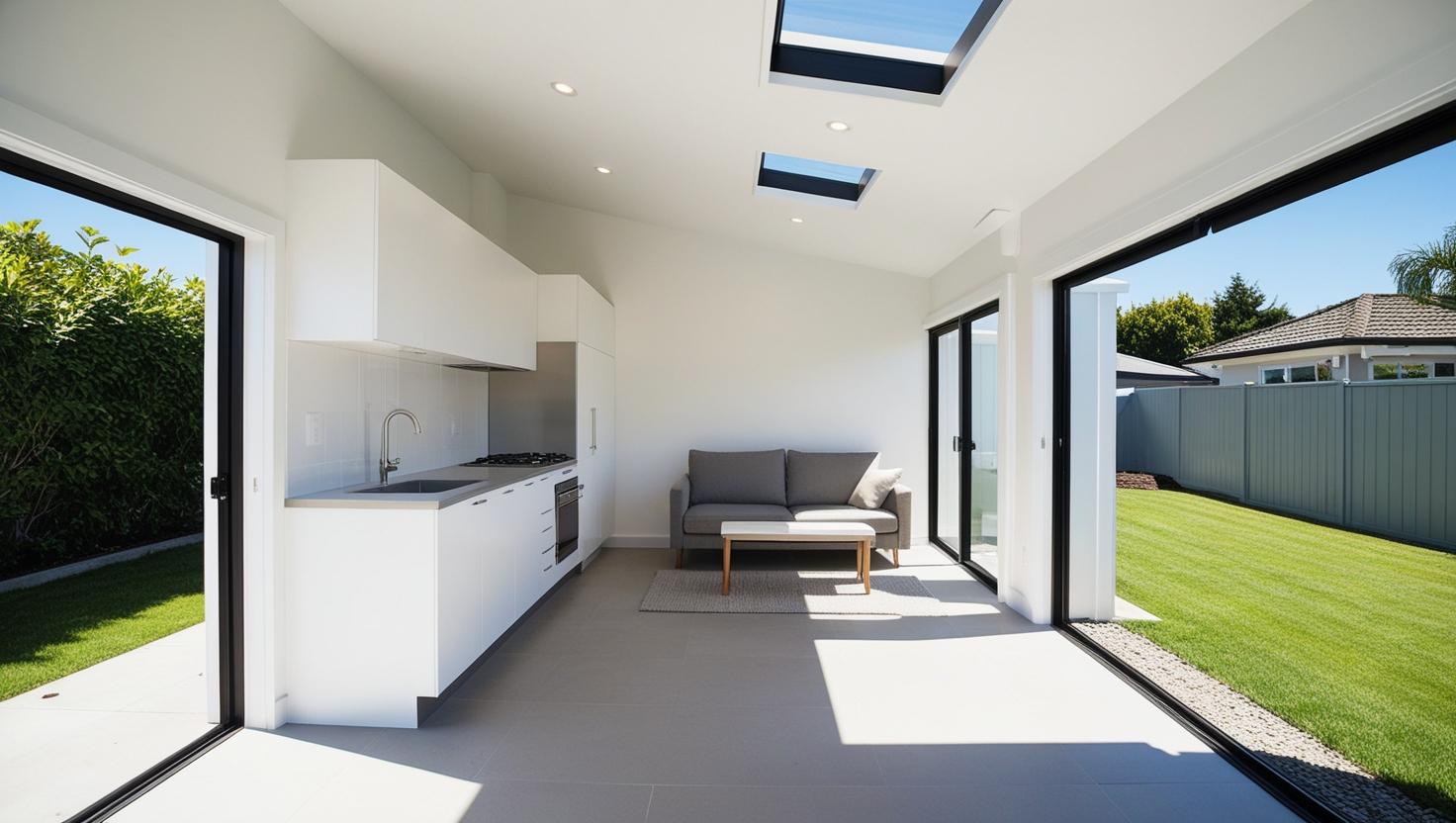
This is genuinely significant for Auckland homeowners. From late 2024/2025, the government has enabled small standalone dwellings (SSADs) of up to 70 square metres to be built without a building consent, under a new Schedule 1A exemption. This specifically targets the housing shortage and is designed to make it easier and cheaper to add a granny flat or second unit to your property.
But — and this is important — the exemption comes with strict conditions:
- The dwelling must be no more than 70sqm
- The owner must first obtain a Project Information Memorandum (PIM) from Auckland Council before work begins
- The design must meet specific prescribed standards set by MBIE
- Work must still comply fully with the Building Code
- The owner is responsible for ensuring compliance — without the safety net of inspections
This is one of those cases where the exemption exists on paper but professional guidance is still strongly recommended in practice. If the conditions aren’t fully met, you’re exposed to enforcement action and the property will carry a compliance question mark. (MBIE: Exempt Building Work Guidance)
Auckland Council’s Discretionary Exemption
There’s also a discretionary exemption under Schedule 1, Clause 2, that allows Auckland Council to exempt building work on a case-by-case basis — even if it’s not automatically covered by Schedule 1 — if the council is satisfied the work will either comply with the Building Code or won’t endanger people or property if it doesn’t fully comply.
This discretionary pathway is less commonly used but available. It requires an application and council assessment, and council policies on granting discretionary exemptions vary. Worth knowing about if your project sits in a grey zone.
What to Do If You’re Not Sure
Auckland Council provides a helpful “Do I need a consent?” tool on its website for small residential projects. For anything more complex, MBIE has also developed a “Can I build it?” tool that walks you through exemption criteria. (MBIE: Technical Requirements for Exempt Building Work)
But honestly? For anything beyond a fence, a small garden shed, or obvious cosmetic work, the safest and cheapest approach in the long run is to get professional advice before you start. The cost of a quick architectural consultation is trivial compared to the cost of sorting out unconsented work later.
💡 Tip for skimmers: Exempt work still must comply with the Building Code — you just don’t need pre-approval. If in doubt, get advice. The exemption isn’t worth the risk if you’re not certain it applies.
The Grey Zone: Work That’s Technically Exempt but Practically Risky
There’s a category of work worth calling out separately: work that may technically be exempt, but where not getting consent creates practical problems later.
The classic example is significant landscaping or retaining work near a property boundary. It might be technically exempt by height, but if it affects neighbouring properties’ drainage or stability, you could face civil liability even without any consent issue. Similarly, non-consented exempt work can still show up as an anomaly in a property file if it’s visible but not documented.
Best practice, even for genuinely exempt work: inform Auckland Council of the work and provide documentation (drawings, specs, photos) so they can update your property file. This means future buyers can see clearly what was done and that it was intentional — not a mysterious alteration of unknown origin.
“To avoid possible issues when on-selling your property, you should formally notify your council and provide them with any relevant documentation (such as drawings, specifications and photographs) if you have carried out exempt building work.” — MBIE: Building Work that Does Not Require a Building Consent
5. How to Reduce Your Building Consent Costs in Auckland: Expert Tips to Avoid Delays, RFIs, and Budget Blowouts
Building consent fees are, to a significant extent, within your control. The biggest driver of costs beyond the base deposit is the time Auckland Council spends on your application — and that time increases dramatically when plans are incomplete, unclear, or inconsistent. Here’s how to minimise that time, and your bill.
Here’s a truth about building consents that not many people talk about: the consent fee itself is relatively predictable; it’s the extras that kill your budget.
That extra $800 for responding to an RFI. The $1,100 amended plans deposit when you decide to shift the bathroom wall after the consent is issued. The additional inspection charge because your inspector spent more than 45 minutes on site. The delay — measured in weeks — caused by incomplete documentation that stops the 20-working-day clock while the council waits for information you could have provided upfront.
These are the real cost drivers. And most of them are within your control.
Tip 1: Get Your Project Value Right From the Start
Your project’s declared value drives your consent deposit band, MBIE levy, and BRANZ levy. Underestimating your project value doesn’t save you money — it backfires. Auckland Council will assess your declared value and adjust it if they think it understates actual construction cost. This creates delays while they seek clarification, and potentially results in a higher deposit than you’d have paid with an accurate estimate upfront.
Use the NZ Building Economist report rates as a guide for residential construction, or ask your architect to calculate it based on current Auckland build costs (typically $2,500–$4,000 per sqm for standard residential work as at 2025, depending on specification). An accurate declaration from day one makes everything smoother. (Auckland Council: Guide to Estimating Building Consent Value of Work)
Tip 2: Submit a Complete, High-Quality Application
This is the single most impactful thing you can do to control your consent costs. Auckland Council’s biggest source of processing delay is incomplete applications. When a consent officer has to pause to issue an RFI — requesting missing information, additional drawings, or clarification — the 20-working-day clock stops. Your application sits in a queue while you or your architect respond. Every hour the council spends on RFIs and reviewing responses is billed to your account at $195–$234/hr. A single RFI cycle might cost $400–$900 extra, depending on its complexity.
Auckland Council itself advises: “Submit all the required information with your application to avoid further processing costs.” It sounds obvious, but you’d be surprised how many applications arrive missing something — particularly structural engineering calculations, producer statements, or specific Building Code compliance pathways for unusual elements. (Auckland Council: Building Consent Fees and Charges)
💡 Tip for skimmers: One complete, accurate application is far cheaper than a fast but incomplete one. Your architect’s thoroughness at the application stage directly saves you money on council fees.
Tip 3: Use a Pre-Application Meeting Strategically
For complex projects, Auckland Council offers a pre-application meeting with a building consent officer, at a cost of $331. This sounds like an extra charge — and it is — but for complex or unusual projects, it can be worth every dollar.
A pre-application meeting lets you identify potential compliance issues before you lodge. You can clarify what documentation the council will want to see, flag any unusual Building Code compliance pathways, and get guidance on whether a resource consent will also be needed. Solving a problem before lodgement costs you one meeting. Solving it after lodgement costs you an RFI response, additional processing time, and potentially amended plans.
Tip 4: Avoid Mid-Consent Changes
Changing your plans after a consent is issued — even minor changes — requires an amended plans application. For projects valued $20,000–$99,999, this attracts an $1,100 deposit. For projects over $100,000, it’s a $1,500 deposit, plus additional processing charges. Changes also add processing time to your project timeline.
The best way to avoid this is to make all your design decisions before lodging for consent. Sounds obvious, but it’s easy to think “we’ll sort out that kitchen layout detail later.” Later costs you $1,500 and three weeks. Settle on your design thoroughly during the concept and developed design phases — before the drawings are finalised for submission.
Tip 5: Understand the Inspection Process — and Be Ready
Inspections are charged based on actual time. If an inspection runs over 45 minutes, additional charges kick in. The best way to keep inspections efficient is to:
- Have all required elements exposed and accessible before the inspector arrives
- Keep a copy of your consented plans on site at all times (legally required)
- Ensure your builder knows exactly what the inspector will want to see at each stage
- Book re-inspections only when work is genuinely complete — failed inspections aren’t “free”
Tip 6: Know When You Need a Resource Consent (and Plan For It Early)
Discovering you need a resource consent after you’ve already lodged for building consent is an expensive form of surprise. Syncing your building consent and resource consent processes from the beginning can save months off your timeline.
Resource consents are needed when your project breaches Auckland Unitary Plan rules — typically around height, site coverage, setbacks, or proximity to overlays (coastal, volcanic viewshaft, heritage). For Auckland’s North Shore, Eastern suburbs, and coastal fringe, these overlays are common. The Auckland Council Unitary Plan is publicly searchable at aucklandcouncil.govt.nz, and any good architect will check your zone and overlays as part of the initial feasibility assessment.
Tip 7: Work With an LBP Designer — It Matters for Consent Quality
Licensed Building Practitioners (LBPs) in the Design class are qualified and authorised to design restricted building work (RBW) — the structural and weathertightness-critical elements that most residential consents involve. Working with an LBP designer (like our director John Mao) doesn’t just meet a legal requirement — it signals to council reviewers that your application has been prepared by a credentialled professional.
Council reviewers process hundreds of applications. Applications from known, credentialled practices tend to get smoother processing because reviewers have confidence in the documentation standard. LBP designers also provide a Record of Work at project completion — formal documentation that proves the restricted building work was designed in compliance with the Building Code. This is valuable for your property file and for future buyers.
Tip 8: Know Your Auckland Unitary Plan Zone Before You Design
Different zones in Auckland’s Unitary Plan have very different rules — and designing your project to fit within those rules from day one means you avoid the cost and delay of a resource consent entirely.
| Zone Type | Common Auckland Locations | Key Rules (Indicative) |
|---|---|---|
| Single House Zone | Many character suburbs (Ponsonby, Remuera) | Lower density, stricter setbacks, character controls |
| Mixed Housing Suburban | Wider inner suburbs (Mt Roskill, Avondale) | Up to 2 storeys as of right, more development potential |
| Mixed Housing Urban | Closer to centres (Sandringham, Mt Eden) | Up to 3 storeys as of right, higher density allowed |
| Terrace Housing & Apt Buildings | Near town centres and transit | Highest density, multiple dwellings encouraged |
The Bigger Picture: What a Good Architect Actually Costs You (and Saves You)
Let’s address the elephant in the room. Architectural fees aren’t free. But in the context of building consent costs, they’re an investment in efficiency — not an additional expense on top of consent fees.
A well-prepared consent application from an experienced Auckland architect minimises RFIs, minimises council processing time, and produces the Record of Work documentation that protects your investment. The alternative — using a cheaper, less experienced draftsperson whose application generates multiple RFIs — can easily cost you $2,000–$5,000 more in additional council charges, plus weeks of project delay. Delay has its own cost: it might mean living through a second Auckland winter in a half-renovated kitchen.
We’ve written about this in detail in our blog on the architectural design process in NZ — it’s worth reading before you make your team selection.
“Getting consent is easy if you are partnered with the right architect. We will guide you through the entire process from initial consultation to getting your permit approved, ready for construction.” — Sonder Architects
The Bottom Line on Auckland Building Consent Costs in 2025
Let’s bring it all together. After everything we’ve covered in this guide, here’s the summary you can take into your next planning conversation.
Building consents in Auckland are not optional for most significant building work — and the cost of skipping one is almost always higher than the cost of getting one. Between potential fines, Certificate of Acceptance fees, and the impact on property sales and insurance, unconsented work is a risk that just isn’t worth taking.
The actual cost of a building consent in Auckland ranges from around $1,270 for very minor work under $5,000 to $10,530+ in initial deposits for million-dollar projects — with total consent costs (including CCC, levies, and additional processing) sitting meaningfully above those initial deposits in almost every case. For the most common Auckland renovation projects, expect to budget:
- Small alterations (adding a toilet, minor plumbing): $2,500–$3,500 total consent cost
- Bathroom or kitchen renovation: $3,500–$5,500
- Single-storey home extension: $6,000–$9,000
- Full recladding: $7,000–$12,000
- Garage conversion / minor dwelling: $4,000–$8,000
- New build: $9,000–$15,000+
These numbers are manageable — especially when you consider them as a percentage of total project cost (typically 1–4% for larger projects). The real money-saver is a complete, well-prepared application that minimises council RFIs and processing time. That’s where your architect’s expertise pays for itself.
Whether you’re at the “just wondering” stage or you’re ready to get started, the best next step is always the same: get a feasibility assessment. Know what’s possible on your property, what consents you’ll need, and what the total project cost — consent fees included — is likely to be. No surprises. Just a clear path forward.
“We design with empathy, knowing every home holds a unique story. Our team listens, collaborates and creates spaces that truly feel like yours.” — John Mao, Founder, Sonder Architects
At Sonder Architects, we offer a free feasibility report for Auckland homeowners — it’s your starting line. We’ll assess what’s possible on your property, give you an honest picture of likely consent requirements and costs, and help you figure out whether your project makes sense. No pressure, no jargon. Just honest advice from an experienced team that’s helped hundreds of Auckland homeowners navigate exactly this process.
Give us a ring on 0800 272 469, flick us an email at admin@sonderarchitects.co.nz, or visit sonderarchitects.co.nz to get started. Your new space is closer than you think.
How much does a building consent cost in Auckland in 2025?
It depends on your project's declared value. Auckland Council's initial deposits range from $1,270 for projects under $5,000 to $10,530 for projects valued over $1,000,000. These are deposits only — actual final costs are usually higher once processing time, inspections, CCC fees, and government levies (MBIE and BRANZ) are added. For most residential renovations, total consent costs fall between $3,500 and $12,000. For new builds, budget $9,000–$15,000+.
Do I need a building consent for a kitchen renovation in Auckland?
Usually yes, if the renovation involves structural changes (removing or altering walls), significant plumbing changes (adding fixtures or relocating drainage), or electrical work that affects the building. Purely cosmetic work — new benchtops, cabinetry, flooring, painting — typically doesn't require consent. If you're unsure, ask your architect or use Auckland Council's online consent checker.
How long does a building consent take in Auckland?
Auckland Council has a statutory target of 20 working days (roughly four calendar weeks) to process a consent application. However, this clock pauses whenever the council issues a Request for Information (RFI). A complete application with no RFIs can come through in 4–6 weeks total. Complex applications or those also requiring resource consent can take 2–6 months. Your architect's role is to minimise the chance of RFIs by submitting a thorough, complete application.
What's the difference between a building consent and a resource consent in Auckland?
A building consent checks that your project meets the New Zealand Building Code (safety, structure, weathertightness, insulation, etc.). A resource consent checks that your project complies with the Auckland Unitary Plan — the rules about what you can build where on your land (zoning, height limits, setbacks, etc.). Many projects only need a building consent. Projects that breach Unitary Plan rules — like an extension that's too tall or sits too close to a boundary — need both.
Can I build a granny flat without a building consent in Auckland?
As of late 2024/2025, yes — under new government rules, standalone dwellings up to 70sqm may be built without a building consent under the Schedule 1A exemption, provided specific conditions are met (including obtaining a Project Information Memorandum first and complying with prescribed design standards). However, this exemption has strict requirements and the homeowner bears full responsibility for Building Code compliance. We strongly recommend professional advice before proceeding.
What happens if I build without a consent in Auckland?v
Building without a required consent is an offence under the Building Act 2004. Auckland Council can issue infringement notices, Notices to Fix, and in serious cases pursue prosecution with fines up to $200,000. Unconsented work also complicates property sales, can void insurance coverage related to that work, and may require expensive Certificate of Acceptance applications (starting at $1,403) with no guarantee of approval.
What is included in Auckland Council's building consent fee?
Auckland Council's consent fee covers the cost of its engineers and specialists reviewing your plans and conducting building inspections, charged at published hourly rates ($195–$234/hr depending on the officer's level). On top of this, government levies are added: the MBIE building levy ($1.75 per $1,000 of project value, for projects over $65,000) and the BRANZ research levy ($1 per $1,000 of project value, for projects over $20,000). You'll also need to budget for the Code Compliance Certificate at the end of the project ($250–$700 base fee depending on project value).
Why are Auckland building consent fees higher than other NZ councils?
Auckland uses a full cost-recovery model — meaning you pay for the actual time its specialists spend on your application. Compared to Wellington (which recovers less of its costs through rates) or Christchurch, this makes Auckland fees higher. Research has found that Auckland charges approximately $4,982 for a $350,000 project, compared to $1,253 in Wellington and $1,900 in Christchurch for a similar project.
Do I need an architect to get a building consent in Auckland?
Technically, you (as the property owner) are the applicant and can lodge a consent yourself. But for anything involving restricted building work (structural elements, weathertightness), the design work must be done by a Licensed Building Practitioner (LBP) in the Design class. In practice, using an experienced architect dramatically reduces the risk of RFIs, minimises council processing time, and produces a quality consent package that protects your investment. It almost always saves money in the long run.
How do I calculate the MBIE and BRANZ levies for my Auckland project?
The MBIE building levy is $1.75 for every $1,000 (or part thereof) of project value — but only applies to projects with a declared value of $65,000 or more (as of July 2024). The BRANZ research levy is $1 for every $1,000 (or part thereof) of project value, for projects over $20,000 (GST-exclusive). Example: a $150,000 project would attract an MBIE levy of $262.50 (150 × $1.75) and a BRANZ levy of $150 (150 × $1.00).