
Who Is Responsible for Building Consent in NZ?
Quick answer: Under the Building Act 2004, you — the property owner — are always legally responsible for obtaining building consent in New Zealand, even when you hire an architect, builder, or project manager to handle the application on your behalf.
That single fact surprises a lot of Auckland homeowners. We hear it regularly at Sonder Architecture: “I assumed my builder was sorting the consent.” Or: “Doesn’t the architect handle all of that?”
The short answer is yes — professionals like us do handle the consent process day-to-day. We prepare the drawings, compile the documentation, and submit the application to Auckland Council. But the legal responsibility never leaves the property owner’s hands. That’s you.
Why does this matter? Because if something goes wrong — unconsented work discovered during a sale, a failed inspection, or a consent that lapses before the build finishes — the council comes knocking on the owner’s door first. Not the builder’s. Not the architect’s. Yours.
This isn’t designed to scare you. It’s designed to make sure you go into your renovation or new build with your eyes open. And the good news? Once you understand how building consent responsibility works in NZ, you can structure your project so you’re protected at every stage. That’s exactly what we help our clients do, whether they’re extending a 1960s brick-and-tile in Remuera or building a new home on the North Shore.
In this guide, we’ll break down what the Building Act 2004 actually says about owner responsibility, who does what in practice, how different project arrangements change the picture, and — most importantly — what you should be checking to protect yourself.
https://www.aucklandcouncil.govt.nz/building-and-consents/building-renovation-projects/Pages/default.aspx
What the Building Act 2004 Says About Building Consent Responsibility in NZ
Let’s start with the law itself, because this is where the confusion begins — and where it ends.
Section 14B — The Owner’s Responsibilities
Section 14B of the Building Act 2004 spells it out: the owner is responsible for obtaining any necessary consents, approvals, and certificates. The same section makes the owner responsible for ensuring that all building work complies with the building consent — or, if no consent is required, with the New Zealand Building Code (NZBC).
This section was inserted by the Building Amendment Act 2012, and it exists for a specific reason. Before 2012, the Building Act didn’t have a single clear section that said “here is what owners must do.” Responsibilities were scattered across different parts of the legislation. The 2012 amendment tidied this up, creating sections 14A through 14F — one for each party involved in a building project.
Important: Under Section 14B of the Building Act 2004, the property owner is responsible for: obtaining building consent before work begins, ensuring work complies with the consent, and obtaining the Code Compliance Certificate (CCC) when work is complete. This responsibility cannot be transferred — only delegated.
Here’s the key distinction that trips people up. You can delegate the task of applying for consent. Your architect can prepare and submit the application. Your builder can coordinate the inspections. A project manager can oversee the lot. But delegating the task does not transfer the legal responsibility. If the Building Act is breached, MBIE’s guidance is clear: the owner is likely to be fully liable.
Think of it like your tax return. You can hire an accountant to prepare and file it. But if there’s an error, the IRD still comes to you — the taxpayer — first.
Sections 14C to 14F — Everyone Else’s Responsibilities
The Building Act doesn’t stop at the owner. It also defines responsibilities for other parties:
| Section | Party | Key Responsibility |
|---|---|---|
| 14B | Owner | Obtain consents, ensure work complies, get the CCC |
| 14C | Owner-builder | Ensure work complies with the consent and approved plans |
| 14D | Designer | Ensure plans and specifications will meet the Building Code |
| 14E | Builder | Build to the approved plans and consent; comply with the Building Code |
| 14F | Building Consent Authority (council) | Check plans for Building Code compliance; process the consent application |
Every party has defined obligations — but only the owner carries the overarching legal responsibility for the project as a whole. Your designer must produce compliant plans. Your builder must build to those plans. The council must process your application fairly. But making sure it all happens? That sits with you.
This layered responsibility system is actually a good thing. It means that if your builder deviates from the consented plans, the builder is accountable under Section 14E — and they can face disciplinary action through the Licensed Building Practitioners Board. Your architect is accountable for design compliance under Section 14D. So while you hold the overarching responsibility, the professionals around you are individually accountable too.
💡 Homeowner tip: Before your project starts, ask your architect or designer to explain exactly how the consent application will be submitted and who will be named on each form. You should see your name as the owner-applicant — even if a professional is managing the process for you.
“The consent process works best when everyone knows their role. The owner holds the responsibility. The architect delivers the documentation. The builder executes the plans. When those lines are clear from day one, projects run smoother.”
— Sonder Architecture Team
Who Actually Applies for Building Consent? The Practical Reality
So the law says you’re responsible. But in practice, most Auckland homeowners don’t personally fill out Form 2 (the prescribed building consent application form), compile the documentation, or walk it into the Auckland Council e-consent portal themselves. Nor should they — it’s a technical process that benefits enormously from professional expertise.
Here’s how it typically works across different project setups.
Scenario 1 — You Hire an Architect (Design-Only Service)
This is common for renovation and extension projects in Auckland. You engage an architectural studio — like Sonder Architecture — to design your project and prepare the consent documentation. The architect produces the drawings, coordinates with structural engineers and other subconsultants, and compiles the full application package. In most cases, the architect submits the consent application to Auckland Council on your behalf, acting as your authorised agent.
You’re still the applicant. Your name is on the form. The consent, once granted, is issued to you. When the project finishes, you (or your agent) must apply for the Code Compliance Certificate (CCC) — the document Auckland Council issues when they confirm the finished work meets the Building Code.
At Sonder Architecture, this is the model we use most often. We handle the full architectural design process through to consent approval, so you don’t have to worry about the paperwork — but we make sure you understand your ownership of the consent at every stage.
Scenario 2 — You Hire a Design-and-Build Company
In a design-and-build arrangement, one company handles both the architectural design and the construction. This is how Sonder Architecture works alongside Superior Renovations — we design the project and manage the consent, and Superior Renovations handles the build. The homeowner gets one integrated team.
Even in a design-and-build setup, the building consent is issued to the property owner — not the company. The advantage of this model is that the design and build teams are coordinated from the start, which reduces the chance of consented plans being misunderstood during construction. Fewer surprises, fewer variation requests to council.

Scenario 3 — You Hire a Builder Who “Handles Everything”
This is where Auckland homeowners get caught out most often. You hire a builder. They say they’ll sort the consent. You assume it’s done. Six months later, work is underway — and the consent was never actually granted. Or the builder submitted plans that don’t match what’s being built.
Sound familiar? We’ve seen this scenario play out in Grey Lynn, Henderson, and Papakura — it’s not suburb-specific, it’s industry-wide.
Even when your builder applies for the consent on your behalf, you are the legal applicant. If the builder disappears halfway through, you’re left holding a partially completed project with a consent clock ticking. Under the Building Act, you have 12 months to start work after consent is granted, and generally two years to complete it.
Important: Auckland Council’s standard processing time for building consent is 20 working days from receiving a complete application, as set out in the Building Act 2004. If additional information is requested (an RFI), the clock stops until you provide it. Always confirm with your professional that the application is complete before it’s submitted.
Scenario 4 — You’re an Owner-Builder
If you’re doing the building work yourself — or at least some of it — you’re what the Act calls an “owner-builder.” Section 14C gives you an additional responsibility on top of the standard owner obligations: you must ensure the work complies with both the building consent and the approved plans and specifications.
Owner-builders can apply for an owner-builder exemption from the council to carry out restricted building work (RBW) themselves. RBW is building work that relates to the structure or weathertightness of a home — the critical stuff. Normally, only Licensed Building Practitioners (LBPs) can do RBW. The exemption lets owner-builders do it, but they must live in the property for at least one year afterwards.
This is a big responsibility. If you make a mistake with structural or weathertightness work, there’s no LBP’s professional indemnity insurance to fall back on. It’s all on you.
💡 Homeowner tip: Even as an owner-builder, you still need a Licensed Building Practitioner (LBP) — a tradesperson certified to carry out or supervise restricted building work — to sign off on certain elements. You can’t avoid LBP involvement entirely for anything involving structure or weathertightness. Check the LBP scheme for current requirements.
What Happens When Building Consent Responsibility Goes Wrong
Understanding your responsibility is one thing. Seeing what happens when it’s ignored is another. Here are the real-world consequences Auckland homeowners face when building consent responsibility isn’t taken seriously.
Unconsented Work and Property Sales
This is the most common headache. You’re selling your home. The buyer’s lawyer requests the property file from Auckland Council. The file shows a three-bedroom house. The buyer is looking at a four-bedroom house with a converted garage and an extended kitchen. None of the additions have a building consent or CCC on file.
Unconsented work can derail a property sale, reduce the agreed price, or kill the deal entirely. Buyers’ lawyers will flag it. Banks may refuse to lend against it. Insurance companies may exclude it from cover.
And the person who has to sort it out? The current owner — regardless of whether they did the work or bought the property with it already done.
Fines and Enforcement
Auckland Council has the power to issue a notice to fix under Section 164 of the Building Act. If you don’t comply, MBIE confirms that councils can impose infringement fines. In serious cases, prosecution under the Building Act can result in fines up to $200,000 for using a building that doesn’t have the required consents.
That’s an extreme case. But even a notice to fix creates stress, cost, and delay — and it goes on your property file permanently.
Lapsed Consents
If you don’t start work within 12 months of your building consent being granted, the consent lapses. You’ll need to reapply — paying new fees and potentially having your plans reassessed against any updated Building Code requirements. If you need an extension, you must talk to your council before the 12 months are up.
Similarly, you have two years to complete the building work from the date the consent is granted (unless you agree otherwise with council). If you miss this deadline without requesting an extension, council must decide whether to issue a CCC or take another regulatory path — which could include refusing the CCC.
One of our clients on the North Shore came to us after inheriting a project with a lapsed consent from a previous builder. The original plans no longer met current Building Code requirements for insulation (H1), which had been updated since the consent was first issued. They had to redesign portions of the project and reapply — adding months and thousands of dollars to the timeline.
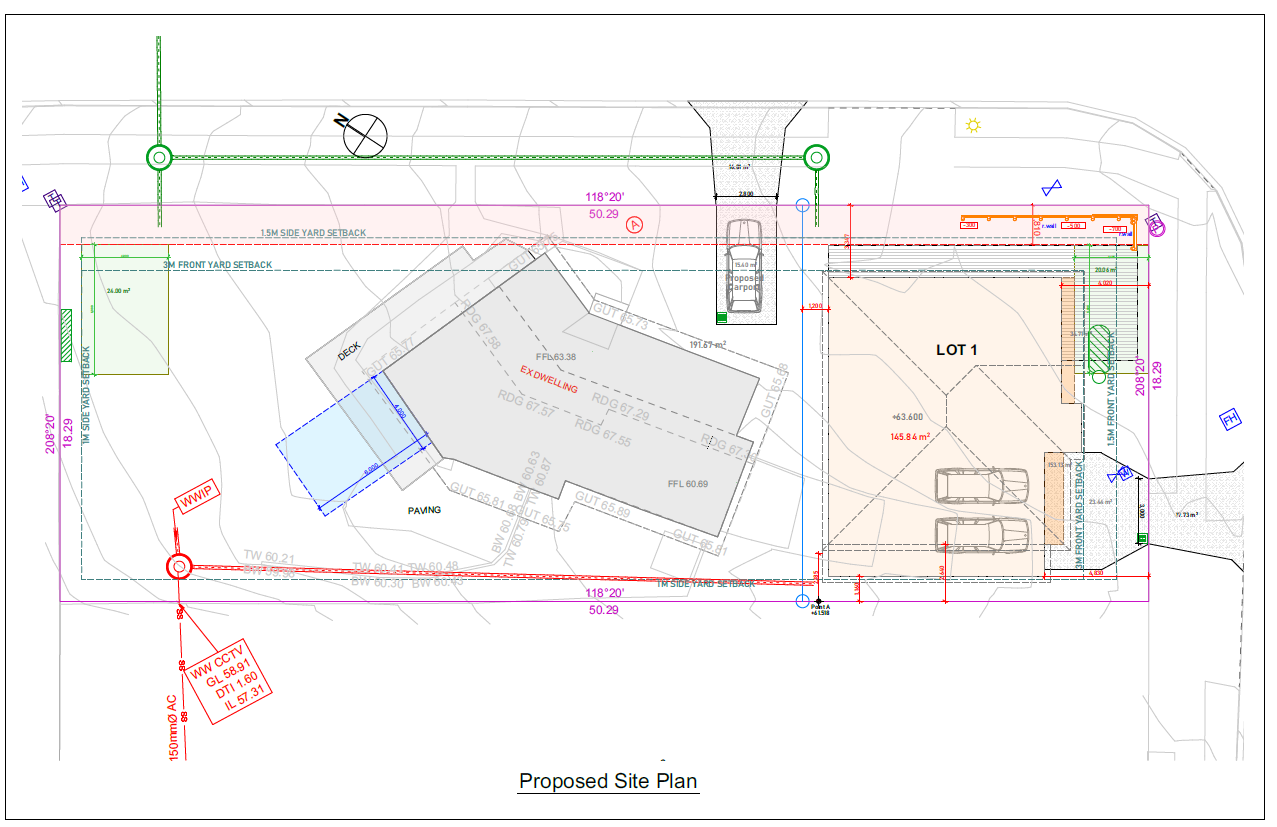
Example of a site where an existing property is being subdivided, and a new dwelling is to be built.
The CCC — Your Final Responsibility
Getting the building consent is just the start. Once construction is complete, you must apply for a Code Compliance Certificate (CCC). This is the document that confirms your finished work meets the Building Code as approved in your consent.
It’s the owner’s responsibility to get the CCC — even when your builder or project manager is coordinating the process on your behalf. Without a CCC, your property file will show an open consent with no sign-off. This creates problems for future sales, insurance, and refinancing.
💡 Homeowner tip: Before your builder finishes on site, confirm that all required council inspections have been called for and passed. The inspection schedule is listed on your building consent. If inspections are missed or failed, your CCC application will be delayed or declined.
“We always tell our clients: the building consent is your project’s birth certificate, and the CCC is its diploma. You need both. And both are your responsibility to obtain.”
— Sonder Architecture Team
How to Protect Yourself as a Homeowner in the Building Consent Process
Now for the practical stuff. You know you’re responsible. Here’s how to make sure that responsibility doesn’t become a liability.
1. Get a Written Agreement That Defines Consent Responsibilities
Your contract with your architect, designer, or builder should spell out exactly who is doing what in the consent process. This includes: who prepares the application, who submits it, who responds to council RFIs (requests for information), who books inspections, and who applies for the CCC at the end.
If your contract is vague on consent responsibility, get it clarified in writing before any work starts. It doesn’t need to be a legal epic — a clear schedule of responsibilities in plain language is enough.
2. Use a Licensed Building Practitioner in the Design Class
For any work involving the structure or weathertightness of your home — which covers most renovations, extensions, and new builds — the designer must be a Licensed Building Practitioner (LBP) in the Design class, or operate under equivalent professional registration.
At Sonder Architecture, John Mao holds Design class LBP registration through the New Zealand Building Practitioners Board. This means our design work on restricted building work is backed by the LBP scheme’s accountability framework. If something goes wrong with the design, there’s a formal complaints and disciplinary process through the Building Practitioners Board.
Hiring an LBP-registered designer gives you a layer of protection that hiring an unregistered drafter does not.
3. Stay Informed Throughout the Process
You don’t need to become a building consent expert. But you do need to stay across the key milestones:
| Milestone | What to Check |
|---|---|
| Consent application submitted | Confirm it’s been lodged — ask for the council reference number |
| RFI received from council | Ask your architect what information council needs and how quickly it’ll be provided |
| Consent granted | Get a copy. Read the conditions and the required inspection schedule |
| During construction | Confirm inspections are being booked and passed at each stage |
| Construction complete | Confirm CCC application has been submitted and all documentation is in order |
| CCC issued | Get a copy for your records. This goes on the property file |
4. Start With a Feasibility Report
Before you commit to a project, a feasibility report tells you what’s actually possible on your property under the Auckland Unitary Plan — and what consents you’ll need. It covers your site’s zoning, any overlays (heritage, flood, coastal), boundary setbacks, height limits, and whether your project will need resource consent in addition to building consent.
We offer a free feasibility report to help Auckland homeowners get this clarity before spending a dollar on design. It’s the single best way to understand your consent obligations before you’re committed to a project.
5. Don’t Skip the Consent — Even for “Small” Work
Auckland homeowners sometimes assume that small projects don’t need consent. Some don’t — there are genuine exemptions under Schedule 1 of the Building Act. Standalone sheds under 30 sqm, certain repair and maintenance work, and low-risk projects may be exempt.
But it’s the owner’s responsibility to determine whether work is exempt — and to ensure that exempt work still complies with the Building Code. Getting this wrong can be expensive. If council discovers unconsented work that should have had a consent, you’ll need a Certificate of Acceptance — which costs more than a consent would have, and doesn’t give you the same level of sign-off.
Important: The 2025 granny flat exemption allows standalone dwellings up to 70 sqm to be built without a building consent under specific conditions. But the owner must still ensure the work complies with the Building Code and is carried out by licensed professionals. Check building.govt.nz for the latest exemption rules.
Not sure whether your project needs consent? That’s exactly what a free consultation with Sonder Architecture can clarify. We’ll review your project scope, check it against Auckland’s rules, and tell you straight whether you need a building consent, a resource consent, both, or neither.
Building Consent Responsibility — Your Role, Your Team, Your Protection
Here’s the bottom line. Under NZ law, building consent responsibility sits with the property owner. Full stop. No contract, no handshake, and no verbal promise from a builder changes that.
But that doesn’t mean you’re on your own. The whole point of hiring qualified professionals — an LBP-registered designer, a licensed builder, a good project manager — is to make sure the process runs smoothly and compliantly. Your job isn’t to become a consent expert. It’s to hire the right people and stay informed enough to ask the right questions.
At Sonder Architecture, we guide Auckland homeowners through every step of the building consent process — from feasibility and concept design through to consent approval and CCC. We work alongside Superior Renovations to deliver integrated design-and-build projects where the consent process is coordinated from day one.
If you’re planning a renovation, extension, or new build in Auckland and you want to make sure the consent side is properly handled from the start — get in touch.
➡ Book a free consultation with Sonder Architecture
➡ Request your free feasibility report
➡ Read our guide to building consent for renovations in Auckland
Who is legally responsible for building consent in NZ?
Under Section 14B of the Building Act 2004, the property owner is always legally responsible for obtaining building consent in New Zealand. You can delegate the application process to an architect, designer, or builder — but the legal responsibility remains with you as the owner. This includes ensuring work complies with the consent and obtaining the Code Compliance Certificate when work is complete.
Can my builder apply for building consent on my behalf?
Yes. Your builder, architect, or project manager can submit the building consent application to council as your authorised agent. But you remain the legal applicant. The consent is issued in the owner's name. If something goes wrong — a lapsed consent, unconsented work, or a failed inspection — the council holds the owner responsible first.
What happens if I start building work without a consent in NZ?
Building without a required consent is a breach of the Building Act 2004. Auckland Council can issue a notice to fix, and infringement fines can be imposed. In serious cases, prosecution can result in fines up to $200,000. You may also need to apply for a Certificate of Acceptance, which costs more than a standard consent and provides a lower level of assurance.
Do I need a building consent for a small renovation in Auckland?
It depends on the scope. Schedule 1 of the Building Act exempts certain low-risk work — like standalone sheds under 30 sqm, general repairs, and some maintenance. But most structural changes, plumbing additions, and drainage work require consent. It is the owner's responsibility to determine whether work is exempt. When in doubt, check with Auckland Council or an architect before starting.
What is a Code Compliance Certificate and who needs to get it?
A Code Compliance Certificate (CCC) is the document Auckland Council issues when it confirms your finished building work meets the Building Code as approved in your consent. The owner is responsible for applying for the CCC — even when a builder or project manager coordinates it on their behalf. Without a CCC, your property file shows an incomplete consent, which can affect future sales and insurance.
How long does a building consent last before it expires in NZ?
You must start building work within 12 months of your building consent being granted, or the consent lapses. You then have two years from the consent date to complete the work, unless you agree a different timeframe with council. If you need more time, request an extension before the deadline — not after.
What is the difference between building consent and resource consent?
Building consent is about how you build — it confirms your plans meet the NZ Building Code for safety, structure, and durability. Resource consent is about where and what you build — governed by the Resource Management Act 1991, it deals with land use, environmental effects, and zoning rules under the Auckland Unitary Plan. Many Auckland projects need both.
Can I do my own building work in NZ without an LBP?
For restricted building work — anything involving the structure or weathertightness of a home — only Licensed Building Practitioners (LBPs) can carry out or supervise the work. Owner-builders can apply for an exemption from council, but they must live in the property for at least one year afterwards. Non-restricted work, like painting or tiling, can be done by anyone.
What should I check before hiring someone to handle my building consent?
Confirm they hold relevant qualifications — LBP registration in the Design class for designers, licensed trade registration for builders. Get a written agreement that defines who prepares the application, who submits it, who responds to council queries, who books inspections, and who applies for the CCC. Never rely on a verbal promise that someone will handle the consent.
Does Sonder Architecture handle the building consent process for homeowners?
Yes. Sonder Architecture manages the full consent process for Auckland homeowners — from initial feasibility through to consent approval and CCC. Our director John Mao holds Design class LBP registration. We prepare all drawings, coordinate with engineers and subconsultants, and submit the application to Auckland Council on your behalf. Book a free consultation to get started.