
Last updated:
Does a Tiled Shower Need Building Consent? An Auckland LBP Designer Explains
Quick answer: In most cases, yes. A new fully tiled shower needs a building consent in New Zealand, because the waterproof membrane hidden behind and beneath the tiles is consented work. Replacing a shower unit in the same spot usually doesn’t.
You’ve chosen the tiles. You’ve lined up a tiler. You’re ready to go. Then someone says the word “consent”, and the job feels heavier than it did an hour ago.
So does a tiled shower need building consent? Most of the time, the answer is yes, and the reason catches a lot of Auckland homeowners off guard. It isn’t the tiling that triggers a consent. It’s the waterproof membrane underneath: the hidden layer that stops water soaking into the framing and quietly rotting your house from the inside out.
Let’s define the term first, because the whole article hangs off it. A building consent is your council’s formal sign-off that planned construction work meets the New Zealand Building Code (NZBC), the national rulebook for how a building has to perform. For Auckland projects, that council is Auckland Council. Some work needs that sign-off. Some doesn’t. A tiled shower sits right on the line.
“Do I actually need a consent for this, or can I just get someone in to do it?” is the question we hear more than any other at Sonder Architecture. The restricted design work here is carried out or supervised by a Licensed Building Practitioner (Design Class) on our team, so we sit across this line every week. With bathrooms, the honest answer comes down to one thing above all else: whether your project installs a new waterproof membrane. Get that distinction right and you’ll know whether you’re looking at a quick weekend swap or a consented build before you spend a dollar. Get it wrong, and it tends to surface years later, usually when you’re trying to sell.
Below: where the consent line actually falls, why the membrane is the real trigger, how the waterproofing gets signed off, and what to do if you’ve already tiled a shower without consent.
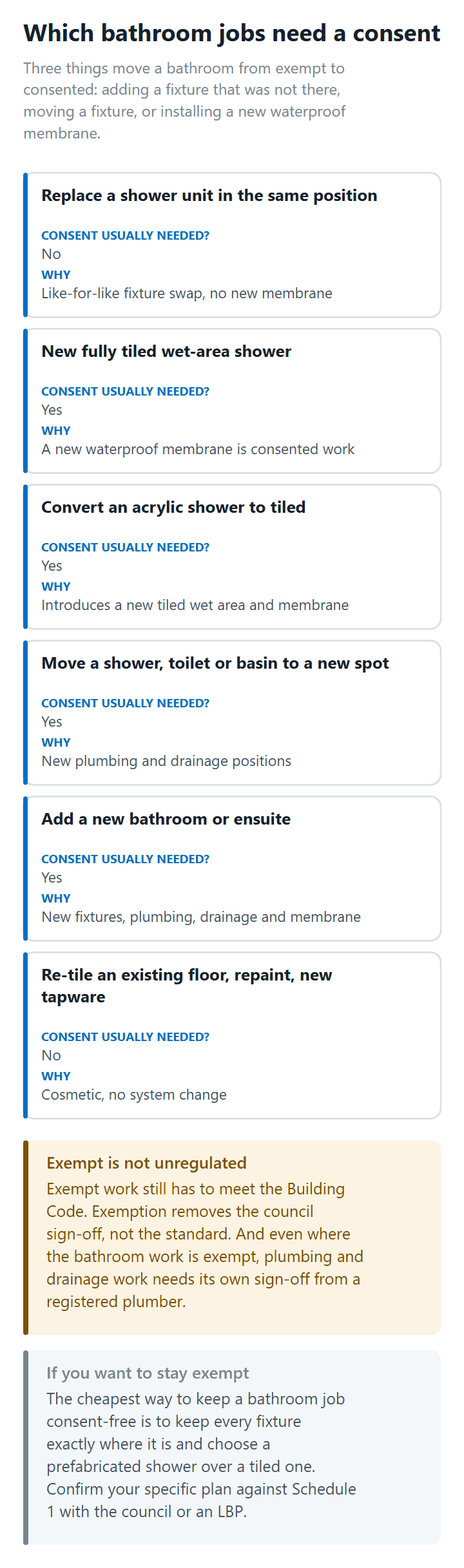
When a Tiled Shower Needs Consent: Replacing vs. Building New
The rules for bathrooms aren’t written room by room. They’re written around building systems: structure, plumbing, drainage, and internal moisture. That’s why a “small” tiled shower can need a consent while a much bigger cosmetic makeover sails through without one. The single question that decides it: are you keeping the existing setup, or creating a new waterproofed wet area?
What usually doesn’t need consent
New Zealand’s Building Act 2004 lists the work you’re allowed to do without a consent in something called Schedule 1, the part of the Act that sets out exempt building work within limits. A good chunk of ordinary bathroom work falls inside it.
Swapping a vanity, a toilet, or a prefabricated shower unit for a comparable one in the same position is generally exempt. So is cosmetic work: painting, new tapware, re-tiling a floor, replacing cabinetry. The Building Performance team at MBIE puts it plainly. Altering existing sanitary fixtures (the toilet, basin, bath and shower) is exempt, as long as you’re not adding to the number of fixtures and you’re not affecting a specified system like fire safety. Replace like with like, keep everything where it is, and a surprisingly deep refresh can stay consent-free. You can read the full list on building.govt.nz, and we’ve broken down the everyday cases in our guide to what you can build without a building consent in NZ.
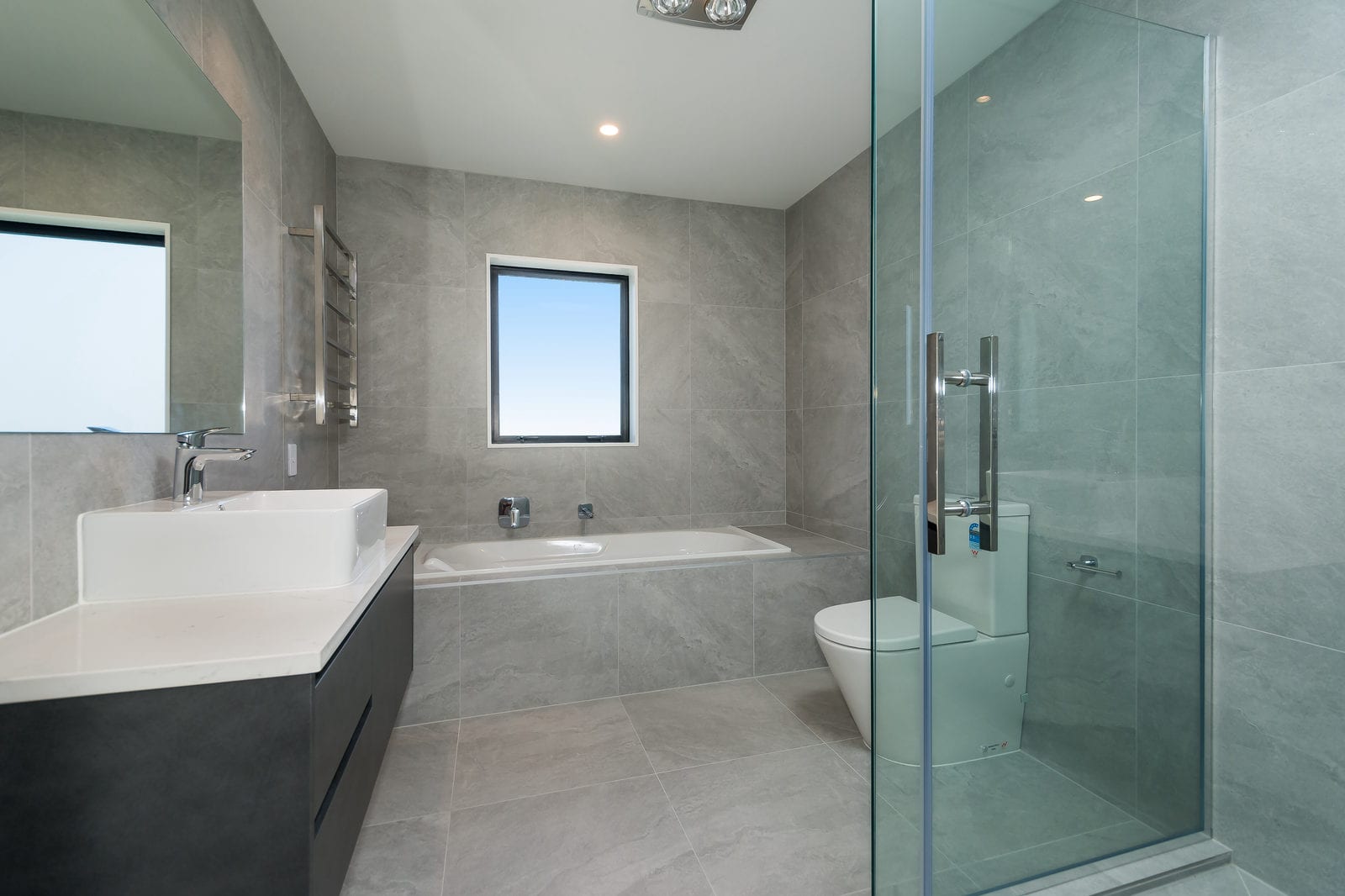
What tips you into consent territory
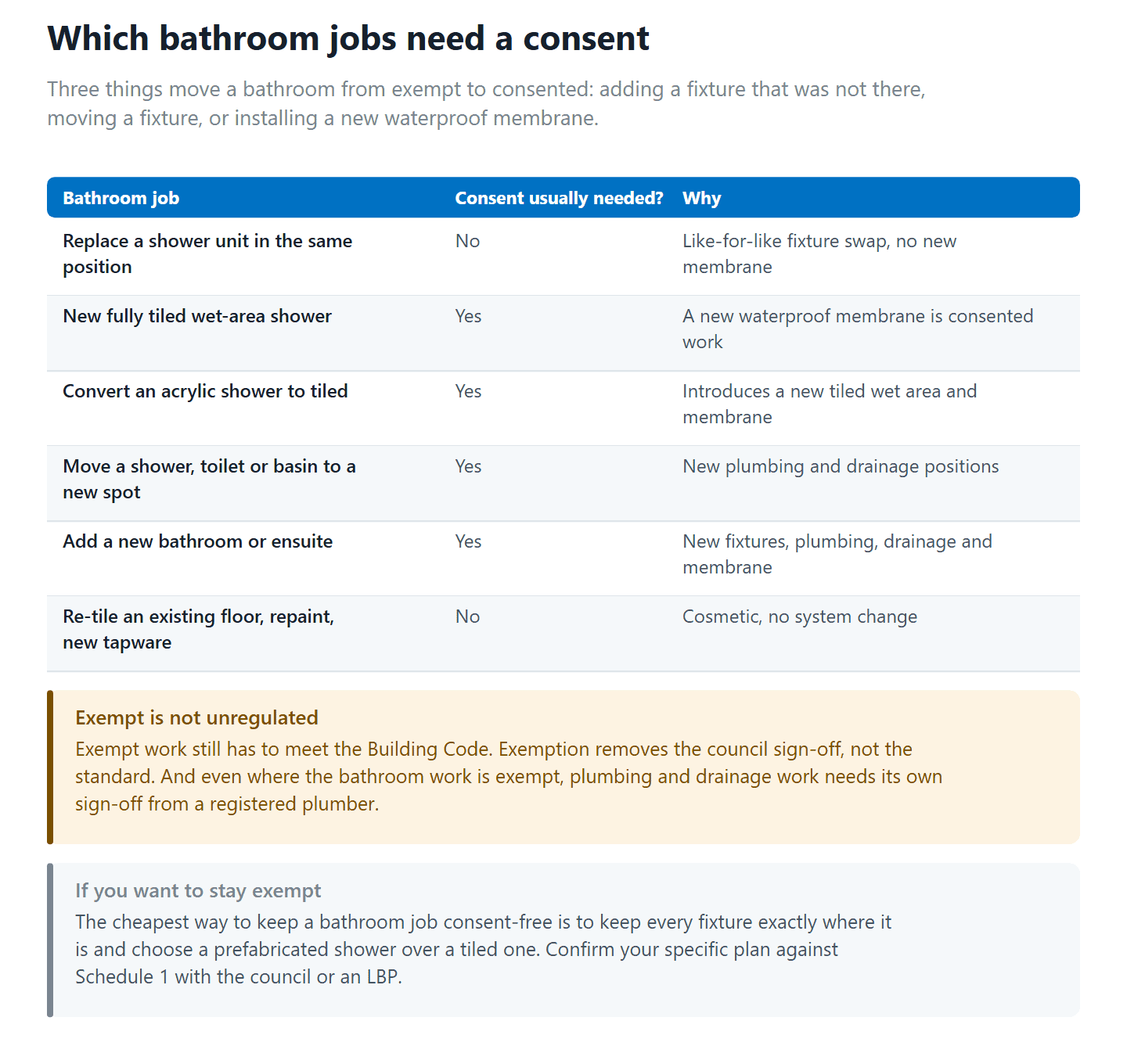
Three things move a bathroom from exempt to consented: adding a fixture that wasn’t there before, moving a fixture to a new position, or installing a new waterproof membrane for a tiled wet area. Build a fully tiled shower where there wasn’t one, or convert an acrylic shower into a tiled one, and you’ve created a new waterproofed wet area that needs a consent. Add a second bathroom or an ensuite anywhere in the house, and that’s consent too.
Picture a 1960s brick-and-tile in Remuera. The owners want to pull out the old moulded acrylic shower and replace it with a sleek tiled walk-in. Same corner, same footprint. It feels like a like-for-like swap. It isn’t. The moment that tiled wet area needs a new membrane, the council wants to see it. Sound familiar? It’s one of the most common surprises we unpick for homeowners.
| Bathroom job | Consent usually needed? | Why |
|---|---|---|
| Replace shower unit in same position | No | Like-for-like fixture swap, no new membrane |
| New fully tiled wet-area shower | Yes | New waterproof membrane is consented work |
| Convert acrylic shower to tiled | Yes | Introduces a new tiled wet area and membrane |
| Move shower, toilet or basin to a new spot | Yes | New plumbing and drainage positions |
| Add a new bathroom or ensuite | Yes | New fixtures, plumbing, drainage and membrane |
| Re-tile an existing floor, repaint, new tapware | No | Cosmetic; no system change |
💡 Homeowner tip: The cheapest way to keep a bathroom job consent-free is to keep every fixture exactly where it is and choose a prefabricated shower over a tiled one. The look is less premium, but a same-position swap usually stays inside Schedule 1.
Important: Exempt work still has to meet the Building Code. Exemption removes the council sign-off, not the standard. Always confirm your specific plan against Auckland Council’s building and consents guidance before you commit, because the detail of your layout is what decides it.
So if the tiles aren’t the problem, what exactly is the council worried about? That’s where the membrane comes in.
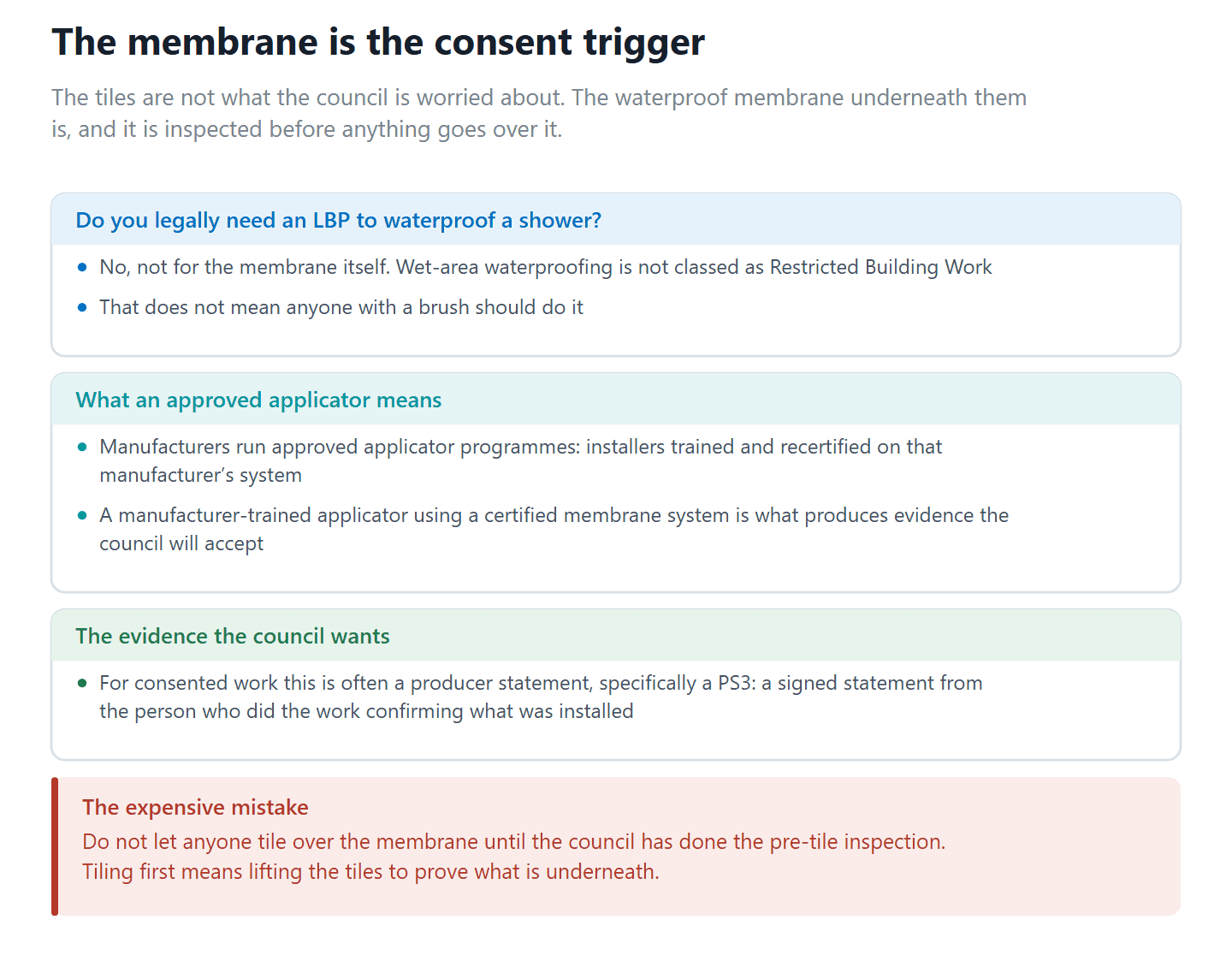
Why the Waterproof Membrane Is the Real Consent Trigger (NZBC E3)
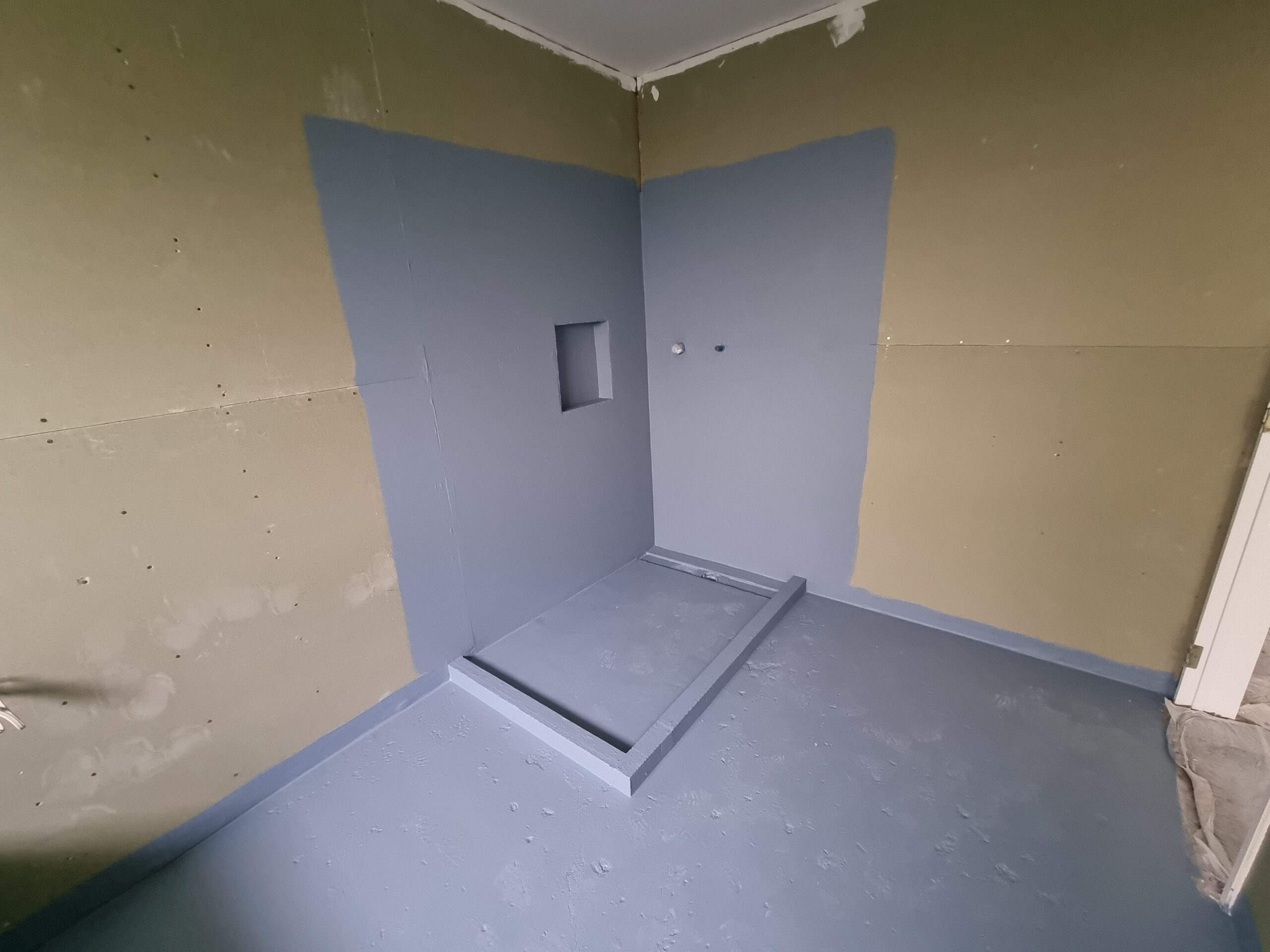
Here’s the part most homeowners never get told. The tiles are decoration. The thing keeping water out of your walls and floor is the waterproof membrane underneath them: a continuous waterproof layer applied to the surface before the tiles go on. Tiles and grout aren’t waterproof. Water gets through them. The membrane is the bucket that catches it and sends it to the drain.
The Building Code clause that governs it
Wet areas are covered by NZBC clause E3 Internal Moisture, the part of the Building Code that requires buildings to be built so they avoid fungal growth and excess moisture in spaces like bathrooms and laundries. The approved recipe for meeting it is E3/AS1, an “Acceptable Solution”, which simply means a deemed-to-comply method the council accepts without further proof. Sitting alongside it is AS/NZS 4858, the New Zealand and Australian standard for wet-area membranes, plus MBIE’s Code of Practice for Internal Wet-area Membrane Systems.
The detail in those documents is exactly why the council cares. A compliant shower membrane has to extend a set height up the walls in the shower area and turn up at the floor edges, lapped and sealed at every junction. The tiling itself sits outside the scope of that membrane standard, which confirms the point: the consented element is the hidden waterproofing, not the finish you actually see. You can read the clause direct from the source at building.govt.nz.
The ruling that settles the argument
If you ever want proof this isn’t just a cautious designer’s opinion, there’s a binding one. In Determination 2024/054 (a formal ruling MBIE issues to settle a consent dispute), the Ministry confirmed that installing the waterproof membrane under the tiled walls of a shower is “critical building work that requires building consent”. The case turned on exactly this question: were two tiled showers exempt, or did the membrane make them consented work? The answer was the latter. You can read it on building.govt.nz.
“People fixate on whether the tiles need a consent. They don’t. The tiles are the easy part. It’s the waterproofing behind them that the council inspects, because by the time you can see a leak under a tiled shower, the framing has been wet for months. That’s the whole reason E3 exists.”
— Sonder Architecture Team
This is the same logic that governs the outside of your house, just turned inward. We cover the external side of moisture in our guide to NZBC E2 external moisture for Auckland renovations. E2 keeps rain out of the walls; E3 keeps your shower water out of the floor. Same principle, different direction.
💡 Homeowner tip: Ask any quote you get a single question: “Does this price include a Building Code compliant E3 waterproof membrane, and the consent for it?” If the tiler shrugs, you’ve found the gap that turns into a leak, or a problem at resale.
Knowing the membrane is the trigger is half the battle. The other half is proving to the council it was done properly, which comes down to who applies it and what paperwork you get.
Getting the Waterproofing Signed Off: Approved Applicators, CodeMark and Producer Statements
Once your tiled shower is consented work, the council doesn’t just take your word that the membrane is sound. They inspect it, and they want evidence. The most important inspection of the whole bathroom is the pre-tile inspection, done after the waterproofing goes on but before a single tile is laid. Once it’s tiled, the membrane is hidden forever, so that’s the council’s one chance to check it.
Do you legally need an LBP to waterproof a shower?
Short answer: no, not for the membrane itself. Wet-area waterproofing isn’t classed as Restricted Building Work (RBW), the structural and weathertightness work that legally must be carried out or supervised by a Licensed Building Practitioner (LBP). RBW protects the structure and the external envelope of the house. Internal waterproofing falls outside it, so there’s no statutory “licensed waterproofer” the way there’s an LBP for structure.
That doesn’t mean anyone with a brush should do it. The smarter route is a manufacturer-trained applicator using a certified membrane system, because that’s what gives you a workmanship warranty and the documentation the council and your insurer will want.
What “approved applicator” actually means
Take ARDEX, the waterproofing system we specify on our projects. ARDEX runs an Approved Applicator programme: installers who’ve been trained and recertified every two years, and who can issue a workmanship warranty on the system. Several of their membranes, like the locally made WPM range, hold CodeMark certification, an independent building-product certification recognised under the Building Act 2004 that gives the council strong assurance the product meets the Code. Pairing a CodeMark-certified membrane with a trained applicator is about as clean as the evidence trail gets.
For consented work, that evidence often takes the form of a producer statement, specifically a PS3: a signed statement from the person who did the work confirming it was installed to the approved specification. One useful detail worth knowing is that the PS3 form itself comes from the council, not the product manufacturer. A good applicator will hand you a producer statement, a photo record of the membrane before tiling, and the product warranty. Keep all three with your property file.
This is the part where having your design, consent and build join up matters. Sonder Architecture handles the design and consent side as LBP Design Class architectural designers, and where you need the build delivered as well, our build partner Superior Renovations manages the waterproofing and tiling trades so the paperwork lands the way the council expects. End to end, under one roof.
💡 Homeowner tip: Don’t let anyone tile over the membrane until the council has done the pre-tile inspection. We’ve seen Grey Lynn renovations where an eager tiler covered the waterproofing the day before the inspector arrived, and the owner had to strip new tiles back off to prove the membrane underneath was right.
Important: Even when your bathroom work is exempt from building consent, plumbing and drainage work still needs its own sign-off. A registered plumber must issue a plumbing Certificate of Compliance for the work. Confirm what applies via MBIE’s exempt building work guidance or Auckland Council before you start.
All of this assumes you’re planning ahead. Plenty of people only think about consent after the tiles are already on. If that’s you, don’t panic. There’s a path back.
Already Tiled Your Shower Without Consent? The Certificate of Acceptance Path
Maybe a previous owner did it. Maybe you DIY’d a tiled shower years ago and only just found out it needed a consent. It’s far more common than you’d think. The fix is a Certificate of Acceptance (CoA), the document a council can issue for work that should have had a building consent but didn’t, confirming as far as they can tell that the completed work meets the Code.
Why a CoA costs more than the original consent would have
Here’s the catch that stings. With a normal consent, the council inspects the membrane before tiling. With a CoA, the work is already finished and the membrane is buried under tiles. So the council can require destructive testing: they may ask you to cut into the finished tiled shower to prove the waterproofing underneath was done correctly. That’s expensive, disruptive, and there’s no guarantee of the outcome. A CoA routinely costs more than doing the consent properly the first time, which is the whole argument for getting it right up front.
Where it really bites: selling your home
Unconsented work tends to stay quiet until you list the house. When you sell, the buyer’s lawyer orders a LIM (Land Information Memorandum), the council’s detailed report on a property covering zoning, consent history and known issues. A tiled shower that the property file knows nothing about shows up as a gap between what’s on record and what’s physically there. That gap can stall the sale, give buyers room to renegotiate, let a bank decline lending, or let an insurer decline a future water-damage claim.
Think of a 1980s brick-and-tile in Takapuna going to market with a beautifully retiled ensuite the council has never seen. Every buyer’s solicitor will flag it. We walk through the downstream version of this, finished work that never got signed off, in our guide on whether you can sell a house without a Code Compliance Certificate in NZ.
How seriously the rules treat tiled showers
Want a measure of how much weight the system puts on this? Look at the new granny flat rules. From 15 January 2026, you can build a standalone dwelling up to 70m² without a building consent, but the exemption specifically excludes a level-entry shower that needs a waterproof membrane. Of all the things they could have carved out of a consent-free dwelling, the membrane shower made the list. That’s no accident. We cover the full set of conditions in our guide to granny flat design in NZ.
Important: If you suspect a tiled shower in your home was done without consent, the worst time to find out is mid-sale. Order a LIM from Auckland Council early, and talk to a designer about whether a Certificate of Acceptance is the right move before you list.
💡 Homeowner tip: Buying a house with a recently renovated bathroom? Ask to see the consent and Code Compliance Certificate for it. No paperwork is a red flag worth raising before you go unconditional, not after.
So if you do need to do this properly, what does a consented tiled shower actually involve, in time and money?
Costs, Timeline and What a Consented Tiled Shower Involves
Once you know a consent is in play, the next two questions are always the same: how long, and how much. The honest answer is that the consent is rarely the expensive part. It’s the design, the build and the waiting that shape your project. The consent process is the predictable bit; it’s the rest of the job you need to plan around.
How long it takes
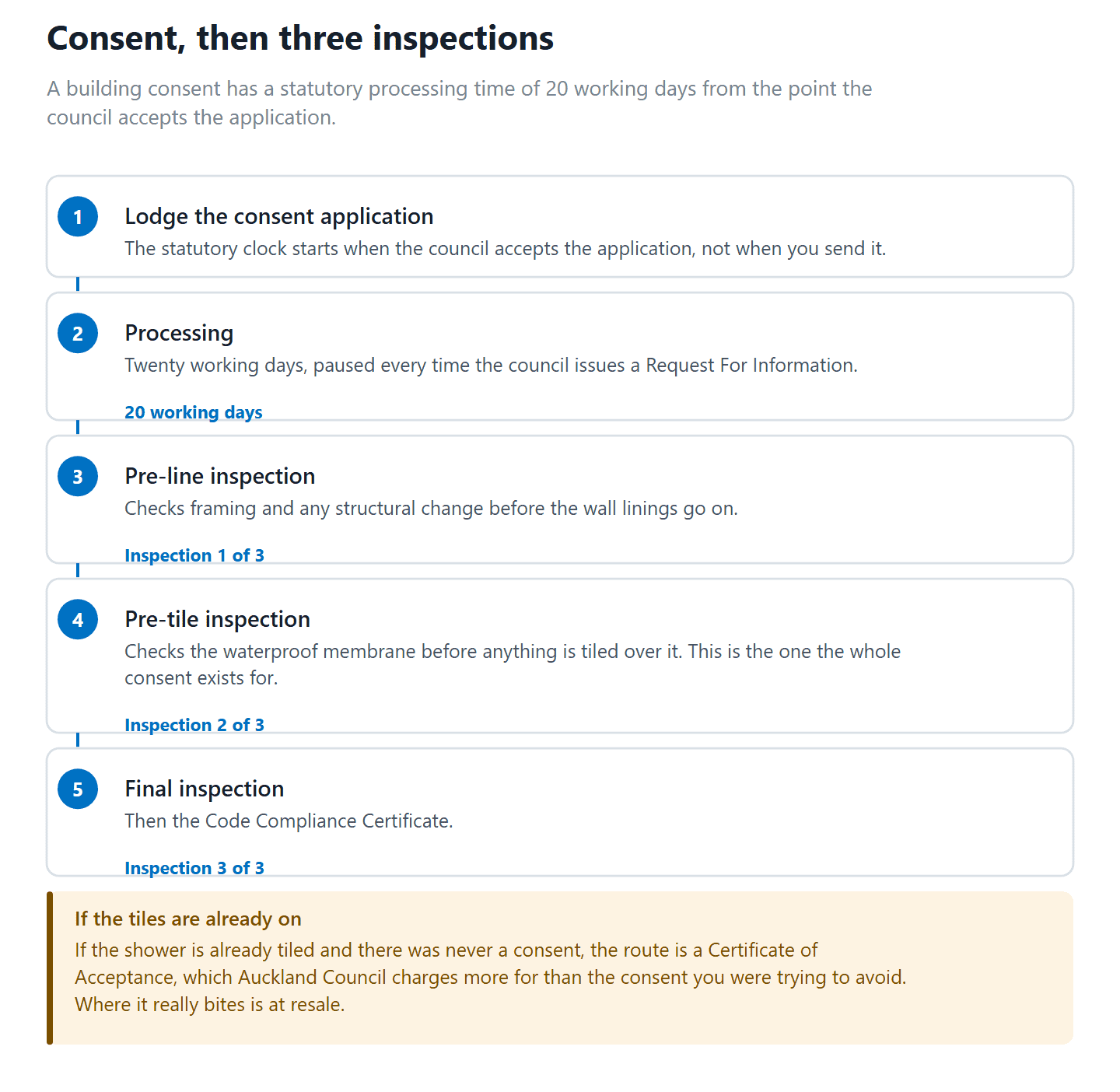
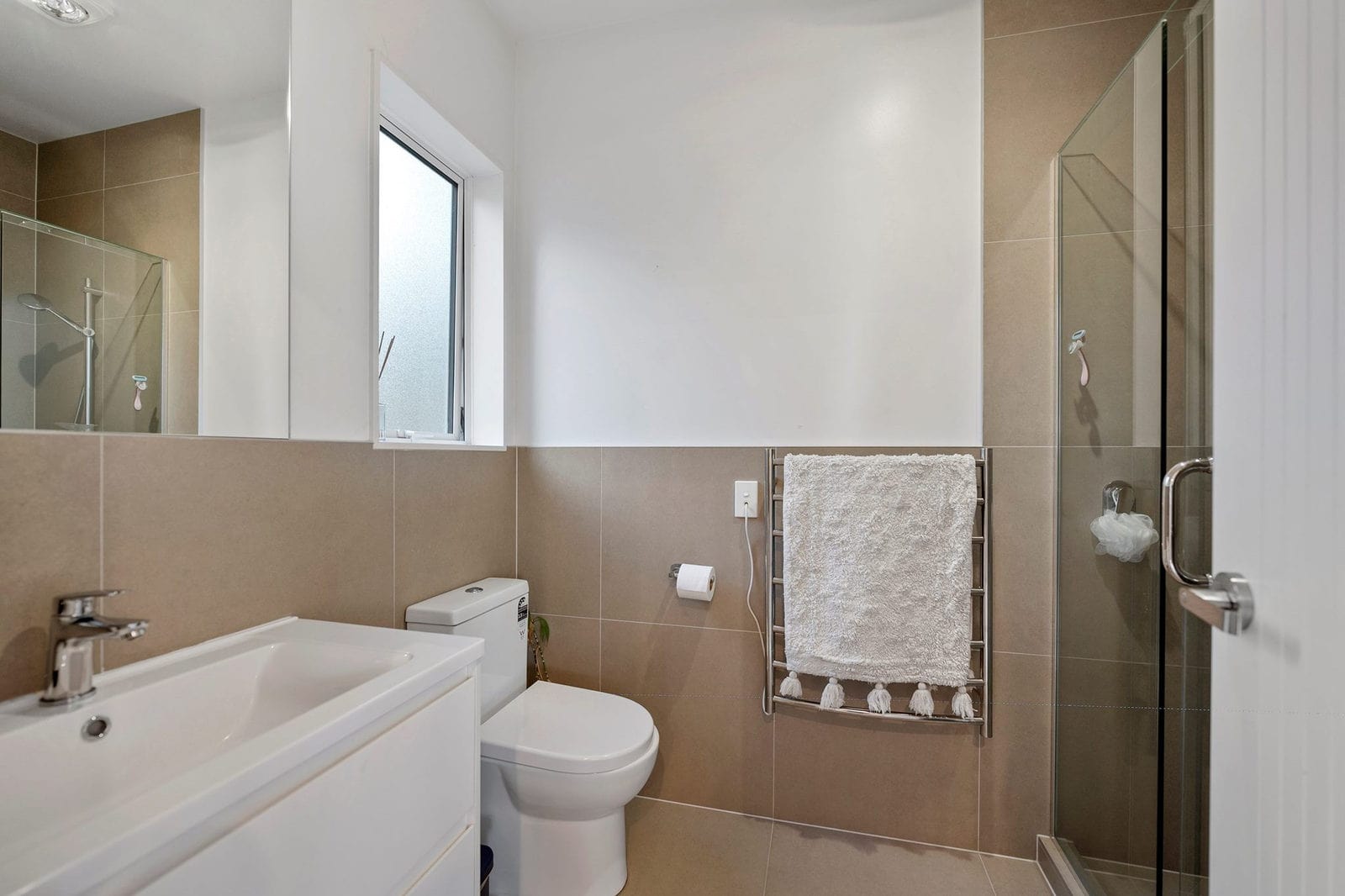
A building consent has a statutory processing time of 20 working days from the point the council accepts your application, which is the legal clock set out in Auckland Council’s building consent process guide. In practice, Auckland Council often runs longer than 20 days for residential work, and any Request for Information (RFI) stops the clock entirely. End to end, counting design, consent, build and final sign-off, a consented tiled-shower bathroom is realistically a several-month project, not a few weeks. Knowing that going in saves a lot of frustration.
What it costs
Auckland Council charges a building consent fee made up of a lodgement charge, a processing component and the cost of inspections. For a bathroom-scale project, that fee currently sits at roughly $3,005. On top of the council fee, the build cost of a fully tiled, consented bathroom runs well above a like-for-like prefab swap. A same-position acrylic shower swap is a fraction of the price and time of a new tiled wet area. As a guide, a consented tiled-shower bathroom renovation in Auckland typically lands around $30,000, depending on spec and the state of what’s behind the walls.
The inspection sequence
For a tiled-shower bathroom, expect the council out three times. A pre-line inspection checks framing and any structural change before the wall linings go on. The pre-tile inspection is the critical one, verifying the waterproof membrane coverage, laps and drain detail before tiling. The final inspection checks the fall to the drain, the seals at junctions and overall workmanship. Pass all three and the council issues your Code Compliance Certificate (CCC), the document confirming the finished work matches the consent and meets the Building Code. In a character home, say a villa in Ponsonby with original framing, budget extra contingency, because what’s behind the old linings has a habit of surprising everyone.
💡 Homeowner tip: If your only goal is a tidy, low-cost refresh and you’re happy with the shower where it is, a quality prefabricated unit avoids the membrane, the consent and the timeline altogether. Save the tiled walk-in for when you’re reworking the whole bathroom anyway.
None of this should put you off a tiled shower. They’re worth it, and done right they last decades. It just pays to know which side of the line you’re on before the tiler turns up.
Planning a Tiled Shower or Bathroom Renovation in Auckland?
The simplest way to avoid a nasty surprise is to find out where your project sits before you commit to anything. Is it a same-position swap that stays exempt, or a new tiled wet area that needs a consent and a properly documented membrane? That single answer changes your budget, your timeline and your paperwork, and it’s exactly what our free feasibility report is designed to tell you. We’ll look at your bathroom, your idea and your home, and tell you straight whether you need a consent and what the path looks like.
➡ Book a free consultation with Sonder Architecture
➡ Request your free feasibility report
➡ Read our full guide to building consent for renovations
➡ See recent projects we’ve done across Auckland
Does a tiled shower need building consent in NZ?
In most cases, yes. A new fully tiled wet-area shower needs a building consent because the waterproof membrane behind the tiles is consented work under the Building Act. The tiling itself isn't the trigger; the hidden membrane is. Replacing an existing shower unit like-for-like in the same position is usually exempt under Schedule 1. Confirm your specific plan with Auckland Council before you start.
Do I need consent to retile an existing shower?
It depends on whether you disturb the waterproof membrane. Re-tiling over a sound existing membrane in the same position can fall within the cosmetic exemption. But if the work involves installing a new membrane, which most genuine re-tiling jobs do because the old one is usually removed or compromised, you're back into consented work under NZBC E3. When in doubt, treat a new membrane as the trigger and check with the council.
Is replacing a shower like-for-like exempt from consent?
Generally yes. MBIE guidance confirms that altering existing sanitary fixtures like a shower is exempt as long as you don't add to the number of fixtures and don't affect a specified system. So swapping an old prefabricated shower for a new one in the same spot usually doesn't need consent. The exemption stops applying the moment you create a new tiled wet area needing a waterproof membrane, move the fixture, or add a new one.
Why does the waterproof membrane need consent but not the tiles?
Because tiles and grout aren't waterproof; water passes through them. The waterproof membrane underneath is what protects your framing and floor from rot. The Building Code clause E3 Internal Moisture treats that membrane as critical building work. The tiling is a finish applied over the top and sits outside the membrane standard. MBIE Determination 2024/054 confirmed the membrane under a tiled shower requires building consent.
What is NZBC E3 and how does it apply to my shower?
NZBC E3 Internal Moisture is the New Zealand Building Code clause requiring buildings to avoid fungal growth and excess moisture in wet spaces like bathrooms. For a tiled shower, it sets out how the waterproof membrane must be installed, including the height it extends up the shower walls and how it's lapped and sealed at junctions. The approved compliance method is E3/AS1, alongside the AS/NZS 4858 wet-area membrane standard.
Do I legally need an LBP to waterproof my shower?
Not for the membrane itself. Wet-area waterproofing isn't classed as Restricted Building Work, which is the structural and weathertightness work that legally requires a Licensed Building Practitioner (LBP). So there's no statutory licensed waterproofer. But best practice, and what protects your warranty and resale, is a manufacturer-trained approved applicator using a CodeMark-certified membrane system, with a producer statement and photo record handed over before tiling.
How much does building consent for a tiled shower cost in Auckland?
Auckland Council's building consent fee for a bathroom-scale project is made up of a lodgement charge, a processing component and inspection costs. The exact figure depends on the declared project value, so confirm it against Auckland Council's current fee schedule. The council fee is usually the smaller part of the total. The design, waterproofing and tiling of a consented tiled bathroom cost considerably more than a like-for-like prefabricated shower swap.
How long does consent take for a bathroom renovation?
The statutory processing time is 20 working days from when Auckland Council accepts your application. In practice the council often takes longer for residential work, and any Request for Information pauses the clock. Counting design, consent, the build and final sign-off, a consented tiled-shower bathroom is realistically a several-month project end to end, not a few weeks. Building that timeline into your planning avoids a lot of stress.
What happens if I tiled my shower without consent?
Building without a required consent is an offence under the Building Act, but the practical problem usually shows up at resale. The fix is to apply to the council for a Certificate of Acceptance (CoA). Because the membrane is already hidden under tiles, the council can require destructive testing, cutting into the finished shower to verify the waterproofing. A CoA commonly costs more than the original consent would have, which is why getting it right first is worth it.
What is a Certificate of Acceptance and how much does it cost?
A Certificate of Acceptance (CoA) is what a council can issue for work that should have had a building consent but didn't, confirming as far as they can establish that the finished work meets the Building Code. For a tiled shower, the council may need destructive testing to inspect the buried membrane, which makes it expensive and uncertain. Costs vary with the work involved, so talk to your council and a designer before applying. It routinely exceeds the original consent cost.
Does a level-entry shower in a granny flat need consent?
It can change the picture significantly. From 15 January 2026, a standalone dwelling up to 70m² can be built without a building consent under Schedule 1, but the exemption specifically excludes a level-entry shower that needs a waterproof membrane. Include one and the exemption no longer applies, meaning the whole build needs a full consent. It's a clear signal of how seriously the rules treat waterproofed showers. Check the full conditions before you design.
Do I still need a plumbing certificate if my bathroom work is consent-exempt?
Yes. Even when your bathroom work is exempt from building consent, plumbing and drainage work must be done by a registered plumber, who issues a plumbing Certificate of Compliance for it. Building consent and plumbing sign-off are separate things. Many homeowners overlook the plumbing certificate because they're focused on the building consent question. Keep both records with your property file for when you eventually sell.