
Last updated:
Quick answer: Connecting a new dwelling to Auckland’s water and wastewater network costs far more than the connection itself. The Watercare connection cost for a metropolitan Auckland home is $29,348.46 including GST in infrastructure growth charge alone, plus meter and connection fees, and it sits completely outside your building consent.
Most Auckland homeowners plan a project around two numbers: the build cost and the building consent. Then, somewhere between concept drawings and breaking ground, a third number lands. It arrives as a Watercare invoice, it has five figures in it, and nobody warned them it existed.
That number is the infrastructure growth charge, a one-off fee for connecting a new home to the water and wastewater network. On 1 July 2026 it went up 20 per cent.
Here is the structural problem: Auckland runs your project through two organisations that do not share an application, a timeline or a decision. Auckland Council handles resource consent, which is permission to use your land in a particular way, and building consent, which is permission for the construction work itself. Watercare, the council-owned company that runs the region’s water and wastewater networks, handles connections, capacity and anything built near its pipes. A granny flat can be fully exempt from building consent and still need three separate approvals from Watercare. A perfectly consented extension can be stopped because it sits over a public sewer.
We are Sonder Architecture, an Auckland studio and the design arm of Superior Renovations. Our team holds LBP Design Class credentials, meaning Licensed Building Practitioner qualified to design and document Restricted Building Work, the structural work the council requires a licensed person to sign off. Servicing is one of the first things we test on a site, because it is one of the few constraints that can make an otherwise sound project stop dead.
This guide sets out what Watercare actually charges, how the connection application runs, where in Auckland the network will not take another house, and the approval most homeowners have never heard of until a drainlayer mentions it.
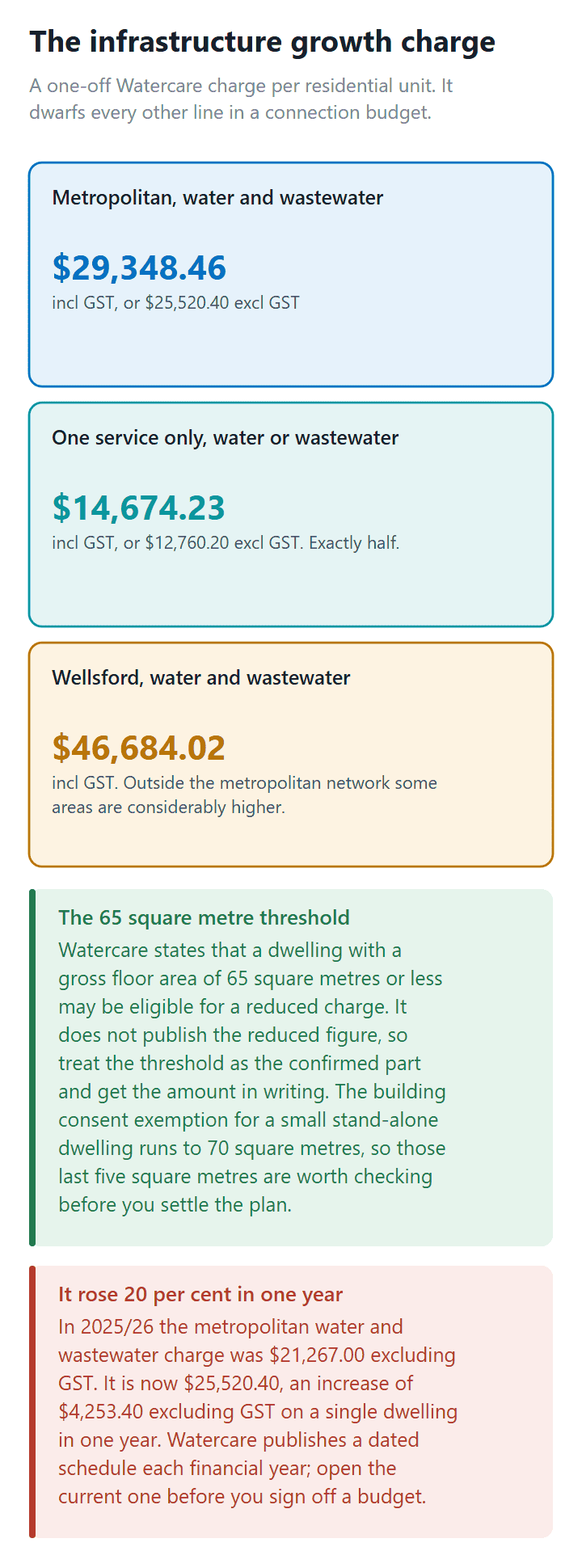
The Infrastructure Growth Charge: The Watercare Bill Nobody Budgets For
Start with the big one, because it dwarfs everything else in this article. The infrastructure growth charge, usually shortened to IGC, is a one-off charge Watercare applies when a new dwelling connects to its networks, or when an existing connection increases how much it uses. It does not pay for your pipe, your meter or your drainlayer. It pays for the trunk network behind them: the large mains, pump stations, reservoirs and treatment plants that have to grow as Auckland does.
What a metropolitan Auckland dwelling pays right now
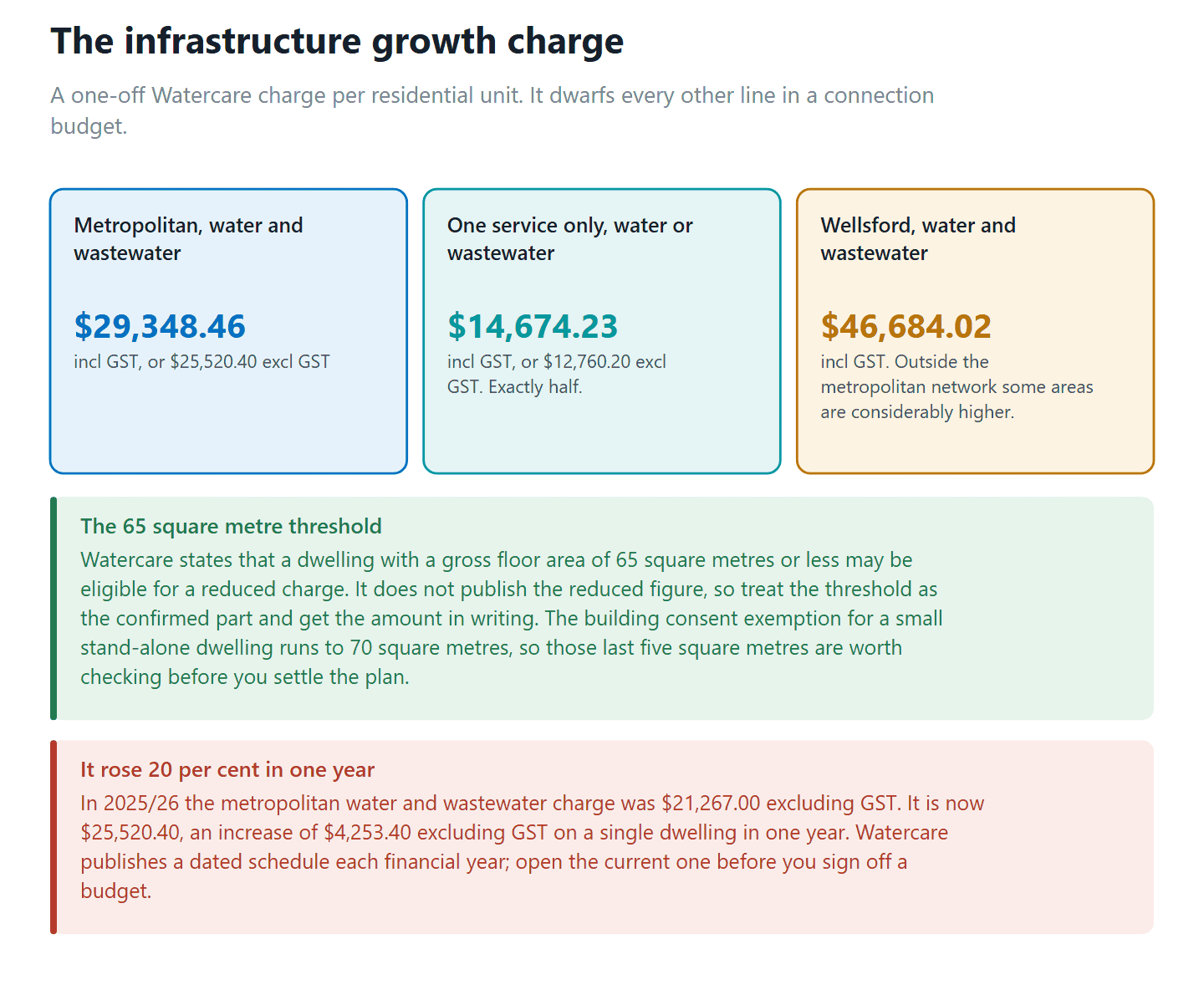
For a new residential unit in Watercare’s metropolitan area needing both water and wastewater, the IGC is $25,520.40 excluding GST, or $29,348.46 including GST. That is per residential unit, so a minor dwelling, meaning a self-contained second home on the same section, is charged as its own unit even when it sits behind an existing house. The figures took effect on 1 July 2026 and are published in Watercare’s own schedule of charges.
If you only need one of the two services, you pay half: a water-only or wastewater-only IGC is $12,760.20 excluding GST, or $14,674.23 including GST. This matters more often than you would think, and we come back to it below.
The metropolitan area is broader than the word suggests. Watercare defines it as properties supplied by its connected water supply system or served by the wastewater treatment plants at Māngere, Rosedale, Army Bay or Pukekohe, and it specifically includes the Hibiscus Coast, Kumeu, Huapai, Riverhead, Paerata, Clevedon and Pukekohe. So a new home in Riverhead pays the same IGC as one in Remuera.
Outside that network, some areas are considerably higher. A new water and wastewater connection in Wellsford carries an IGC of $46,684.02 including GST. In the southwest sub-regional area of Franklin, where the property drains to a treatment plant other than Pukekohe or Māngere, it is $47,121.48 including GST.
The 65 square metre discount most people never hear about
Buried in Watercare’s fees page is a line that should change how small second dwellings get designed in Auckland. Watercare states that if a dwelling has a gross floor area of 65 square metres or less, you may be eligible for a reduced infrastructure growth charge. Gross floor area is the total floor area measured to the outside of the external walls.
Watercare does not publish the reduced figure in its schedule of charges, so treat the threshold as the confirmed part and the amount as something to get in writing for your own project. But the threshold alone is worth designing around.
Now hold that number against the building consent exemption. The consent exemption for a small stand-alone dwelling runs up to 70 square metres. Watercare’s reduced rate cuts off at 65. The two systems set their thresholds five square metres apart, and nothing tells you that when you are drawing. A granny flat at 68 square metres is still consent-exempt and has quietly moved out of the reduced IGC band. One at 64 keeps both.
💡 Homeowner tip: If your second dwelling is landing anywhere between 65 and 70 square metres, get the reduced-rate figure from Watercare before you settle the plan. Those last five square metres may be the most expensive on the drawing.
It rose 20 per cent in one year
In the 2025/26 year the metropolitan water and wastewater IGC was $21,267.00 excluding GST. It is now $25,520.40. That is an increase of $4,253.40 excluding GST on a single dwelling, in twelve months.
The practical consequence is about timing. If you are weighing up a minor dwelling or a second house on your section and the decision has been drifting for a year, the drift has a price now. It also means any cost estimate you were given before July is out of date on this line item, and you should ask whoever prepared it to reissue rather than assume the gap is small.
💡 Homeowner tip: Watercare publishes its charges as a dated schedule each financial year. Before you sign off a budget, open the current one and check the IGC line yourself. It takes two minutes and it is the single largest fee in this whole article.
The IGC is not the council’s development contribution
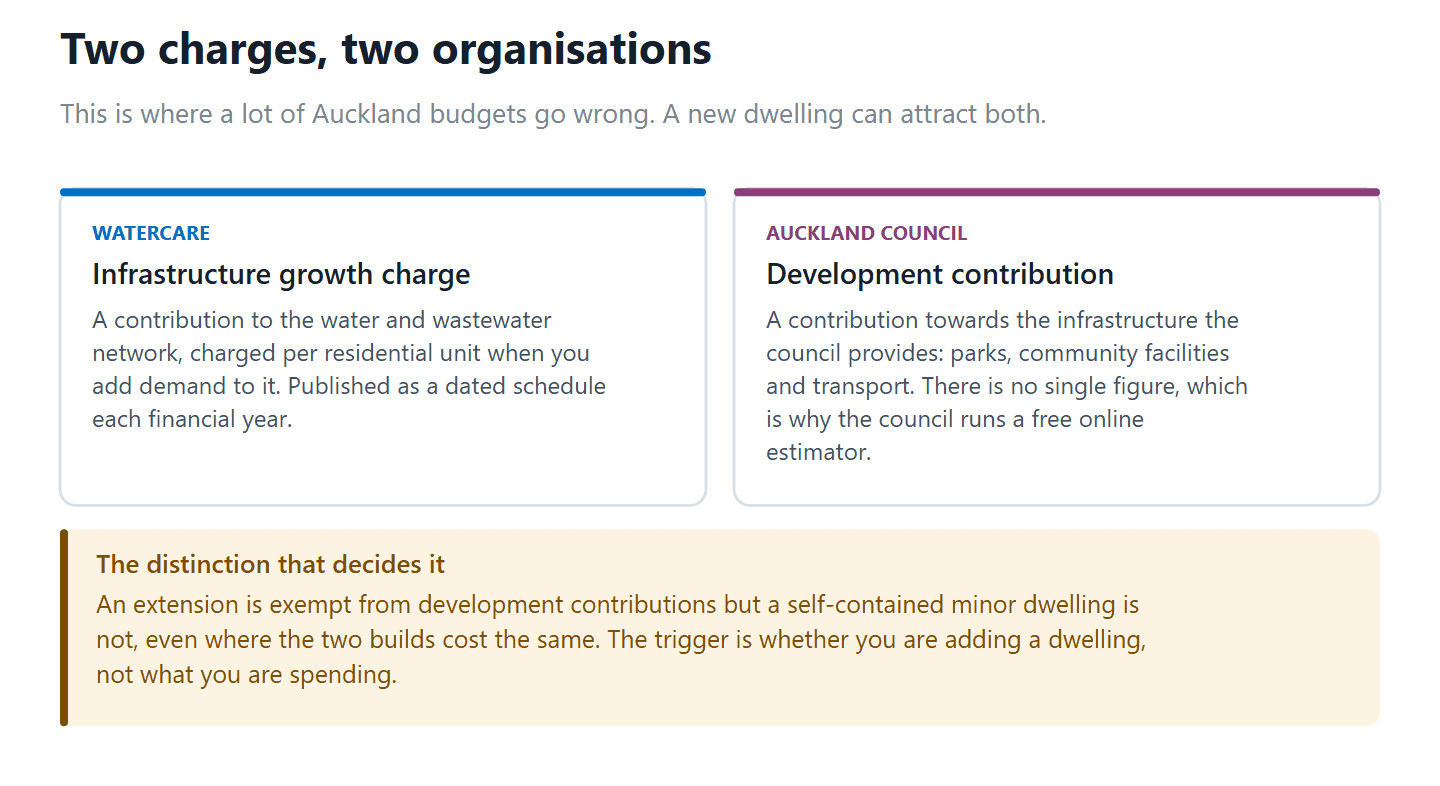
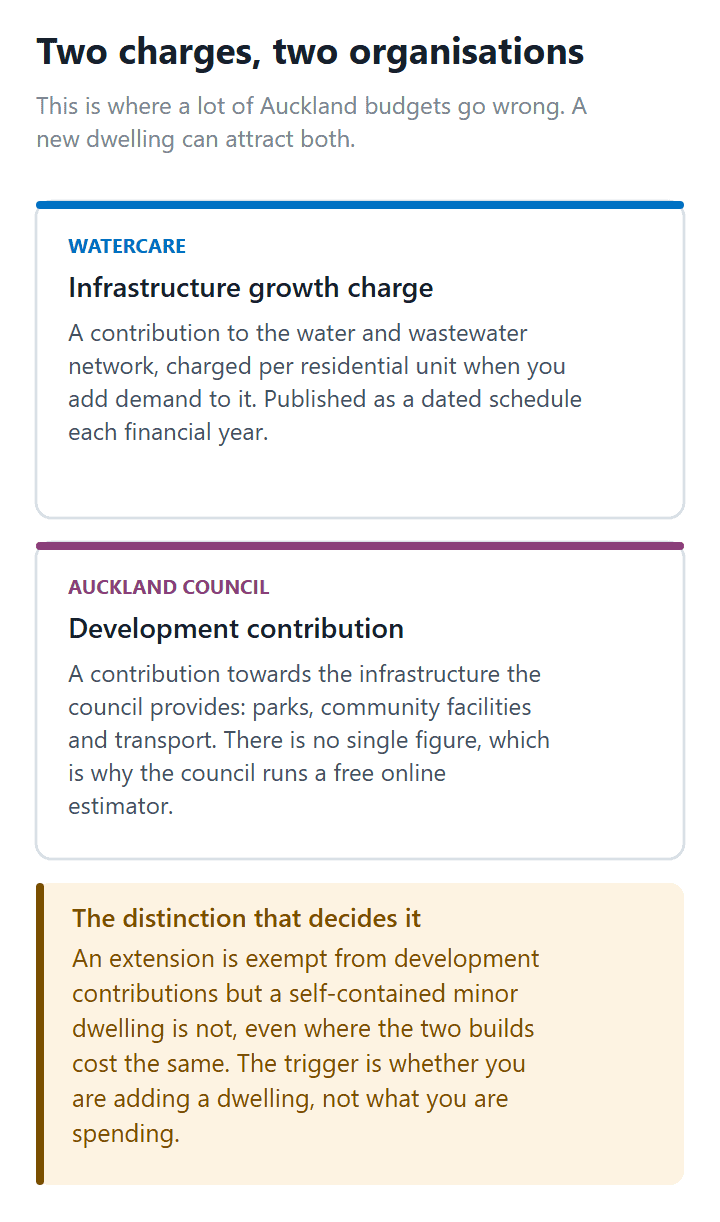
This is where a lot of Auckland budgets go wrong. The IGC and Auckland Council’s development contribution are two different charges, from two different organisations, and a new dwelling can attract both.
A development contribution is Auckland Council’s charge towards the infrastructure it provides, things like parks, community facilities and transport. Auckland Council confirms that development contributions apply to new houses, granny flats and minor units, while house extensions are exempt. The schedule sits in the council’s Development Contributions Policy 2025, charges rise 2 per cent each year from 1 July 2026, and the amount depends on your location and the size of the unit.
We are not going to quote you a single development contribution figure, because there is no single figure. Auckland Council runs a free online estimator for exactly this reason, and you should use it with your actual address and floor area rather than trusting a range you read somewhere.
Important: An extension is exempt from development contributions but a self-contained minor dwelling is not, even if the two builds cost the same. The trigger is whether you are adding a household, not whether you are adding floor area. Check your project against Auckland Council’s development contributions page before you commit to a layout.
Meters, Pipes and Processing: The Rest of the Watercare Connection Cost
The IGC buys you the right to connect. It does not buy the connection. Those are separate line items, they are all published, and together they add well over a thousand dollars to a straightforward job and a great deal more to an awkward one.
The water side
A water meter is the device that measures your supply and marks the boundary between Watercare’s network and your private pipework. A service lead is the small pipe running from the main in the street to that meter. What you pay depends on whether a service lead already exists.
| Watercare charge (residential, from 1 July 2026) | Excluding GST | Including GST |
|---|---|---|
| 20mm water meter onto an existing service lead, installed | $859.74 | $988.71 |
| 20mm water meter and new service lead, installed | $1,778.45 | $2,045.22 |
| 20mm meter, backflow prevention device and new service lead | $2,298.37 | $2,643.12 |
| Meter relocation, 15 to 25mm, within two metres of the existing lead | $561.73 | $645.99 |
| Meter disconnection, 15 to 25mm | $593.89 | $682.97 |
| Application processing and site inspection, per hour, one hour minimum | $200.46 to $225.12 | $230.53 to $258.89 |
The processing fee is charged on top of everything else in that table, at a technician rate of $230.53 including GST per hour or an engineer rate of $258.89, with a one hour minimum. A backflow prevention device is a valve stopping water flowing back from your property into the public main, and Watercare requires one on certain installations, including irrigation meters.
Anything unusual is priced on application rather than listed. Watercare names the common triggers: a road crossing, traffic management, arborist work, other utility services in the way, or above-ground structures blocking access. If your meter position needs the footpath or berm opened on a busy road, expect the quote rather than the schedule.
The wastewater side
Wastewater is charged differently. Approval to access or connect to the live wastewater network is $258.89 including GST. A CCTV inspection of the wastewater line, meaning a camera survey of the pipe’s internal condition, is $634.89 including GST per inspection.
Then there is a line that catches people badly. Where a pit connection is required, the fee is $23,569.90 including GST per development unit for one or two connections, with three or more priced on application. A pit connection is used where the site cannot connect by the normal method and Watercare has to open and reconnect into a structure on its network. It is not the standard residential path, but it is not rare either, and finding out about it late is the difference between a project proceeding and a project being reconsidered.
Extending the public network to reach your site is priced on application as well. If the nearest main stops short of your frontage, that extension is on you.
💡 Homeowner tip: Ask your drainlayer to confirm the connection method before the design is finalised, not after consent. A standard connection into a gravity sewer, meaning one that carries flow downhill without pumping, and a pit connection are the same drawing to you, and roughly $23,000 apart on the invoice.
How the Connection Application Actually Runs
Watercare’s residential connection process is published step by step, and it is worth reading in that order because the sequence explains why servicing so often becomes the critical path on an Auckland job.
What you have to have ready
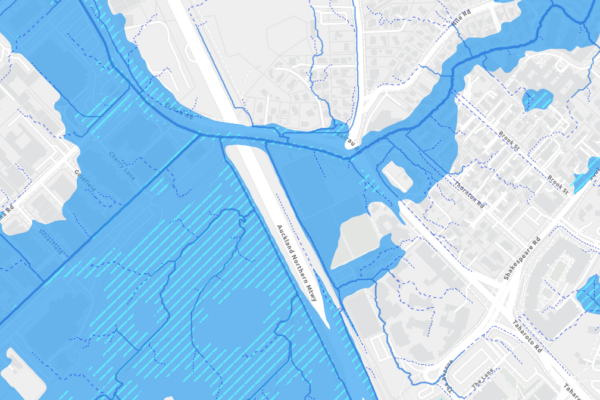
Before applying, check whether the pipes even reach you. Watercare’s mapping tool shows water lines in blue and wastewater lines in red, and it is free.
Then the paperwork. Watercare asks for the legal property address matching Auckland Council’s numbering standards, the Lot and Deposited Plan numbers, which identify your section on the survey plan it was created from, the Certificate of Title number, which is the official record of who owns the land, owner and on-site contact details, your Auckland Council consent numbers, and stamped approved Auckland Council site and drainage plans showing the proposed water meter position and the wastewater connection point. You also need to declare any development contributions already paid, and flag known obstructions such as power cables, trees or road restrictions.
Read that list again and notice the dependency. The application wants stamped council plans, which means your building consent generally has to be granted before Watercare can process the connection. That is a sequence, not a parallel process, and it is why servicing is a programme item rather than an afterthought.
The timeline, on Watercare’s own numbers
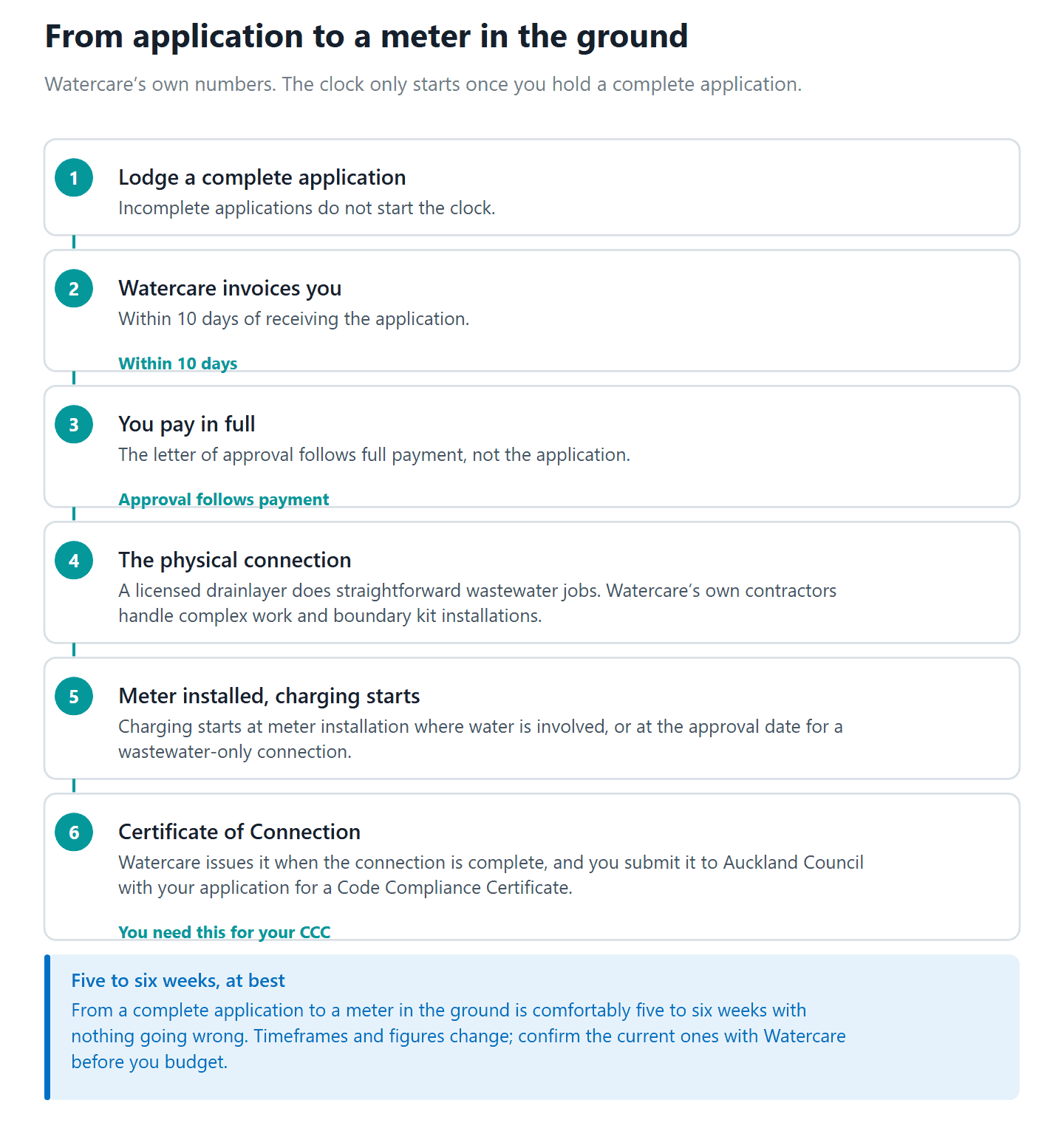
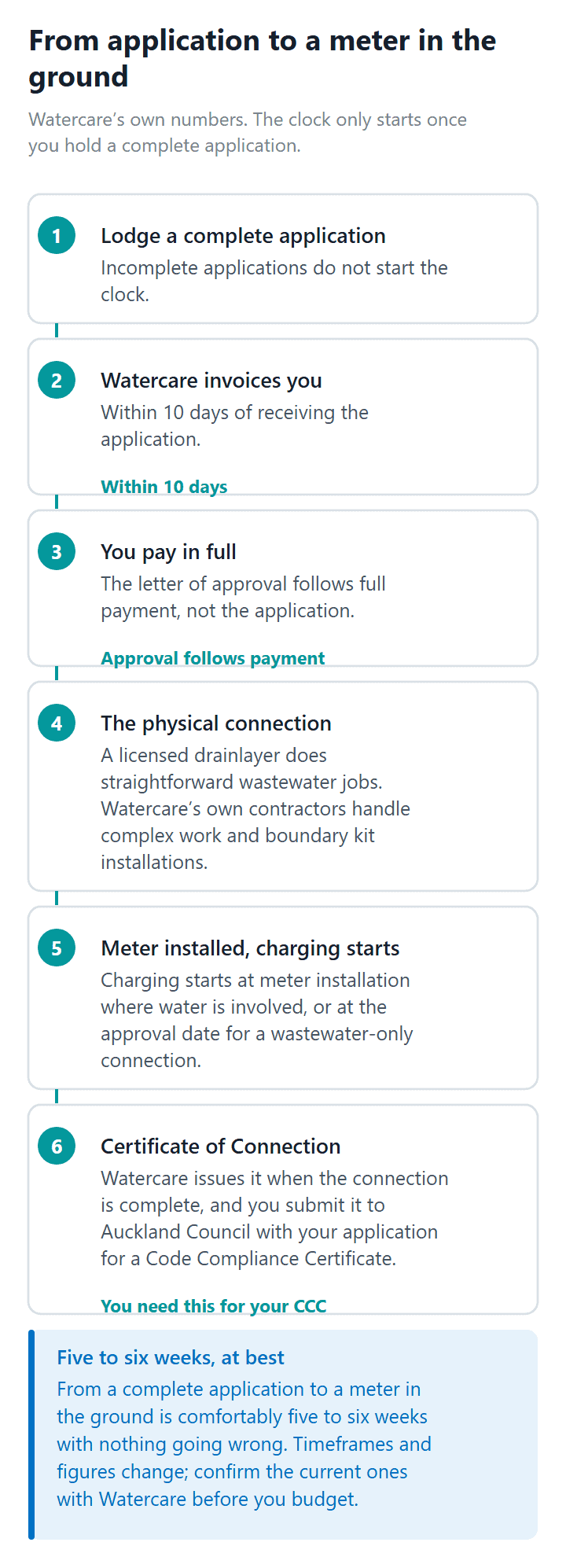
Watercare issues an invoice within 10 days of receiving the application. The letter of approval follows full payment, not the application. The water meter is then installed, or the wastewater connection plans approved, approximately 15 working days after your payment date, and Watercare notes that traffic management can push that out.
Add it up honestly. From a complete application to a meter in the ground is comfortably five to six weeks with nothing going wrong, and the clock only starts once you hold stamped consent drawings. If you are also building near a Watercare pipe, there is another 20 working day approval running alongside it, which we cover in the next section.
Who does the physical work, and the certificate you need at the end
For straightforward wastewater jobs, a licensed drainlayer does the connection. Watercare’s own contractors handle complex work and boundary kit installations. On the water side, Watercare installs the meter.
When the connection is complete, Watercare issues a Certificate of Connection, and you submit it to Auckland Council with your application for a Code Compliance Certificate. A Code Compliance Certificate, or CCC, is the document the council issues when it confirms your finished building meets the Building Code. Which means a missing or delayed Certificate of Connection does not just annoy your drainlayer. It sits directly in the path of the certificate that makes your build lawfully complete, and the consequences of not having one are covered in our guide to selling a house without a CCC.
Charging for the service starts at meter installation where water is involved, or at the approval date for a wastewater-only connection. So a wastewater connection begins costing you from approval, whether or not anyone has moved in.
When the Network Says No: Capacity Limits Across Auckland
Everything above assumes Watercare will connect you. In parts of Auckland, it will not, and that is a design constraint rather than a fee.
Four places where new connections have stopped
Watercare states plainly in its published charges that no further connections are available in Bombay, Kingseat, Muriwai and Waiwera. That wording has appeared in consecutive years of the schedule, so it is a settled position rather than a temporary outage.
It also warns more generally that there are capacity limitations on parts of both the water and wastewater networks and that connections are not always available. There is no map of that. It is a site-by-site enquiry, and the answer can change as the network is upgraded.
If you are considering buying a section in one of those areas with a build in mind, or adding a second dwelling somewhere the network is tight, this is the first question to ask and the cheapest one to get wrong. Across the central Auckland isthmus in particular, where much of the older network carries stormwater and wastewater in the same pipe, capacity is a genuine feasibility question and not a formality.
The half-price consequence of an unavailable connection
There is a specific rule worth knowing. Watercare charges a water-only IGC where a customer already has a wastewater connection and will not increase demand on the wastewater network, or where a wastewater connection is unavailable.
So a project that cannot get wastewater, and deals with it on site instead, pays $14,674.23 including GST rather than $29,348.46. That is not a loophole to chase. An on-site wastewater system, meaning a septic tank or similar treatment system that discharges into your own land, has its own consent path, its own maintenance obligations and its own land area requirements. On a small urban section it is usually not viable. On a larger site at Auckland’s edges it can be the difference between a project that works and one that does not.
Pressurised wastewater areas and the boundary kit
Some parts of Auckland do not have a gravity sewer at all. In pressurised wastewater areas, each property has a pump and a boundary kit, which is the assembly connecting your private system to the pressurised main.
Watercare identifies Kumeu, Huapai, Riverhead, South Glenbrook and parts of Waiuku as pressurised areas where a boundary kit is required, and its own contractors install those rather than your drainlayer. The kit is priced on application. If you are designing a new home in Huapai or a minor dwelling in Riverhead, this changes both your budget and who does the work.
One more detail that matters for minor dwellings specifically. Where a property connects through an existing private drain, which is the usual arrangement for a granny flat behind an existing house, Watercare needs approved drainage documentation showing the existing connection point. If your property file is thin on drainage, that documentation has to be produced before the application can proceed. Our guide to the minor dwelling rules that apply in Auckland covers where those units can sit on a section.
Important: Servicing availability is not part of your building consent assessment. Auckland Council can grant consent for a dwelling that Watercare will not connect. Confirm capacity with Watercare’s connections team before you spend money on design.
Building Over or Near a Public Pipe: The Approval Most People Miss
Here is the one that stops extensions. If your work is over or near a public water, wastewater or stormwater pipe, you need Works Over approval from Watercare. It is a separate application from your connection, and separate again from your council consent.
What Watercare wants to see
The application is technical, and it tells you how seriously Watercare treats it. You need a foundation plan showing the whole proposed development in relation to its pipes and every Watercare asset on the site. You need cross sections showing bridging details and the actual vertical and horizontal clearances, including the 45 degree line of influence taken from a point 500 millimetres below the bottom of the affected pipe. That line is the zone where your foundation loads could bear on the pipe, and it is why a deep pile near a sewer is a different conversation from a shallow slab.
You also need a pre-construction CCTV inspection and a current permit to access the wastewater network, neither older than six months, plus the pipe size and invert level. The invert level is the height of the inside bottom of the pipe, and it is what determines whether your drainage can fall into it at all.
Watercare says Works Over applications are typically processed within 20 working days once all required information has been received. That last clause does the work. An incomplete application restarts the wait.
Two answers that change the project
The first is a flat no. Watercare will not permit building over a water main or a wastewater pressure pipe. The pipe has to be relocated, at your cost, and the relocation itself needs approval before it starts. On a narrow site in Grey Lynn or Kingsland, where a main can run through the only realistic extension zone, that is a design decision made for you.
The second is a condition. If the CCTV survey shows the pipe under your build is damaged or in poor condition, Works Over approval comes with a requirement to repair it, at your expense. You inherit the cost of a public pipe’s condition because you chose to build over it. That is a real risk on the older parts of the network across the central suburbs, and it is an argument for finding out early.
💡 Homeowner tip: Order the CCTV inspection while you are still testing footprint options, not after the plans are drawn. For roughly $635 you find out whether the pipe under your preferred extension zone is sound, and whether that zone is viable at all.
“Servicing is the constraint people discover last and should check first. A pipe position, a capacity limit or a pressurised network changes the footprint, and footprint is the cheapest thing to change at concept stage and the most expensive thing to change after consent.”
— Sonder Architecture Team
What This Means for a Consent-Exempt Granny Flat
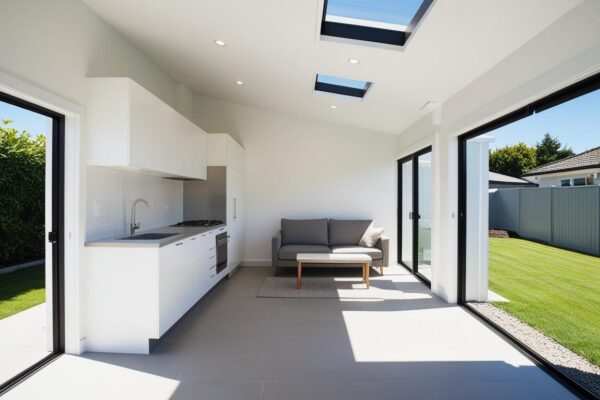
Since 15 January 2026, a qualifying small stand-alone dwelling can be built in Auckland without a building consent. That exemption has been read far too broadly, and water is where the misunderstanding bites.
Exempt from consent is not exempt from Watercare
Auckland Council’s own criteria for the exemption require that the dwelling has connections to the public stormwater and wastewater network, or a compliant on-site water and drainage system. The council then states directly that you must get approval for connections to network utilities, naming water and electricity supply and stormwater and wastewater disposal.
So the exemption removes a building consent. It does not remove the connection application, the meter fee, the wastewater access approval or the infrastructure growth charge. A granny flat in Papakura is a new residential unit as far as Watercare is concerned, and it is charged as one, consent or no consent. Keeping it to 65 square metres of gross floor area or less is what may reduce that charge, not the consent exemption.
The council step that still applies
The exemption is also not paperwork-free on the council side. Auckland Council requires you to apply for and receive a Project Information Memorandum before construction starts, submitted to a dedicated granny flat exemption address with forms 2A and 2AA, plans, the location and external dimensions of the building, and how you will deal with stormwater and wastewater. A Project Information Memorandum, or PIM, is a council report on what is officially recorded about your property and what your project will need. The base fee is $537 and it is not refundable.
Auckland Council also notes that the PIM process may attract a development contribution. Which brings the total picture for an exempt granny flat in metropolitan Auckland to: no building consent, a $537 PIM, a likely development contribution, an IGC of $29,348.46 if it needs both services and exceeds 65 square metres, and the full connection process described above.
Design decisions follow from that. Where the unit sits relative to the existing drainage, whether it can share a connection point, and whether it needs its own meter are all worth resolving at concept stage. Our guides to designing a granny flat in New Zealand and what you can build without a building consent cover the rest of the exemption criteria. If your plans run to subdividing rather than a second dwelling, Superior Homes covers the cost of subdividing land in Auckland from the development side, and Superior Renovations handles the drainage and groundwork on the build itself.
Check the Water Before You Draw the House
Servicing is not a detail that gets sorted during construction. It is a constraint with a five-figure price tag, a five-week minimum lead time, a capacity answer that can be no, and a pipe position that can dictate your footprint.
The order that saves money is straightforward. Check the network maps and confirm capacity for your address. Get the IGC and development contribution figures for your actual site rather than a range. Find out whether a public pipe crosses the part of the section you want to build on, and get it surveyed if it does. Only then lock the footprint and start the drawings.
That sequence is how we check what services a site can actually get before design starts, and it is why the servicing question sits in our feasibility work rather than turning up as a surprise at consent. If you would like the consent side of the picture as well, our breakdown of what a building consent costs in Auckland covers the council fees that run alongside all of this.
➡ Book a free consultation with Sonder Architecture
➡ Request your free feasibility report
➡ Read the Auckland minor dwelling rules
➡ See recent projects we’ve done across Auckland
The largest component is the infrastructure growth charge. For a new residential unit in Watercare's metropolitan area needing water and wastewater it is $25,520.40 excluding GST, or $29,348.46 including GST, effective 1 July 2026. On top of that sit connection fees: a 20mm water meter on an existing service lead is $988.71 including GST, a meter with a new service lead is $2,045.22, and approval to connect to the live wastewater network is $258.89. A processing and inspection fee of $230.53 to $258.89 per hour applies as well. It is a one-off charge Watercare applies when a new development connects to its water and wastewater networks, or when an existing connection increases its demand. It funds the trunk infrastructure that supports growth: large mains, pump stations, reservoirs and treatment plants. It is charged per residential unit, so a minor dwelling behind an existing house is charged as its own unit. It is separate from Auckland Council's development contribution, and a new dwelling can attract both. Yes. The metropolitan water and wastewater infrastructure growth charge was $21,267.00 excluding GST in the 2025/26 year and is $25,520.40 excluding GST from 1 July 2026. That is an increase of $4,253.40 excluding GST per dwelling, or 20 per cent, in a single year. Any project estimate prepared before July 2026 understates this line item, so it is worth asking for the figure to be reissued rather than assuming the difference is minor. Yes, if it needs a new connection or increases demand on the network. The 15 January 2026 exemption removes the building consent requirement for a qualifying small stand-alone dwelling, but it does not remove Watercare's charges or its connection process. Auckland Council's own exemption criteria require the dwelling to be connected to the public stormwater and wastewater network or to have a compliant on-site system, and the council states you must get approval for connections to network utilities. Watercare issues an invoice within 10 days of receiving your application, and the water meter is installed or the wastewater connection plans approved approximately 15 working days after your payment date. Traffic management can extend that. Because the application requires stamped approved Auckland Council site and drainage plans, the clock generally cannot start until your building consent is granted, so allow five to six weeks after consent as a realistic minimum. Yes. Watercare's published schedule of charges states that no further connections are available in Bombay, Kingseat, Muriwai and Waiwera. It also warns that there are capacity limitations on parts of both the water and wastewater networks and that connections are not always available, which is a site-specific enquiry rather than a mapped list. Auckland Council can grant building consent for a dwelling Watercare will not connect, so confirm servicing before you spend on design. Yes. Works Over approval from Watercare is required where work is over or near a public water, wastewater or stormwater pipe, and it is a separate application from your council consent and your connection. Watercare typically processes it within 20 working days once all required information is received. It will not permit building over a water main or a wastewater pressure pipe at all, in which case the pipe must be relocated at your cost with approval obtained before the relocation starts. Works Over approval requires a pre-construction CCTV inspection, a camera survey of the pipe's internal condition, no more than six months old. If that survey shows the pipe is damaged or in poor condition, Watercare's approval comes with conditions requiring the remedial work, at the applicant's expense. On the older parts of Auckland's network this is a genuine risk, which is an argument for inspecting the pipe while you are still choosing between footprint options rather than after the plans are drawn. A boundary kit is the assembly that connects your private wastewater system to a pressurised main in areas without a gravity sewer. Watercare identifies Kumeu, Huapai, Riverhead, South Glenbrook and parts of Waiuku as pressurised areas where a boundary kit is required, and its own contractors install it rather than your drainlayer. The kit is priced on application rather than published, so get a figure early if you are building in one of those areas. No, they are two different charges from two different organisations. Watercare's infrastructure growth charge covers water and wastewater trunk infrastructure. Auckland Council's development contribution covers council infrastructure such as parks, community facilities and transport. Auckland Council confirms development contributions apply to new houses, granny flats and minor units, while house extensions are exempt. The amount depends on location and unit size, and the council provides a free online estimator. Yes. When your connection is complete, Watercare issues a Certificate of Connection, and you submit it to Auckland Council with your application for a Code Compliance Certificate, the document confirming your finished building meets the Building Code. A delayed connection therefore delays the certificate that makes your build lawfully complete, which is why servicing belongs in your programme rather than being treated as a final tidy-up item. Possibly. Watercare states that if a dwelling has a gross floor area of 65 square metres or less, you may be eligible for a reduced infrastructure growth charge. It does not publish the reduced amount in its schedule of charges, so get the figure in writing for your own project. Note the mismatch with the building consent exemption, which runs up to 70 square metres. A dwelling at 68 square metres is still consent-exempt but has moved out of the reduced charge band, so those last five square metres can be expensive.
How much does a Watercare connection cost in Auckland?
What is the Watercare infrastructure growth charge?
Did the Watercare IGC go up in 2026?
Do I pay the infrastructure growth charge on a granny flat?
How long does a Watercare connection take?
Are there parts of Auckland where Watercare will not connect a new house?
Do I need approval to build over a public wastewater pipe?
What happens if the pipe under my extension is in poor condition?
What is a boundary kit and do I need one?
Is the Watercare charge the same as an Auckland Council development contribution?
Do I need a Watercare certificate to get my Code Compliance Certificate?
Is there a cheaper Watercare charge for a small granny flat?
References
- Watercare — Water, wastewater, infrastructure growth charges and other charges 2026/2027
- Watercare — Residential charges and other charges 2025/2026
- Watercare — Infrastructure growth charge
- Watercare — Apply for a residential connection
- Watercare — Apply for Works Over approval
- Watercare — Fees and charges
- Auckland Council — Development contributions
- Auckland Council — Development Contributions Policy 2025
- Auckland Council — Granny flats building consent exemption