Last updated:
Quick answer: Most trees on an ordinary Auckland residential section are not protected, and you can remove them without resource consent. Protection now comes from five specific things — and a scheduled notable tree can put a no-dig circle across the middle of your build.
Here is a scenario that plays out across Auckland every year. A homeowner in a leafy suburb like Titirangi plans an extension. Two large trees sit right where the new living room wants to go, and the removal quote has already been priced on the assumption that the council will fight it.
Neither of those trees turns out to be protected. They could come down without anyone’s permission. The problem is the tree nobody looked at: a scheduled pōhutukawa on the neighbouring section, whose protected root zone reaches metres under the fence and straight through where the new foundations were going.
That is the shape of Auckland’s tree rules. The obvious tree is usually fine. The one that catches people is the one they were not looking at.
Since 2013, New Zealand law has stopped councils protecting trees on ordinary urban sections as a general class. Auckland Council states it plainly on its own website: no class or species of tree has automatic protection here. Not kauri. Not pōhutukawa. Not natives as a group, and not trees over a certain size. That surprises almost every homeowner we say it to.
But five things do still protect a tree, and a couple of them are invisible from the street. This article walks through each one, what the Notable Trees Overlay actually permits, what it costs to apply, and the part almost nobody plans for — how the protected root zone around a scheduled tree eats into the footprint you can build on. Every rule and figure here is taken from the Auckland Unitary Plan, Auckland Council’s published fees or the legislation itself, and each one is linked so you can check it yourself.
Why Most Auckland Trees Lost Their Blanket Protection
Older Aucklanders remember a different regime. Under the legacy city and district plans, whole categories of tree were protected by rule — anything over a certain height or trunk size, anything native, anything in a bush-clad gully. Those rules are gone, and they did not go quietly.
Section 76 of the Resource Management Act 1991 now sets a hard limit on what a council may do. The Resource Management Act, usually shortened to the RMA, is the law that governs land use and requires resource consent — council permission for an activity that a plan does not simply allow. It is a different approval from a building consent, which is the separate check that what you build meets the Building Code.
What section 76 actually says
Section 76(4A) of the RMA allows a council rule to prohibit or restrict the felling, trimming, damaging or removal of a tree on a single urban environment allotment only if, in a schedule to the plan, two things are true: the tree is described, and the allotment is specifically identified by street address or legal description of the land, or both.
Read that again, because it is stricter than it looks. It is not enough for a council to map a green blob over your gully. The plan has to name your tree and name your address in a written schedule. Section 76(4D) makes that explicit: the requirement applies regardless of whether the tree or allotment is also shown on a map, and regardless of whether the section is clad in bush.
Section 76(4B) does the same job for groups. A council can protect a line, grove or cluster of trees spread across two or more allotments, but only where the allotments are next to each other and the schedule again describes the group and names the addresses.
Important: These limits took their current form on 4 September 2013, under the Resource Management Amendment Act 2013. Any tree advice you read that predates that, including older council brochures still floating around, may describe rules that no longer exist. Check the current wording of section 76 on legislation.govt.nz.
What counts as an urban environment allotment
The protection carve-out only applies to what the Act calls an urban environment allotment. An allotment is the legal parcel of land your title covers. Under section 76(4C), it qualifies as urban only if all four of these are true:
- it is no greater than 4,000m2
- it is connected to a reticulated water supply and a reticulated sewerage system — reticulated meaning a piped network run by a utility, so town water and town wastewater rather than a rainwater tank and a septic system
- there is a building on it used for industrial or commercial purposes, or as a dwellinghouse
- it is not a reserve, and it is not subject to a conservation management plan or strategy
Fail any one of those and the freedom disappears. A 6,000m2 lifestyle block on the edge of Kumeū is not an urban environment allotment. Neither is a bare section in Riverhead on tank water and a septic tank, because there is no reticulated supply and no dwelling on it yet. Neither is a bush section you have bought to build on later, for the same reason. On those sites the council’s Auckland-wide vegetation rules apply in full, and clearing can very much need consent.
💡 Homeowner tip: If you are buying a bare section with trees on it and intending to clear, check the reticulation and the size before you assume anything. The tree freedom most Aucklanders take for granted does not attach to an empty, unserviced site.
Auckland Council says it in plain English
You do not have to take our reading of the Act for it. Auckland Council’s own tree guidance states that no class or species of tree has automatic protection where its vegetation rules apply, with the Hauraki Gulf islands excluded from that statement.
That exclusion matters if you own on Waiheke or Great Barrier. Those islands sit under the Auckland Council District Plan — Hauraki Gulf Islands section, a separate plan with its own vegetation clearance rules, and the mainland freedom simply does not read across. Budgeting a Waiheke clearing job on mainland assumptions is an expensive way to find that out.
The practical upshot for a standard section in Remuera, Papakura, Massey or Howick is this: if none of the five triggers in the next section applies to your tree, you can remove it without resource consent. You may still want an arborist for safety and for the neighbours, but you do not need the council. Working that out early is exactly the kind of thing we sort out when we find the overlays sitting on a site before a design is drawn, rather than after a concept plan has been paid for.
Five Things That Still Protect a Tree on Your Section
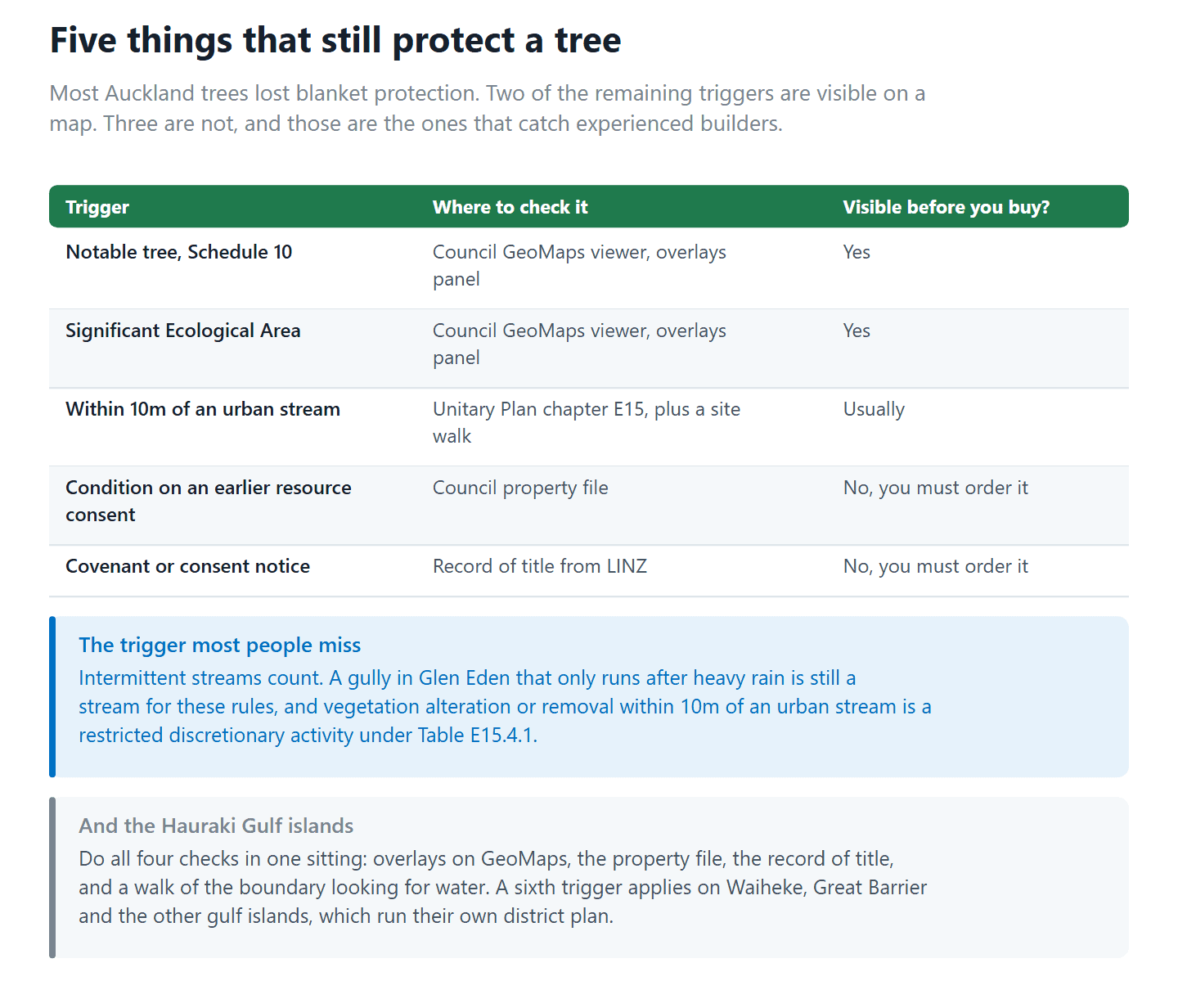
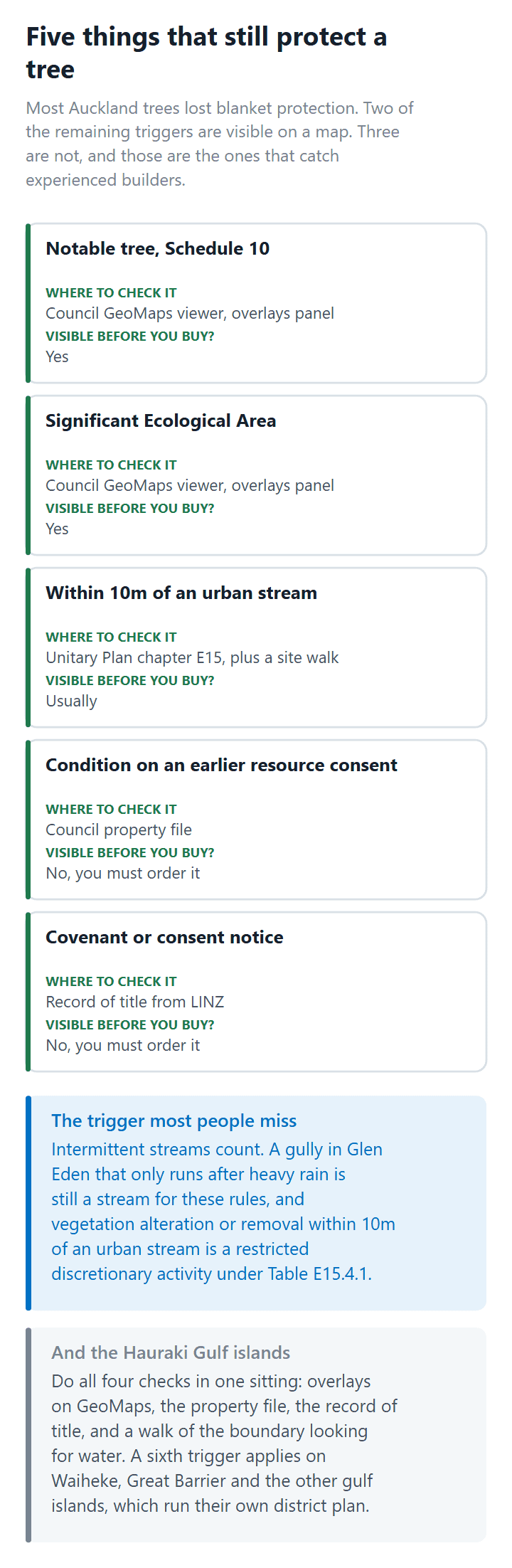
Auckland Council lists the reasons a tree on private land may be protected. Two are visible on a map. Three are not, and those are the ones that catch experienced builders, let alone first-time renovators.
1. It is a notable tree, or it sits in a Significant Ecological Area
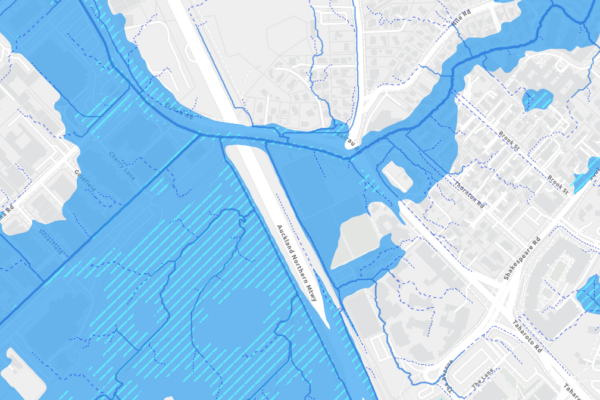
A notable tree is one the council has individually scheduled in the Auckland Unitary Plan — the single rulebook that sets what can be built where across the region. Scheduled trees are listed in Schedule 10, the Notable Trees Schedule, and shown by the Notable Trees Overlay. An overlay is a layer of extra rules that sits on top of whatever the underlying zone allows.
Council’s criteria for scheduling are narrow. A notable tree commemorates an important event in the nation’s history, is an exceptional or unique example of its species, is critical to the survival of other plant or animal species, or is of such age, stature, character and visibility that it is regarded as the best in the district. These are not simply the big trees; they are individually assessed, and adding a new one requires a full plan change with public submissions and a hearing.
A Significant Ecological Area, or SEA, is a mapped area recognised for its ecological value. Council notes that trees within an SEA carry an additional layer of protection on top of anything else.
2. It is near water
This is the trigger most people miss on an urban section, because the stream is often piped, fenced off or hidden behind a hedge. Auckland Council’s guidance flags rules for trees and vegetation located on or within 20m of steep coastal cliffs and within 150m of the high tide mark, on or within 20m of stream and river banks, and within or close to sensitive coastal or wetland areas.
The Unitary Plan carries the detail. In Table E15.4.1 of chapter E15, vegetation alteration or removal within 10m of urban streams is a restricted discretionary activity — meaning consent is required, and the council will assess it against a defined list of matters rather than waving it through. The same table makes removal near rural streams, lakes and natural wetlands consentable too. By contrast, vegetation removal for routine maintenance within 3m of an existing building is permitted, so trimming back what is growing against your weatherboards is not the problem.
Important: Intermittent streams count. A gully in Glen Eden that only runs after heavy rain is still a stream for these rules. The full activity table sits in chapter E15 of the Auckland Unitary Plan. If your site has any watercourse on or beside it, this is also worth reading alongside our guide to flood plains and overland flow paths in Auckland, because the two constraints usually travel together.
3. A condition on an earlier resource consent protects it
Here is the invisible one. When a site was subdivided or developed years ago, the consent may have carried a condition requiring specific trees to be retained. That condition binds the land, not the person who agreed to it. You inherit it when you buy, whether or not anyone mentioned it at the open home.
Council’s advice is to order the property file to find out. The property file is the council’s document history for your address, and it is where those conditions live. It is not expensive and it is genuinely worth doing before you commit to a layout.
4. A covenant or a consent notice on the title protects it
The second invisible one, and it sits somewhere different again. A covenant is a legal restriction recorded on the property’s record of title, and a consent notice is a condition of subdivision registered on that title. Either can require trees to be kept. Council’s guidance is to order the record of title from Land Information New Zealand to check.
Modern Auckland infill subdivisions do this more often than you would expect — a landscaping condition from the original approval quietly turns three specimen trees into permanent fixtures. If you are considering a second dwelling or a subdivision in Auckland, read the title before you read the zone. Where the project runs on into a new build on the second lot, our group development partner Superior Homes works to the same retained-tree conditions from the start.
5. It is on a Hauraki Gulf island
As above: Waiheke, Great Barrier and the other gulf islands run on their own district plan with its own vegetation clearance rules, and Council publishes a specific practice note on the topic. Do not apply mainland logic there.
| Trigger | Where to check it | Visible before you buy? |
|---|---|---|
| Notable tree (Schedule 10) | Council GeoMaps viewer, overlays panel | Yes |
| Significant Ecological Area | Council GeoMaps viewer, overlays panel | Yes |
| Within 10m of an urban stream | Unitary Plan chapter E15 plus a site walk | Usually |
| Condition on an earlier resource consent | Council property file | No — you must order it |
| Covenant or consent notice | Record of title from LINZ | No — you must order it |
💡 Homeowner tip: Do all four checks in one sitting: overlays on GeoMaps, the property file, the record of title, and a walk of the boundary looking for water. It takes an afternoon and it is the cheapest hour of due diligence in the whole project.
What the Notable Trees Overlay Actually Lets You Do
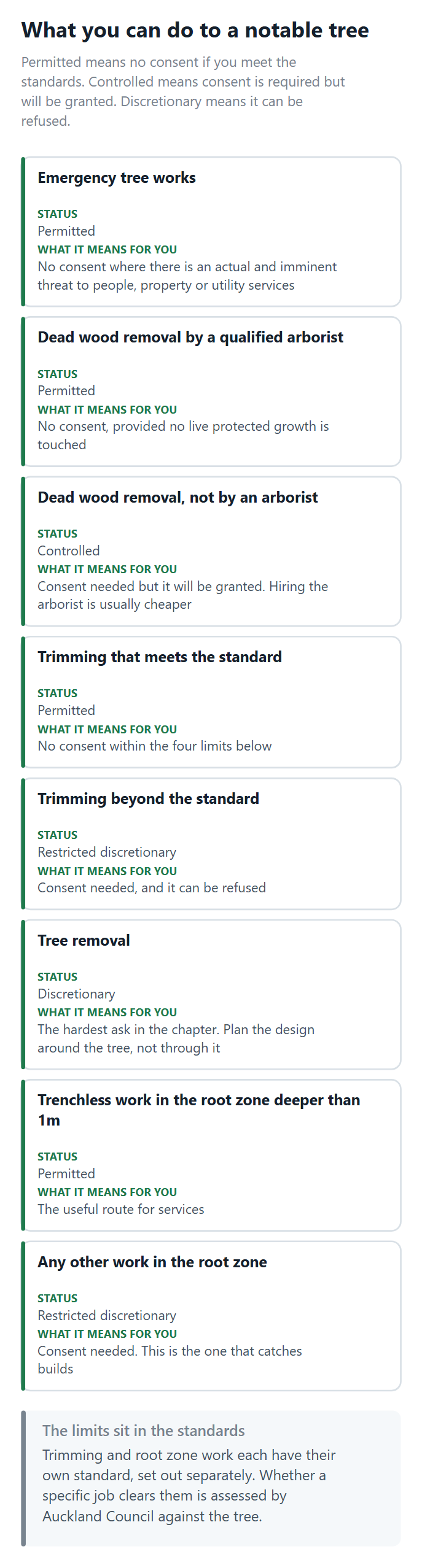
If your tree is scheduled, the rules are not a blanket ban. Chapter D13 of the Unitary Plan sets out exactly which tree works are allowed outright and which need consent, and the difference between them is measured in millimetres.
The activity table, in plain language
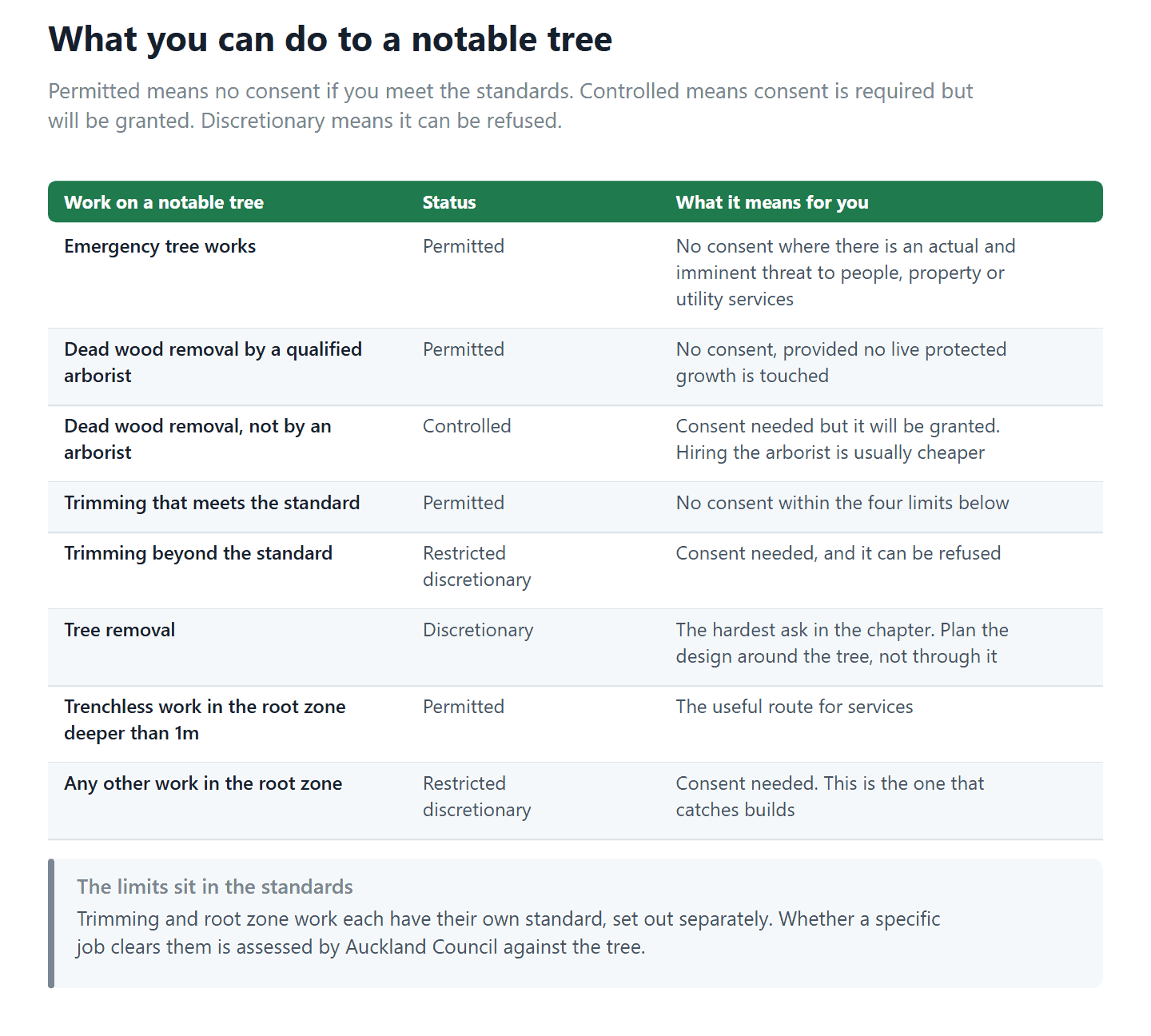
Planning rules sort activities into categories. Permitted means you may do it without consent, as long as you meet the standards. Controlled means consent is required but the council must grant it, with conditions. Restricted discretionary means consent is required and the council may decline it, judging against a set list of matters. Discretionary means consent is required and the council can weigh anything relevant.
| Work on a notable tree | Status | What it means for you |
|---|---|---|
| Emergency tree works | Permitted | No consent where there is an actual and imminent threat to people, property or utility services |
| Dead wood removal by a qualified arborist | Permitted | No consent, provided no live protected growth is touched |
| Dead wood removal not by a qualified arborist | Controlled | Consent needed, but it will be granted — hiring the arborist is usually cheaper |
| Tree trimming or alteration meeting the standard | Permitted | No consent within the size limits below |
| Trimming beyond the standard | Restricted discretionary | Consent needed and it can be refused |
| Tree removal | Discretionary | The hardest ask in the chapter — plan your design around the tree, not through it |
| Trenchless work in the root zone deeper than 1m | Permitted | No consent within the standard — the useful route for services |
| Any other work in the root zone | Restricted discretionary | Consent needed — this is the one that catches builds |
The numbers that decide whether trimming needs consent
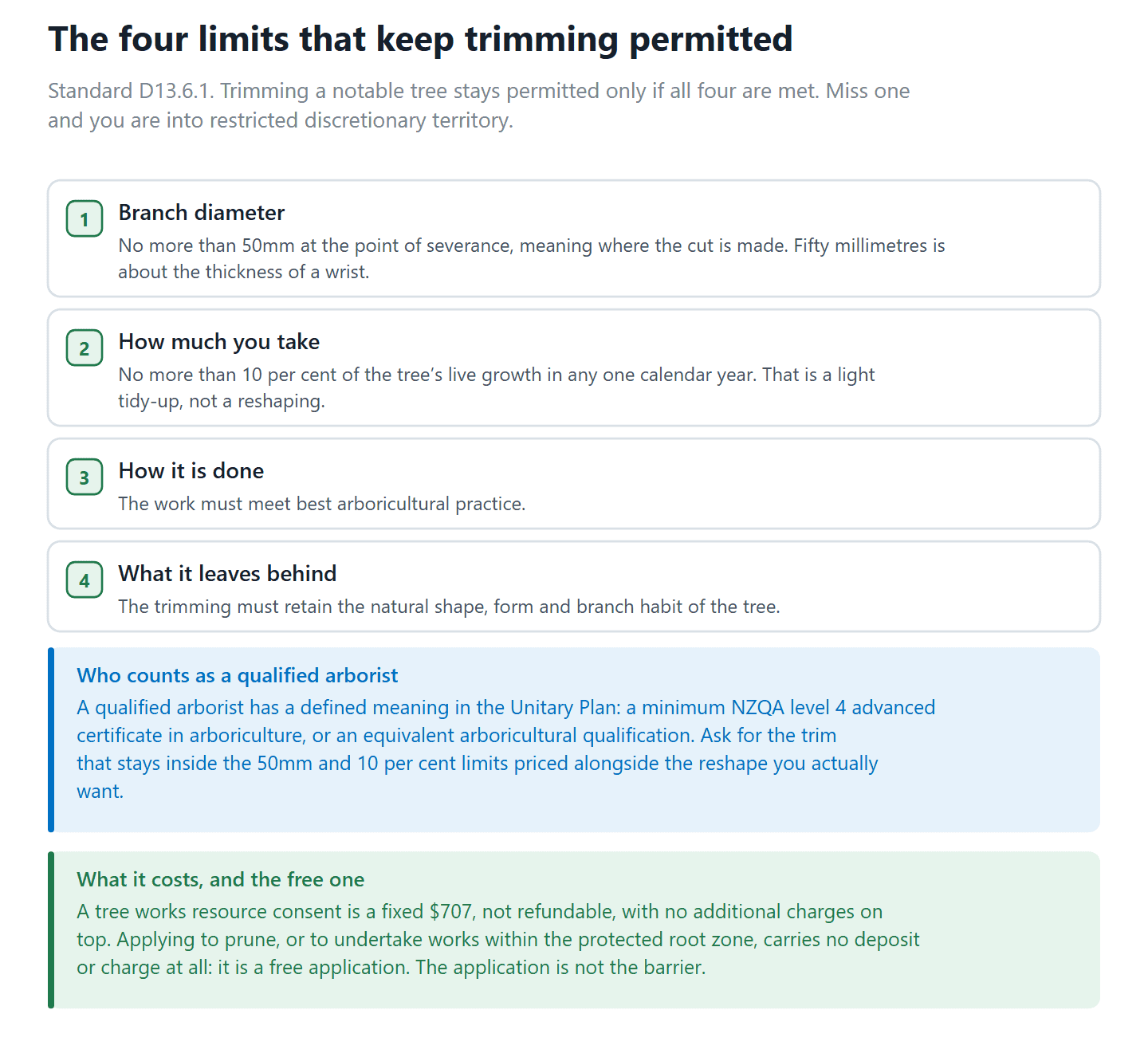
Standard D13.6.1 sets four tests, and trimming a notable tree stays permitted only if all four are met. The maximum branch diameter must not exceed 50mm at severance — severance simply meaning the point where the cut is made. No more than 10 per cent of the tree’s live growth may be removed in any one calendar year. The work must meet best arboricultural practice. And the trimming must retain the natural shape, form and branch habit of the tree.
Fifty millimetres is about the thickness of a wrist. Ten per cent of live growth is a light tidy-up, not a reshaping. Go past either and you have moved into restricted discretionary territory, where the council can say no.
Important: A qualified arborist has a defined meaning in the Unitary Plan — a minimum NZQA level 4 advanced certificate in arboriculture, or an equivalent arboricultural qualification. Ask for it before you engage anyone to work on a scheduled tree. The full chapter is at D13 Notable Trees Overlay.
💡 Homeowner tip: Ask the arborist to price two options side by side: the trim that stays inside the 50mm and 10 per cent limits, and the reshape you actually want. Seeing the permitted version costed against a consent application makes the decision obvious, and it takes one site visit. If you want the constraint checked before you commit, our studio at 16 Link Drive, Wairau Valley is on 0800 272 469.
What it costs, and what it costs to get wrong
Auckland Council charges a fixed fee of $707 for a tree works resource consent. It is not refundable and there are no additional charges on top, which makes it one of the few consent fees in Auckland you can budget with confidence. Applications are processed within 20 working days.
There is a genuinely useful exception buried in the fee schedule that almost nobody knows about. Applying to prune, or to undertake works within the protected root zone of a notable tree, does not incur a deposit or charge at all. That is a free application. If you are weighing up whether to design around a scheduled tree or apply for permission to work near it, the application itself is not the barrier.
Getting it wrong is a different story. Council warns that unconsented work near a protected tree can be prosecuted, and the list of what counts includes things that do not feel like tree work at all: excavation, construction of decks, fences and retaining walls, depositing material, and storing material beneath branches and around roots. Under section 339 of the RMA, the maximum penalty for an individual convicted of a breach is now up to 18 months’ imprisonment or a fine of up to $1,000,000, raised on 21 August 2025. Council’s own tree page still quotes a lower figure. Do not treat it as the ceiling.
“The expensive mistakes we see are almost never someone cutting down a scheduled tree. They are a digger parked under one for six weeks, or a retaining wall poured through its roots, because nobody told the builder the circle on the plan meant anything.”
— Sonder Architecture Team
How a Protected Root Zone Changes What You Can Build
This is the part that reshapes designs, and it is the part homeowners almost never see coming. The rules do not just protect the visible tree. They protect a defined circle of ground around it, and inside that circle a long list of ordinary construction activities becomes a consent matter.
How big the circle actually is
The Unitary Plan’s definitions chapter is precise about this. The protected root zone is the circular area of ground around the trunk of a protected tree, with a radius equal to the greatest distance between the trunk and the outer edge of the canopy. The canopy is the spread of the branches and leaves. For columnar species, meaning tall narrow trees like a Lombardy poplar where the canopy hugs the trunk, the protected root zone is instead half the height of the tree.
Note the word “greatest”. You do not average the canopy. If a mature pōhutukawa leans and its widest limb reaches 7m out from the trunk on one side, the protected root zone is a 7m radius circle all the way round — a protected area of roughly 154m2, which on many Auckland sections is larger than the house footprint you were planning.
What counts as “works” inside it
The definition of works within the protected root zone is broad, and reading it is the fastest way to understand why builders get caught. It includes excavation, depositing of materials, construction activity, installation of services, discharge or dispersal of any toxic substance, placement of any weed control membrane, and storage of vehicles, machinery or materials.
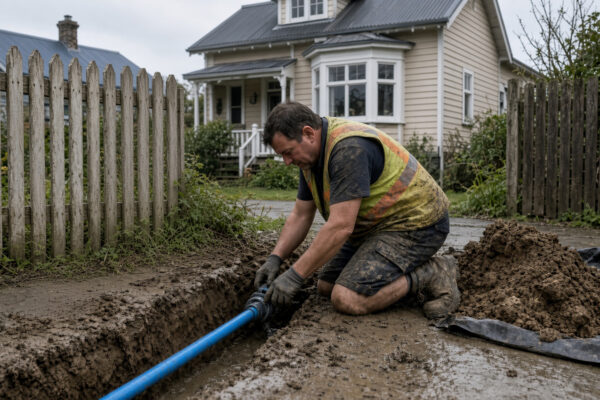
Parking the excavator under the tree is works. Stacking timber under it is works. Running the new drainage line under it is works. None of those involve touching a branch. All of them sit inside a rule that makes the activity restricted discretionary unless it fits a narrow permitted route.
That permitted route is worth knowing. Standard D13.6.2 allows trenchless work deeper than 1m below ground level without consent, provided the excavation is by hand-digging, air spade, hydro vac or drilling machine; a single excavation does not exceed 1m2 of surface area; root pruning is not on roots greater than 35mm in diameter at severance; works do not disturb more than 10 per cent of the protected root zone; machinery operates on top of paved surfaces or ground protection; the bucket is a straight blade; and the whole thing is directed by a qualified arborist. An air spade uses compressed air to expose roots without cutting them, and hydro vac does the same with water and suction.
Important: Work inside a notable tree’s protected root zone that does not fit that permitted route is a restricted discretionary activity, so consent is required and the council can decline it. On the tighter sections common through Mt Eden and Grey Lynn, where a scheduled tree and a proposed extension often sit within a few metres of each other, this is the rule that decides the footprint. The standards are set out in D13.6.2 of the Auckland Unitary Plan.
The design decisions that follow
Once the circle is drawn on the site plan, a handful of choices open up. A footprint can be pulled back or reshaped so habitable rooms sit outside the zone. Foundations can move to a screw pile or bored pier system that touches a fraction of the ground a slab would, though that needs the arborist and the engineer talking to each other early. Service runs can be redirected around the zone, or taken under it by trenchless methods at the right depth. Site access and the material laydown area can be located deliberately rather than by default.
The one thing that does not work is discovering the tree at building consent stage. By then the foundation design is fixed, the driveway is set, and the cheapest option left is usually an application to work in the root zone with a design that was never shaped around it. We would rather find the circle at the feasibility stage, when moving the house 2m north is a free decision.
💡 Homeowner tip: If your works are extensive, Council expects an arborist’s report with the application. Its published list is specific: the plan infringements, existing and proposed cleared areas in square metres, all affected vegetation located on a tree site plan, the construction methodology including machinery and access, an arboricultural assessment of effects, tree protection methods, kauri dieback measures, and a replanting and maintenance schedule. Get that brief to the arborist in one go rather than three.
For a renovation or extension where the tree sits close to the work, the sequence matters as much as the design. Our guide to planning a house extension in Auckland covers how the consent stages line up, and where a tree constraint changes the order you do things in. Where the build side needs to be planned around the same constraint, our build partner Superior Renovations works to the same protection plan rather than discovering it on day one.
Street Trees, Neighbours’ Trees and Trees Under Power Lines
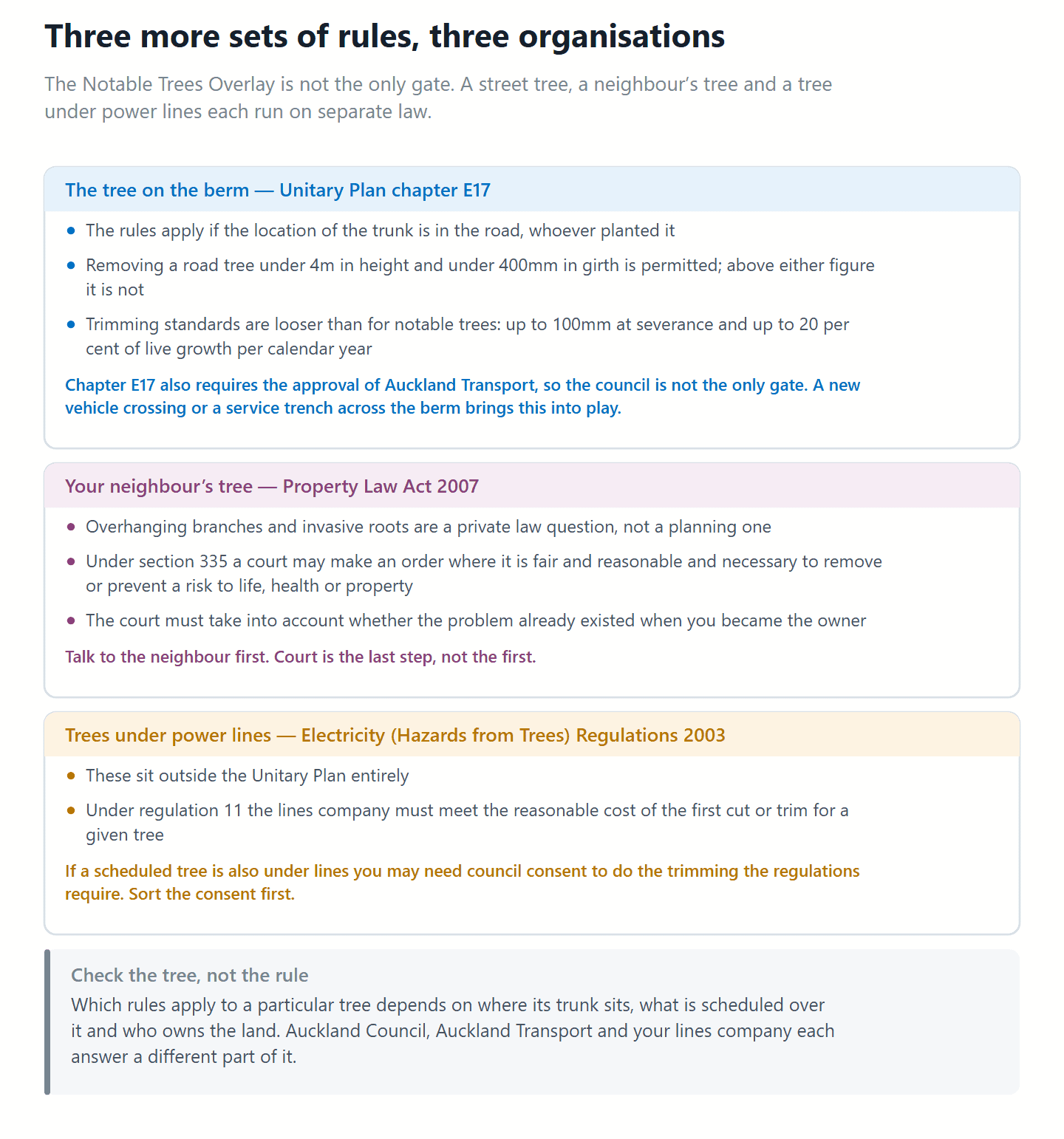
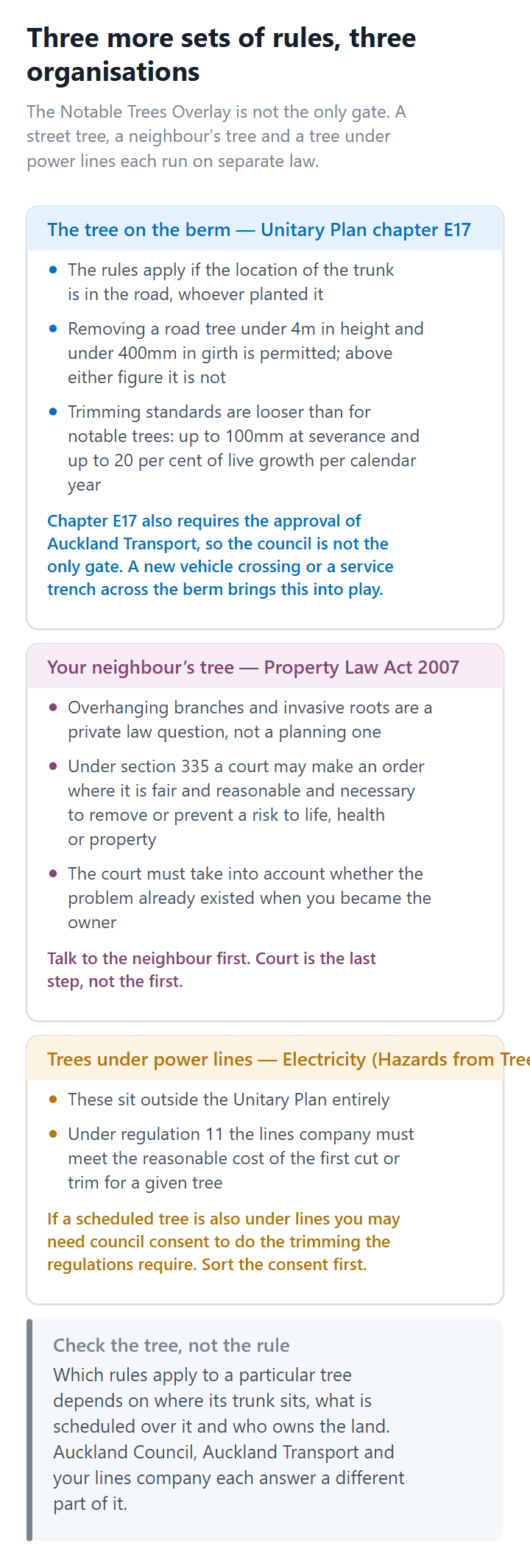
Three more sets of rules sit outside the Notable Trees Overlay, and each is run by a different organisation. This is the pattern we keep writing about in Auckland: one project, several separate approval authorities, none of whom tell you about the others.
The tree on the berm is not yours, and Council is not the only gate
Chapter E17 of the Unitary Plan covers trees in roads. The test is simple and catches people out: the rules apply if the location of the trunk is in the road. A street tree whose canopy hangs over half your front garden is still a road tree, and so are its roots under your driveway.
The chapter carries an instruction most homeowners never read: these activities must also obtain the approval of Auckland Transport. Auckland Transport, or AT, is the council-controlled organisation that manages the road corridor. So a street tree can need two separate approvals — the Unitary Plan rule from Auckland Council, and the road controlling authority’s own tree owner approval from AT. Getting one does not get you the other.
The thresholds are size-based. Removing a road tree less than 4m in height and less than 400mm in girth is a permitted activity. Removing one greater than 4m in height or greater than 400mm in girth is restricted discretionary. Girth is the circumference of the trunk, not its diameter, so 400mm of girth is a trunk about 127mm across — a smaller tree than most people picture.
Trimming standards in the road are looser than for notable trees: branches up to 100mm at severance and up to 20 per cent of live growth per calendar year. Root zone work is where a new driveway meets reality. Without an arborist directing the work you may prune roots up to 35mm at severance and disturb up to 10 per cent of the protected root zone. With a qualified arborist directing it, that rises to 60mm and 20 per cent. Trenchless work must not be shallower than 800mm below ground level, and any machine excavator has to sit on paved surfaces or ground protection with a straight blade bucket.
Important: If you are putting in a new vehicle crossing (the section of driveway between the road and your boundary) or trenching a new service connection across the berm, assume the street tree is in play. Read chapter E17 of the Unitary Plan alongside our guides to vehicle crossings in Auckland and power and fibre connections for a new build.
Your neighbour’s tree: the Property Law Act, not the council
Overhanging branches and invasive roots are a private law question, not a planning one. The Property Law Act 2007 gives a court power to order the owner or occupier of land to remove or trim a tree, and the grounds are wider than most people assume.
Under section 335, a court may make an order where it is fair and reasonable and necessary to remove or prevent an actual or potential risk to life, health or property; an undue obstruction of a view from residentially zoned land; undue interference from the fall of leaves, flowers, fruit or branches, or from shade or loss of access to light; or the obstruction of a drain or gutter by fallen material or by roots. Section 336 requires the court to also weigh the public interest in an attractive environment, the tree’s value as a public amenity, its historical, cultural or scientific significance, and any effect removal would have on ground stability, the water table or run-off.
One detail is worth knowing before you spend money on it: the court must take into account whether the problem already existed when you became the owner. Buying a Devonport villa with a large neighbouring oak already shading the back lawn is a weaker case than watching a new planting grow into one. If an order is made and not complied with, section 338 lets the applicant enter and do the work with the defendant’s agreement or the court’s leave, and recover the reasonable cost.
Council’s own advice is to talk to the neighbour first, and it is right. Court is the last step, not the first, and Citizens Advice Bureau, a community law centre or your solicitor are all cheaper places to start.
Trees under power lines: a third set of rules again
If a tree on your land is growing towards overhead lines, the Electricity (Hazards from Trees) Regulations 2003 apply. These sit outside the Unitary Plan entirely. They oblige the tree owner to keep trees clear of a defined growth limit zone around the conductors, and they give the lines company a process of hazard warning notices and cut or trim notices.
The cost rule is the part worth remembering. Under regulation 11, the lines company must meet the reasonable cost of the first cut or trim for a given tree. After that first notice, the cost falls to you. There is also a dispensation process if you want to keep a tree that would otherwise have to be cut back, with a tight five working day deadline to apply once a cut or trim notice arrives.
💡 Homeowner tip: If a scheduled tree is also under lines, you may need consent from the council to do the trimming the regulations require. Sort the consent path before you book the crew, not after they arrive in Mt Albert with a chipper.
Where This Leaves Your Project
Auckland’s tree rules read as chaos until you see the structure underneath. Most trees on most sections carry no protection at all, because the RMA stopped councils protecting trees as a class in 2013. Protection is now specific: a scheduled tree, an ecological area, proximity to water, a condition on an old consent, a covenant on the title, or a gulf island address.
Find out which of those applies before the design starts, not after. The overlays take five minutes on GeoMaps. The property file and the record of title take a few days and a small fee. Between them they will tell you whether you are dealing with an ordinary section or a site with a no-dig circle bigger than your planned footprint.
And if a scheduled tree is on your site, treat it as a design input rather than an obstacle. Applications to work in a notable tree’s protected root zone cost nothing to lodge and are decided in 20 working days. A house shaped around a mature tree, with the foundations and services planned to suit, is usually a better house than the one that ignored it. It is also the version that gets consented.
➡ Book a free consultation with Sonder Architecture
➡ Request your free feasibility report
➡ Read our guide to building consent for renovations in Auckland
➡ See recent projects we’ve done across Auckland
Do I need consent to cut down a tree on my own property in Auckland?
Usually not. Since 2013 the Resource Management Act has stopped councils protecting trees on ordinary urban sections as a general class, and Auckland Council confirms that no class or species of tree has automatic protection where its vegetation rules apply. You will need resource consent only if the tree is individually scheduled as a notable tree, sits in a Significant Ecological Area, is near a stream or the coast, is protected by a condition on an earlier resource consent or a covenant on the title, or is on a Hauraki Gulf island.
How do I check if a tree on my property is protected?
Do four checks. Search your address in Auckland Council's GeoMaps viewer and read the overlays panel for the Notable Trees Overlay and any Significant Ecological Area. Order the council property file to see whether an earlier resource consent condition requires trees to be retained. Order the record of title from Land Information New Zealand to check for a covenant or consent notice. Then walk the boundary looking for any stream, gully or watercourse, because vegetation removal within 10m of an urban stream needs consent.
What is a protected root zone and how big is it?
The Auckland Unitary Plan defines the protected root zone as the circular area of ground around the trunk of a protected tree, with a radius equal to the greatest distance between the trunk and the outer edge of the canopy. It uses the widest reach of the branches, not an average, so a limb extending 7m out creates a 7m radius circle all the way around the trunk. For columnar species with narrow crowns, the protected root zone is instead half the height of the tree.
How much does a tree resource consent cost in Auckland?
Auckland Council charges a fixed fee of $707 for a tree works resource consent. It is not refundable and there are no additional charges. There is one significant exception: applying to prune, or to undertake works within the protected root zone of a notable scheduled tree, does not incur a deposit or charge at all. Council processes tree resource consent applications within 20 working days and notifies the decision by email or post.
Can I trim a notable tree without resource consent?
Yes, within limits. Standard D13.6.1 of the Auckland Unitary Plan keeps trimming a permitted activity only if all four tests are met: the maximum branch diameter must not exceed 50mm at the point of cut, no more than 10 per cent of the tree's live growth may be removed in any calendar year, the work must meet best arboricultural practice, and the trimming must retain the natural shape, form and branch habit of the tree. Exceed any of these and consent is required, and it can be declined.
Can I park machinery or store materials under a protected tree?
Not without checking the rules first. The Auckland Unitary Plan defines works within the protected root zone to include storage of vehicles, machinery or materials, as well as excavation, depositing of materials, construction activity, installation of services and placement of weed control membrane. Auckland Council specifically lists storing material beneath branches and around roots as work that can be prosecuted if done without consent, alongside building decks, fences and retaining walls.
Who owns the tree on the berm outside my house?
If the trunk is in the road, it is a road tree and not yours. Chapter E17 of the Auckland Unitary Plan applies wherever the trunk is located in the road, even if the canopy overhangs your property. Work on a road tree needs to satisfy the Unitary Plan rules and also obtain the approval of Auckland Transport as the road controlling authority. Removing a road tree over 4m in height or over 400mm in girth is a restricted discretionary activity, so consent is required and can be refused.
What can I do about my neighbour's tree overhanging my property?
Start by talking to your neighbour, because this is a private law matter rather than a council one. If that fails, the Property Law Act 2007 lets a court order an owner to remove or trim a tree where it creates a risk to life, health or property, unduly obstructs a view from residentially zoned land, or causes undue interference through falling leaves, branches, shade, loss of light or blocked drains. The court must also consider whether the problem already existed when you bought the property.
Does a protected tree stop me building an extension?
Rarely outright, but it will change the design. Removing a notable tree is a discretionary activity, which is the hardest category to get approved, so the usual answer is to design around it. That can mean reshaping the footprint, moving to pile or pier foundations that disturb far less ground, routing services around the root zone or taking them underneath by trenchless methods, and choosing where machinery and materials sit on site. Doing this at feasibility stage costs nothing; doing it at building consent stage costs a redesign.
What happens if I remove a protected tree without consent?
It is an offence under the Resource Management Act. Since 21 August 2025 the maximum penalty for an individual convicted of a breach has been up to 18 months' imprisonment or a fine of up to $1,000,000, with a maximum of $10,000,000 for a company. Auckland Council also warns that unconsented excavation, construction and material storage around a protected tree can be prosecuted, not only felling. Enforcement is not limited to felling, and a breach can surface years later when the property file is reviewed for a sale or a subsequent consent application.
Do rural or lifestyle blocks have the same tree freedom as urban sections?
No. The Resource Management Act carve-out only applies to an urban environment allotment, which section 76(4C) defines as a parcel no greater than 4,000 square metres, connected to reticulated water and sewerage, carrying a building used commercially, industrially or as a dwelling, and not a reserve. A larger lifestyle block, or a bare section on tank water and a septic system, does not qualify, so the council's Auckland-wide vegetation rules apply in full and clearing can require consent.
Do I need an arborist's report for my consent application?
If the works are extensive, yes. Auckland Council's published list of what the report must cover includes the Unitary Plan infringements, existing and proposed cleared areas in square metres, all affected vegetation shown on a tree site plan, the construction methodology including machinery and access, an arboricultural assessment of effects, proposed tree protection methods, kauri dieback measures, and a replanting and maintenance schedule. A qualified arborist means someone holding at least an NZQA level 4 advanced certificate in arboriculture.
References
- New Zealand Legislation — Resource Management Act 1991, section 76 District rules
- New Zealand Legislation — Resource Management Act 1991, section 339 Penalties
- New Zealand Legislation — Property Law Act 2007, sections 332 to 338, trees on neighbouring land
- New Zealand Legislation — Electricity (Hazards from Trees) Regulations 2003, regulation 11 costs of first cut or trim
- Auckland Council — Auckland Unitary Plan, D13 Notable Trees Overlay
- Auckland Council — Auckland Unitary Plan, E17 Trees in roads
- Auckland Council — Auckland Unitary Plan, E15 Vegetation management and biodiversity
- Auckland Council — Auckland Unitary Plan, Chapter J Definitions (protected root zone, qualified arborist)
- Auckland Council — Auckland Unitary Plan, Schedule 10 Notable Trees Schedule
- Auckland Council — Tree work rules for your property and neighbouring properties
- Auckland Council — Notable trees
- Auckland Council — Working on or around protected trees
- Auckland Council — Apply for a resource consent to work on or around protected trees (fees and timeframes)