
Last updated:
Quick answer: A power connection for a new build in Auckland is a separate application to Vector, not part of your building consent. Budget from $3,493 in fixed charges and six to eight weeks for a simple connection. Fibre through Chorus is free to quote but averages up to five months.
Here is the phone call we take more often than any other in the weeks before a build starts: the consent is granted, the builder is booked, and someone has just discovered the house has no way to get power to it.
It happens because of a gap in how the process is explained. Auckland Council grants your building consent. The council does not connect your electricity, your fibre, or your water. Three different organisations do that, on three separate applications, on three separate clocks, and none of those clocks starts when your consent is granted. They start when you apply.
For a straightforward new home in Auckland, the electricity side alone runs to roughly $3,500 in fixed charges before anyone quotes you for the physical work — and that is the cheap, simple version. Fibre is free to quote and free to install in most cases, but Chorus tells developers plainly that it can take up to five months to line up a site, with no priority service available.
Both of those numbers are public. Neither of them appears in a building consent application. And both of them are decisions you can influence at design stage, when the switchboard position and the cable route are still lines on a drawing rather than a trench across a finished driveway.
This article walks through what Vector and Chorus actually charge, how long each process takes, and the handful of decisions that belong on the design table rather than on site. We have pulled every figure from the network companies’ own published pricing and standards, current as at August 2026, and we have linked each one so you can check it against your own project.
Why Power and Fibre Sit Outside Your Building Consent
Most homeowners assume the council is the gatekeeper for everything. It is not. Auckland Council controls whether you may build and whether what you built complies. It does not control whether the network companies will connect you, when, or at what price.
Those are commercial and technical decisions made by separate organisations under separate law. Understanding where the line falls saves a lot of frustration later.
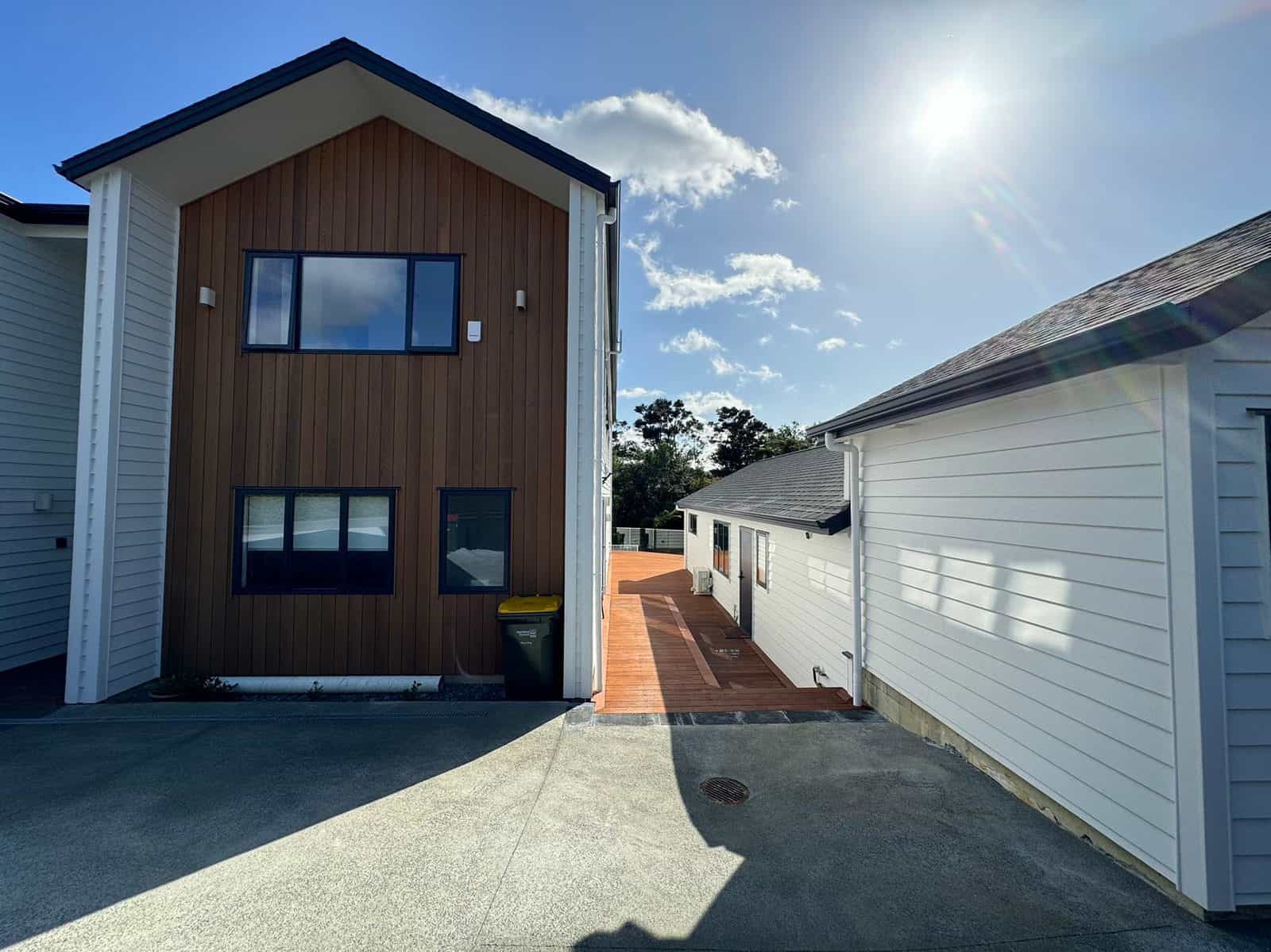
The point of supply: where the network stops and your property starts
Every connected property has a point of supply — the legal boundary between the lines company’s equipment and yours. The term is defined in the Electricity Act 1992, but Vector puts it in plainer terms on its own site: for practical purposes the point of supply is the isolating fuse, sitting either on your boundary or on the pole nearest your property.
Everything on the network side of that fuse is Vector’s. Everything on the house side is yours, including the service line: the cable running from the point of supply to your meter and your switchboard, the panel of circuit breakers that splits the incoming supply out to every circuit in the house. You own that cable, you pay to install it, and you maintain it for the life of the house.
That is a bigger deal than it sounds. A service line is not a wire you can move later on a whim. It is a buried cable running under whatever you have built on top of it.
💡 Homeowner tip: Ask your designer to mark the proposed service line route and the main switchboard position on the site plan before you lodge for consent. Vector’s own connection standard asks customers to supply exactly that marked-up plan, and it is far cheaper to move a line on paper than under a poured driveway.
Three organisations, three sets of paperwork
For a new dwelling in Auckland you are usually dealing with three network organisations, and they do not talk to each other on your behalf.
Vector owns the electricity distribution network across most of Auckland and handles new electricity connections. Chorus owns the fibre network across most of the region and handles new fibre connections. Watercare handles water and wastewater, which we have covered separately in our guide to Watercare connection costs in Auckland.
Each one has its own application, its own quote, its own payment, and its own build queue. Applying to one does not start the clock on the others. A homeowner in Hobsonville Point who applies for water in March and remembers power in July has not saved any time; they have simply moved the delay to the end of the build.
Then there is a fourth party most people forget: your electricity retailer. Vector creates the connection point and issues the number that identifies it. Your retailer, whichever one you choose, installs the meter, turns the power on, and starts billing you. Vector does none of those three things.
What Auckland Council checks, and what it does not
Your building consent (the council’s approval for the actual construction work) covers whether the electrical installation inside your house meets the Building Code. It does not cover whether Vector will run a cable to your boundary.
Where the council does get involved is at the other end. If your project involves subdivision, the council will not sign off the final step until the network companies confirm services are available. That step is the section 224(c) certificate — the certificate confirming your survey plan is approved and every subdivision condition has been met. Auckland Council explains that you need it before Land Information New Zealand will issue new Records of Title, which are the official ownership documents for the new sections.
Important: If you are subdividing, both Vector and Chorus issue their own completion or clearance letters that feed into the council’s 224(c) sign-off. Vector emails a Certificate of Completion for you to forward to the council; Chorus issues a clearance letter once its work is done and your land title plan is supplied. Neither will issue one until their work is finished and paid for, so a late services application delays your titles, not just your power. See Auckland Council’s guidance on applying for a section 224(c) certificate.
For a straight new build on an existing section with no subdivision, none of that applies. You simply need power and fibre before you move in, and the only thing standing between you and that is the queue.
What a New Electricity Connection Costs in Auckland
This is where the numbers get specific, and where most homeowners get their first genuine surprise.
The three charges on a Vector quote
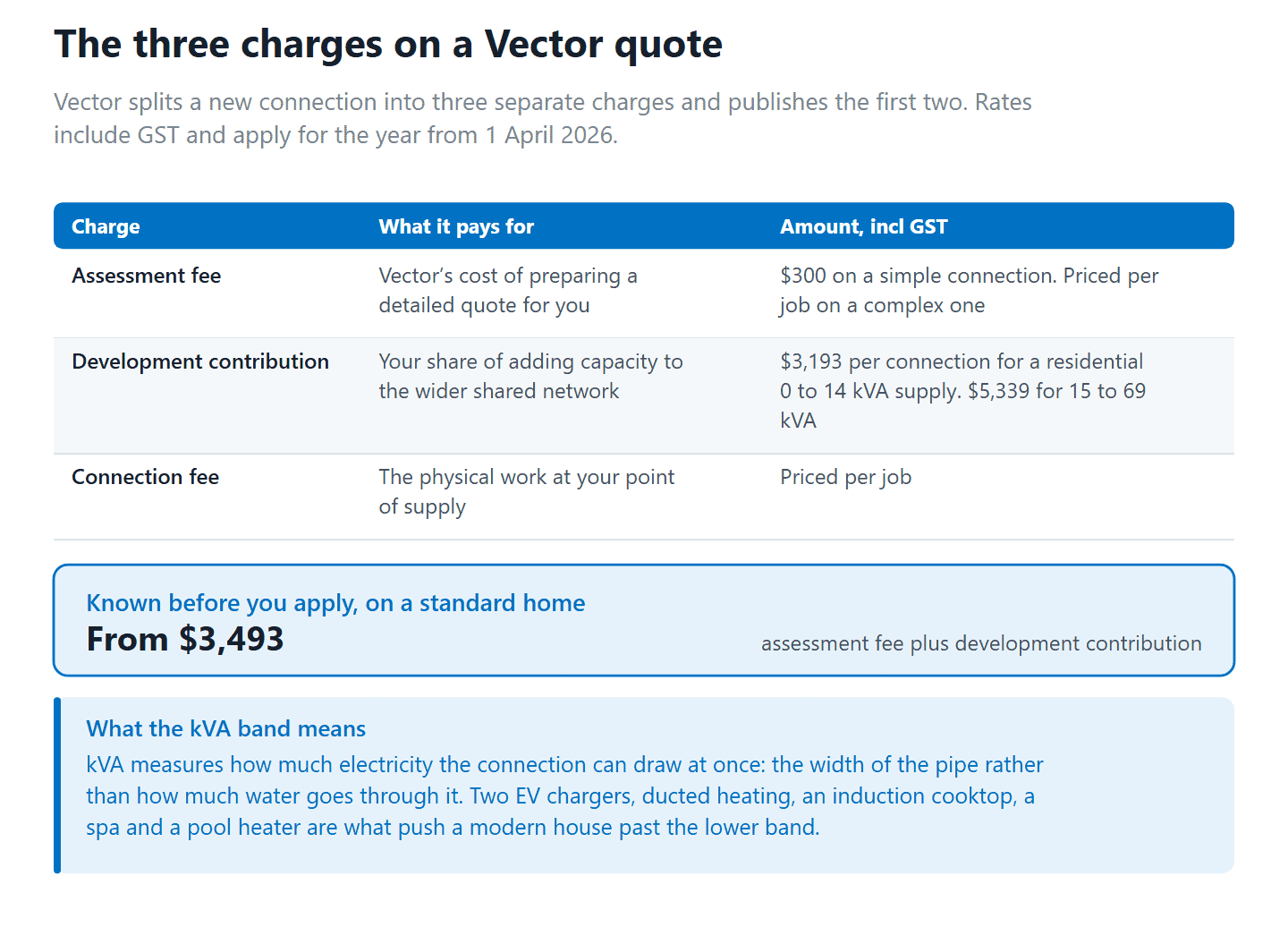
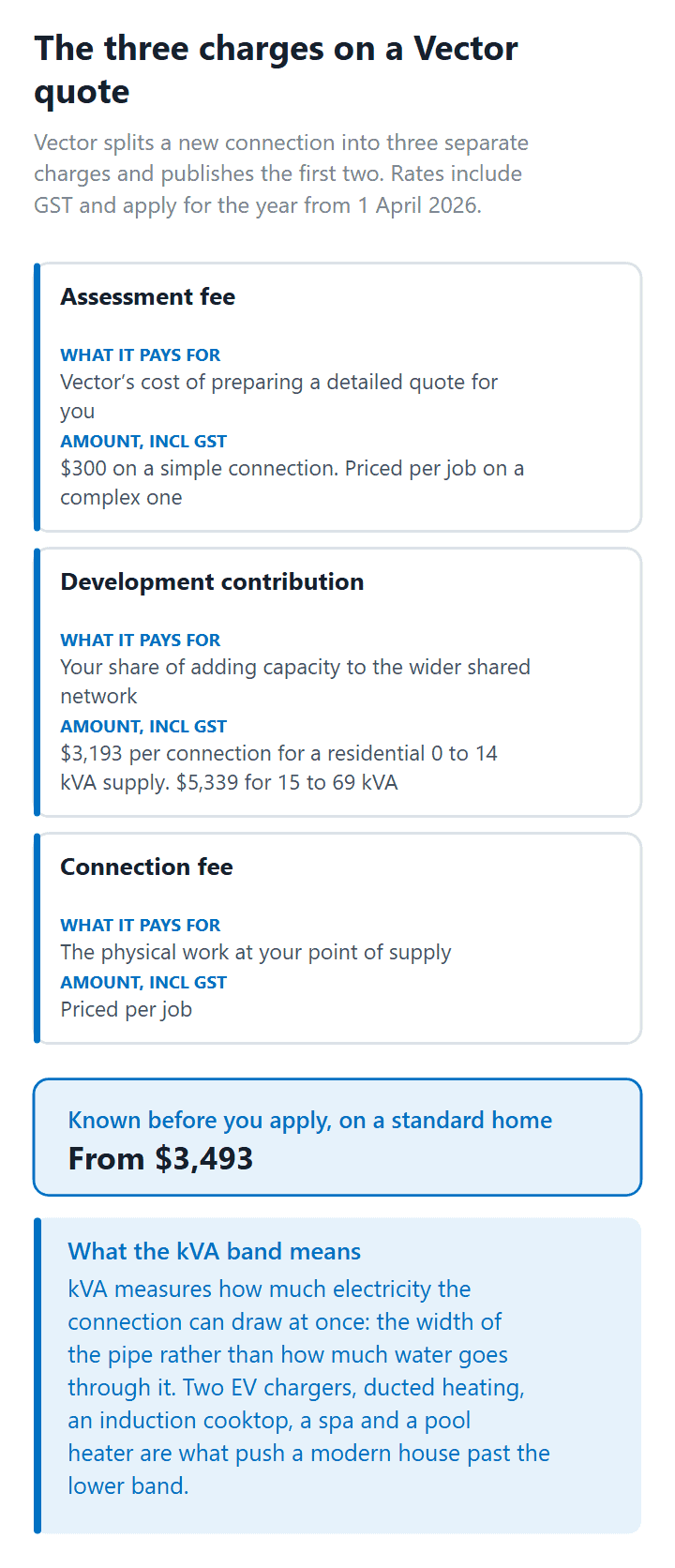
Vector splits a new connection into three separate charges, and its simple connection pricing page publishes them openly. The figures below are Vector’s published rates effective from 1 April 2026, and they include GST.
| Charge | What it pays for | Amount (incl. GST) |
|---|---|---|
| Assessment fee | Vector’s cost of preparing a detailed quote for you | $300 on a simple connection; priced per job on a complex one |
| Development contribution | Your share of adding capacity to the wider shared network | $3,193 per connection for a residential 0–14 kVA supply; $5,339 for 15–69 kVA |
| Connection fee | The physical work at your point of supply | Priced per job |
| Known before you apply | Assessment fee plus development contribution | From $3,493 for a standard home |
kVA is simply a measure of how much electricity your connection can draw at once — think of it as the width of the pipe rather than how much water you use through it. Most Auckland homes sit comfortably in that first band. Vector’s own connection standard states that most residential connections can be adequately supplied from a 60 amp single-phase connection, meaning one live supply cable, which is the standard domestic arrangement. Push past that and you move into a 60 amp three-phase supply, which runs three live cables and carries more load, or a 100 amp supply. Either way you move into the more expensive band.
What pushes a house past 60 amps? Not much, historically. But two electric vehicle chargers, ducted heating, an induction cooktop, a spa and a swimming pool heater in the same house will do it. That is a design conversation, not an afterthought, because the capacity you request determines which development contribution band you land in — a difference of $2,146 on Vector’s published rates.
For Vector’s “other low voltage mains” connection category, the published rate is $264.50 per installed kVA as an alternative charging basis — it is not an extra charge stacked on a standard residential connection fee. The connection fee itself is quoted per job, and it is the genuinely variable part: distance from the network, whether the cable goes underground or overhead, ground conditions and traffic management all move it. For a sense of how the council-side costs sit alongside these, see our breakdown of building consent costs in Auckland.
Important: These development contribution rates apply for the year from 1 April 2026. Vector has published that it is required to charge capacity costs from 1 April 2027 under new Electricity Authority regulations, and that the rates it will actually use from that date are yet to be determined. If your project straddles that date, get your quote and pay it inside its validity period rather than assuming today’s published rates will still apply.
Simple or complex: what pushes a connection onto the slow track
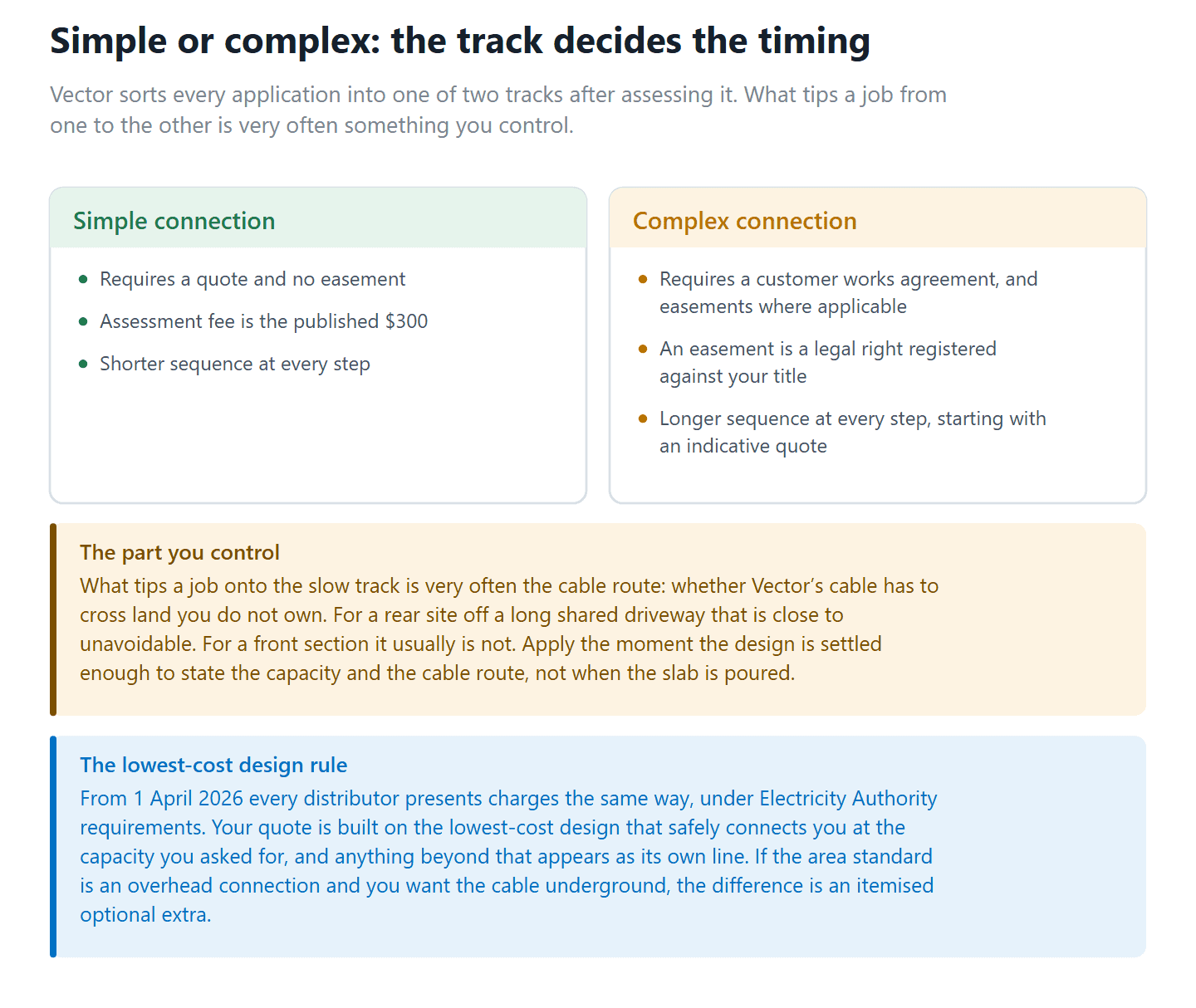
Vector sorts every application into one of two tracks after assessing it, and the difference in timing is significant.
A simple connection only requires a quote and no easement. An easement is a legal right registered against your property title that gives someone else, in this case Vector, permanent access to equipment sitting on your land. Vector says a simple connection can usually be completed in approximately six to eight weeks.
A complex connection requires a customer works agreement and easements where applicable. The sequence is longer at every step: an indicative quote usually within 10 working days, then a design cost to pay before the job proceeds, then a works agreement within five working days of design approval that stays valid for 45 days, and then physical work usually beginning around six weeks after payment is received.
Here is the part that matters at design stage. What tips a job from simple to complex is very often something you have control over — whether Vector’s cable has to run inside your property rather than stopping at the boundary. Vector’s connection standard accepts reticulation, meaning running its own cables and pits, inside a right of way (a shared driveway or access strip serving more than one property), but only if you grant an easement to protect that equipment. That easement goes on your title, permanently, with access rights attached.
For a rear site in Grey Lynn served off a long shared driveway, that is close to unavoidable. For a front section in Millwater, it usually is not. Getting the switchboard onto the street-facing side of the house can be the difference between six weeks and several months.
💡 Homeowner tip: Apply the moment your design is settled enough to state the capacity and the cable route, not when the slab is poured. Vector’s own advice is to apply as early as you can, and there is no penalty for having a connection ready before the house is.
The lowest-cost design rule, and what counts as an optional extra
From 1 April 2026, every electricity distributor in New Zealand changed how it presents connection charges, under new requirements from the Electricity Authority (the regulator overseeing the electricity industry). Vector’s own explainer is direct about the effect: the changes do not automatically increase connection charges or introduce new fees. What changed is the breakdown you see.
The important part for anyone designing a house is this. Your quote is now built on the lowest-cost design that safely connects you at the capacity you asked for, and anything you want above that specification is shown separately as an optional enhancement.
Vector gives the example directly: if your area’s standard is an overhead connection and you would prefer the cable underground, the extra cost appears as its own line item on your quote.
Read that again if you are designing a house where the approach and the street frontage matter. An underground service line on a Remuera site where the street is served overhead is now, formally, an aesthetic upgrade you are electing to buy. It is a legitimate choice and often the right one. It is also a cost you can now see, question and design around, which was not always true before.
Three things you can ask for that almost nobody does
The 1 April 2026 changes brought in three mechanisms that are barely mentioned outside regulatory documents. All three are worth knowing.
A Connection Charge Reconciliation. Once your quote has been issued, you can request one. It is a standard explanation required by the Electricity Authority showing the direct cost of connecting you, your share of wider network costs, and the expected future network revenue from your connection. It does not change your price. It does tell you how the price was built, which is a useful thing to hold when you are deciding whether to challenge a scope.
A flexible connection. From 1 April 2026 you can ask Vector to assess whether one suits you. Some of the capacity you request is only available when there is room on the network, rather than at all times. In some cases that reduces the upfront cost because it avoids an immediate network upgrade. It will not suit every household, but for a home where the heavy loads are an EV charger and a pool pump that can run overnight, it deserves a question.
A pioneer scheme. This is a refund mechanism distributors have been required to set up. If you fund a network extension that later customers connect to, you can be reimbursed as they connect. Vector’s published criteria are specific: pioneer schemes generally apply to eligible connection work above $50,000, with a $25,000 threshold for later connections using that infrastructure, and they explicitly do not apply to land developments for on-selling such as subdivisions. Vector’s connection pages recorded no active pioneer scheme at the time of writing, so treat this as a question to ask rather than a rebate to bank on.
If you are extending the network down a Kumeu or Riverhead lane to reach a single house, and neighbouring sections could later connect to the same extension, that question is worth asking before you sign.
Fibre Takes Longer Than You Think
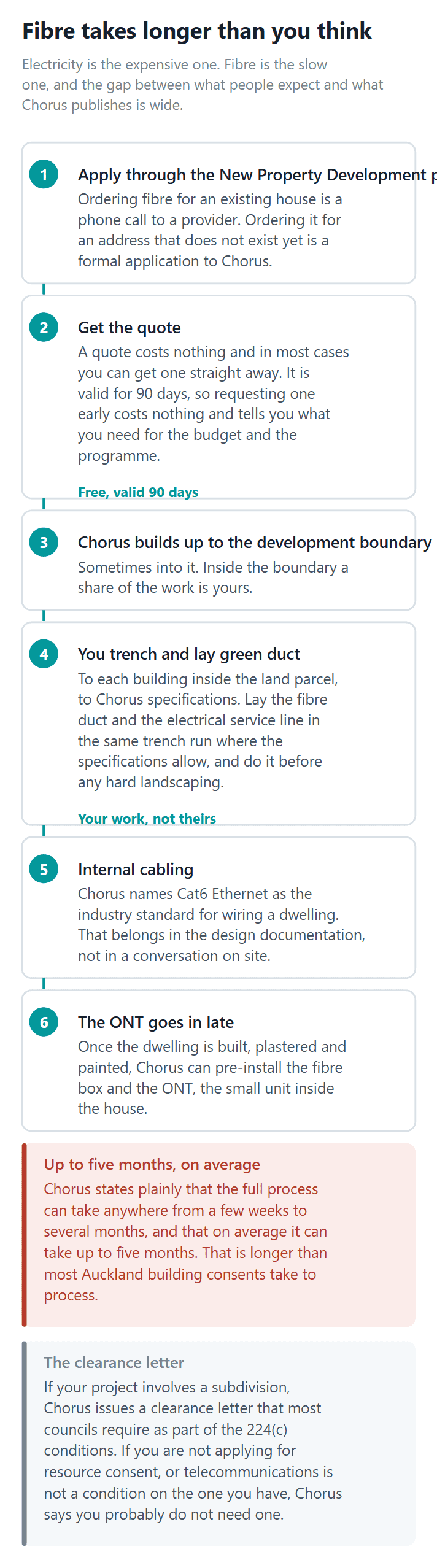
Electricity is the expensive one. Fibre is the slow one, and the gap between what people expect and what Chorus publishes is wide.
When the new property process applies to you
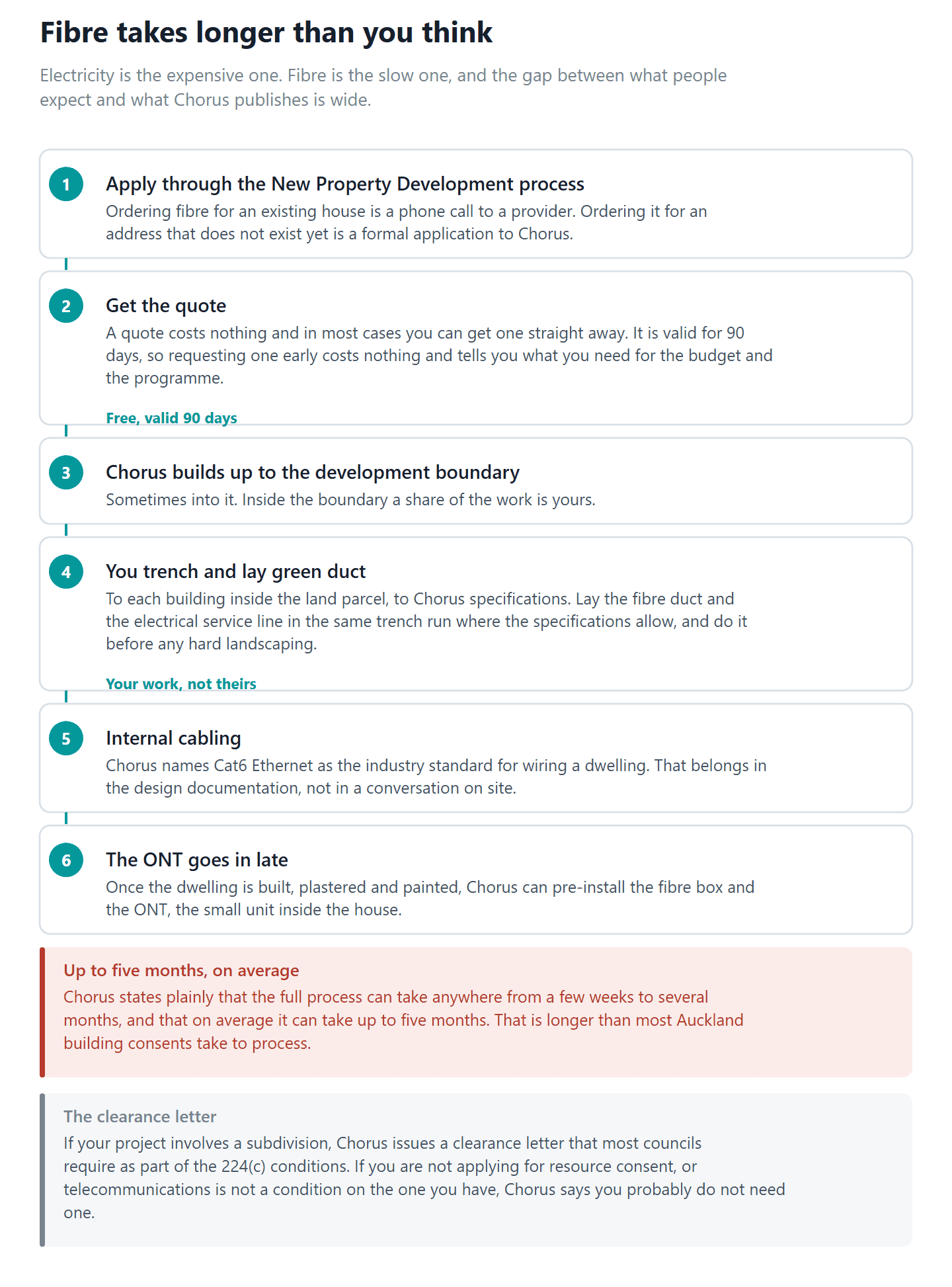
Ordering fibre for an existing house is a phone call to an internet provider. Ordering fibre for an address that does not exist yet is a formal application to Chorus, and it cannot be triggered through a normal broadband sign-up.
Chorus runs this through what it calls the New Property Development process. Getting a quote costs nothing, and in most cases you can get one straight away by supplying the address or legal description, how many connections you need, and the type of development. That quote is valid for 90 days and Chorus does not extend expired quotes — you start a new request.
The timing is the headline. Chorus states plainly that the full process can take anywhere from a few weeks to several months, that on average it can take up to five months to get everything lined up for a site, and that it does not offer a priority service.
Five months is longer than most Auckland building consents take to process, longer than many extensions take to build, and longer than the average homeowner spends between granting a consent and starting on site. That single sentence is the reason this article exists.
Important: Because the Chorus quote is free and valid for 90 days, requesting one costs you nothing but tells you two things you need for your budget and programme: what the work will cost, and whether your site needs anything unusual. Chorus notes you can print the quote and give it to the council for the resource consent process (the council’s permission to use the land in a particular way, which is a separate approval from the building consent covering the construction itself) or hand it to your bank.
The trenching and duct you have to do yourself
Chorus builds the network up to and sometimes into your development boundary. Inside the boundary, a share of the work is yours.
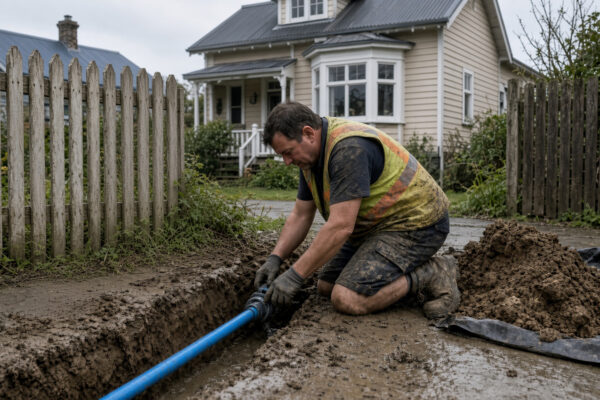
Chorus’s process is explicit that you will need to trench and lay green duct to each building inside the land parcel to its specifications. For a standard single connection that means 20mm green lead-in pipe, bought from an electrical wholesaler, and it must come with a draw-tape inside so Chorus can pull the fibre through. A pipe without a draw-tape is a pipe you will be digging up again.
Internally, Chorus names Cat6 Ethernet cable as the industry standard for wiring a dwelling. That is a decision that belongs in the design documentation alongside the lighting and power layout, because retrofitting data cabling into a finished, painted house is expensive and ugly.
💡 Homeowner tip: Lay the fibre duct and the electrical service line in the same trench run where the specifications allow it, and do it before any hard landscaping goes down. On a tight Mt Eden or Grey Lynn section where the only route to the street is a narrow side path, one trench opened once is the difference between a tidy job and cutting a finished driveway twice.
The last step happens late. Once the dwelling is built, plastered and painted, Chorus can pre-install the fibre box, the ONT (the small unit inside the house that the fibre cable terminates into). Chorus points to the gibbing stage, when the interior linings go on, as the moment to get that organised. With the ONT in place, the connection can be switched on remotely as soon as the occupants pick a provider.
The clearance letter councils ask for
If your project involves a subdivision, Chorus issues a clearance letter that most councils require as part of the 224(c) conditions, confirming phone and internet services are available at the property.
Chorus sets four conditions before it will issue one: you have agreed to the contract terms and paid; Chorus has completed the work outside your development boundary; the work inside the development is finished, with as-built documentation (drawings recording what was actually installed, as opposed to what was designed) supplied where required; and you have provided the draft or final land title plan, the surveyor’s plan showing the new boundaries and any easements.
If you are not applying for resource consent, or telecommunications is not listed as a condition on the one you have, Chorus says you probably do not need a clearance letter at all. Worth checking rather than assuming, in either direction.
For anyone weighing up a subdivision alongside the build, Superior Homes has covered the wider development economics in its guide to the cost of subdividing land in Auckland, and our own overview of subdividing in Auckland sets out the design and consent sequence.
A Second Dwelling on the Same Section: One Connection or Two?
This is the question we field most often, and the answer is more constrained than most people expect.
The default is one connection per installation
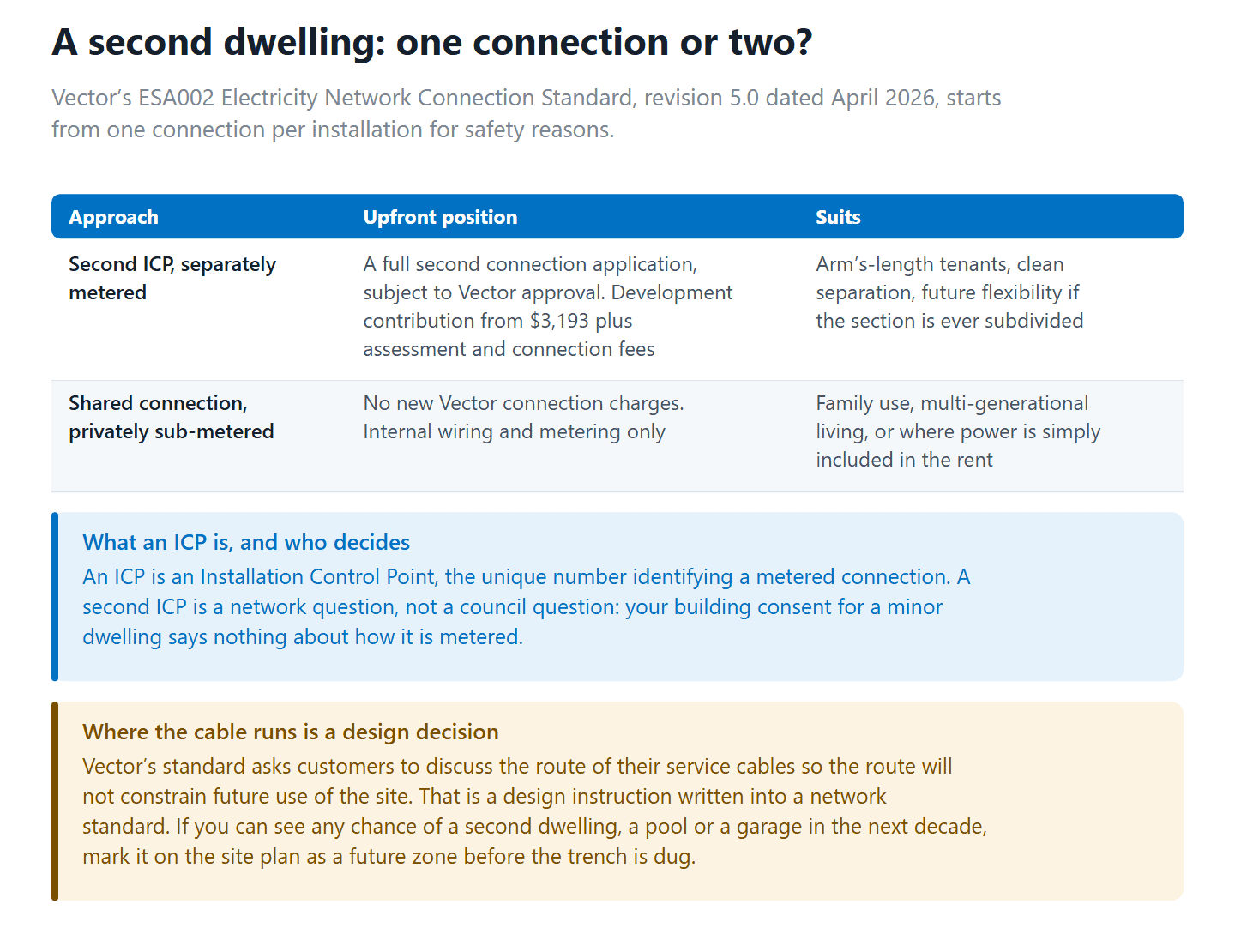
Vector’s ESA002 Electricity Network Connection Standard, revision 5.0 dated April 2026, is unambiguous on the starting position. For safety reasons there will generally be only one connection to the network per installation, and any deviation from that must be approved by Vector.
In this context an installation means the wiring system on a property, and one connection means one ICP. ICP stands for Installation Control Point — the unique number identifying a metered connection point on the network. One ICP is one power account with one retailer and one bill.
So if you are adding a Minor Residential Unit (the planning term for what most people call a granny flat — a self-contained second home on an existing residential section) and you want it separately metered and separately billed, you are asking for a second ICP. That is not automatic. It is a request Vector assesses.
Important: A second ICP is a network question, not a council question. Your building consent for a minor dwelling says nothing about how it is metered, and Auckland Council will not tell you whether Vector will approve a second connection. Check the consent rules for the dwelling itself against our guide to minor dwelling rules in Auckland, then treat the connection as a separate enquiry.
What a second connection actually costs
If Vector approves a second ICP, it is a new connection application with its own charges. On Vector’s published rates that means another assessment fee and another development contribution — a residential 0–14 kVA second connection carries the same $3,193 contribution as the first, plus the assessment fee and whatever the physical work is quoted at.
The alternative is to run the second dwelling off the existing connection and sub-meter it: fitting your own meter on the internal wiring so you can measure what the second dwelling uses, without the network company being involved. That avoids Vector’s charges entirely, but it means one account holder, one bill, and a private arrangement for splitting it.
Neither is right in every case. The honest framing is a trade-off:
| Approach | Upfront position | Suits |
|---|---|---|
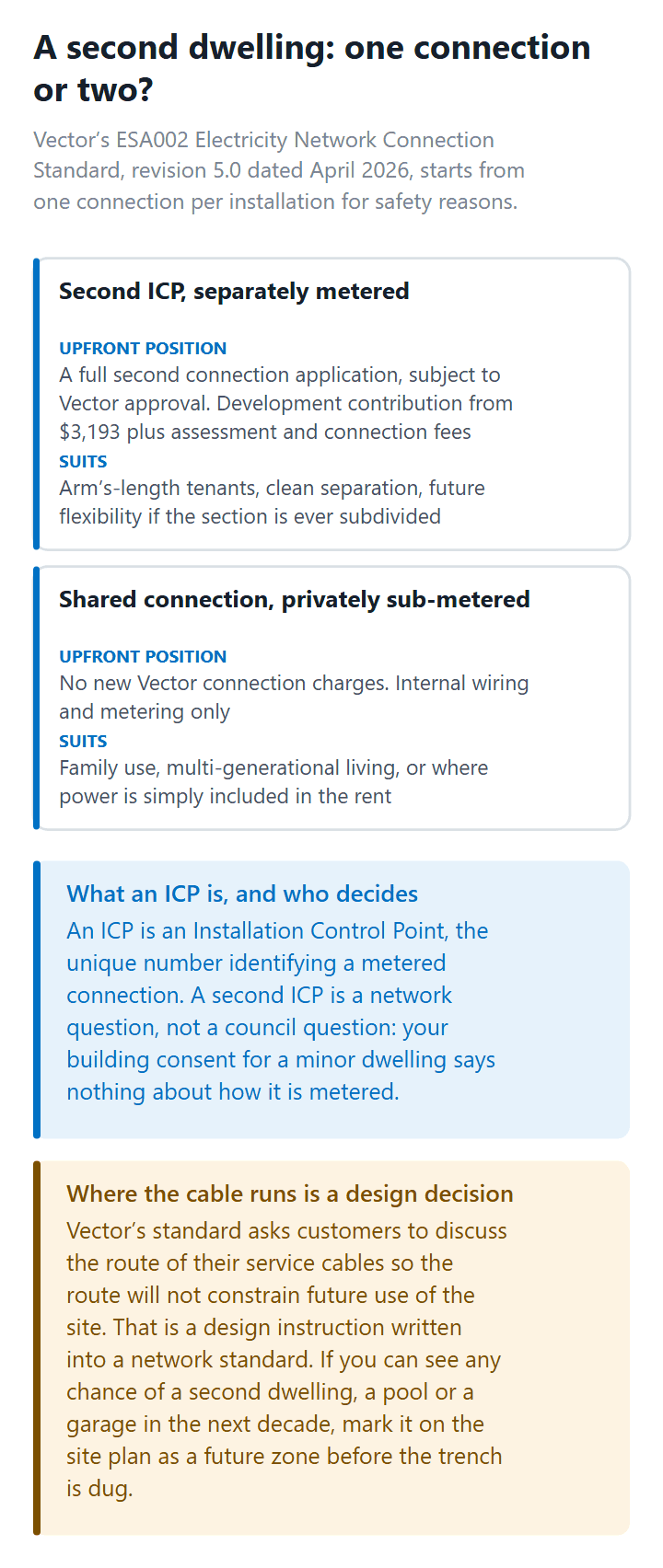
| Second ICP, separately metered | Full second connection application, subject to Vector approval; development contribution from $3,193 plus assessment and connection fees | Arm’s-length tenants, clean separation, future flexibility if the section is ever subdivided |
| Shared connection, privately sub-metered | No new Vector connection charges; internal wiring and metering only | Family use, multi-generational living, or where power is simply included in the rent |
If there is any prospect of subdividing the section later, the second ICP tends to look better in hindsight. Two dwellings sharing one connection across what becomes a new boundary is a problem you have to solve at exactly the moment you are trying to get titles issued.
Where the cable runs is a design decision, not an electrician’s decision
Vector’s connection standard asks customers to discuss the route of their service cables with their electrical service provider to make sure the route will not constrain any future construction plans, and to pick a route where they are unlikely to dig up the cables or build over them later.
That is a design instruction, written into a network standard. It is asking you to think about the whole site, in the future tense, at the moment the trench is being dug.
The version we see go wrong looks like this. A house is built in Flat Bush with the service line taking the shortest run from the boundary to the switchboard, straight across the rear yard. Five years on, the owners want a minor dwelling in exactly that spot. The cable is theirs to move, at their cost, and it is now under a paved patio.
Get it right and the same site is straightforward. On a typical Auckland section, running services down one side boundary and keeping the rear yard clear costs a little more in cable and preserves every future option you have.
💡 Homeowner tip: If you can see any chance of a second dwelling, a pool, or a garage in the next decade, mark it on the site plan as a shaded “future” zone before the services are set out. It costs nothing at design stage and it is the single cheapest piece of futureproofing available on a residential site.
This is the kind of decision that sits squarely with your designer rather than your electrician, and it is part of how we plan where a new home’s services and switchboard land at concept stage. Access is the same conversation: where the cable and the driveway cross is often the pinch point, which we covered in detail in our guide to vehicle crossing rules in Auckland.
How to Sequence It Against Your Design Programme
Put the published timeframes end to end and the sequencing answers itself.
| Stage | Vector (electricity) | Chorus (fibre) |
|---|---|---|
| Quote | Assessment fee payable within 20 working days; quote usually within 7 working days | Free; usually immediate; valid 90 days, not extendable |
| Acceptance | Pay within 35 working days before the quote expires | Accept contract and pay; detailed assessment aimed at 5 business days |
| Build | Simple connection generally completed 40 working days after payment | Up to five months on average from start to site-ready; no priority service |
| Your work | Service line from point of supply to switchboard, installed by your electrician | Trench and lay 20mm green duct with draw-tape to each building |
| Finish | ICP created and retailer notified within 3 working days; reinstatement usually within 10 working days | ONT pre-installed once the dwelling is built, plastered and painted |
The practical rule that falls out of the table: lodge the fibre application first, because it is free and it is the slowest, and lodge the electricity application as soon as the capacity and cable route are settled. Both can sit well ahead of the build. Neither benefits from waiting.
One more piece of sequencing that catches people out. Builders usually want power on site well before the house is finished, which is a Builder’s Temporary Supply — a temporary connection for a site with no existing supply. Vector assesses these within about two working days and then routes them into the simple or complex process. It can later be upgraded to a permanent supply or decommissioned. Worth raising with your builder early rather than discovering it on week one.
“The services are the part of a project where a decision made in ten seconds on site costs a homeowner thousands five years later. Where the cable enters the property, where the switchboard sits, whether the rear yard stays clear — those belong on the drawings, not on a trenching day.”
— Sonder Architecture Team
Get the Services Onto Your Programme Early
The homeowners who get caught out are almost never the ones who made a bad decision. They are the ones who did not know a decision was theirs to make.
Nothing in this article is hidden. Vector publishes its charges and its timeframes. Chorus publishes its five-month average and tells you flatly there is no way to jump the queue. The Electricity Authority’s April 2026 changes exist specifically so you can see how your connection charge was built. It is all public and it is all checkable.
What it is not is joined up. Nobody hands you a single page that says: here are the three organisations, here is what each will cost, here is how long each takes, and here are the four decisions your designer needs to make before any of it starts. That page has to be assembled, and the right time to assemble it is at concept design, while the switchboard is still a rectangle on a plan.
As the architectural design arm of Superior Renovations, we work through the servicing constraints on a site as part of feasibility, before design fees start climbing. Sonder Architecture works under LBP Design Class licensing, the Licensed Building Practitioner category covering Restricted Building Work: the structural and weathertightness work the Building Act requires a licensed person to design or supervise. Being on that side of the fence is also what keeps us across the paperwork on the other side of your boundary.
If your section is tight, sloping, rear, or has a shared driveway, the servicing question is worth answering before the design is locked, not after. Our studio is at 16 Link Drive, Wairau Valley, and the free feasibility report at sonderarchitecture.co.nz is the cheapest way to find out what your site will and will not allow.
➡ Book a free consultation with Sonder Architecture
➡ Request your free feasibility report
➡ Read our guide to Watercare connection costs in Auckland
➡ See recent projects we’ve done across Auckland
Vector publishes two of the three charges. From 1 April 2026 the assessment fee on a simple connection is $300 including GST, and the development contribution is $3,193 per connection for a standard residential 0-14 kVA supply, or $5,339 for 15-69 kVA. The third charge, the connection fee for the physical work, is quoted per job and depends on distance from the network, ground conditions, whether the cable is underground or overhead, and traffic management. Budget from about $3,500 in fixed charges before the quoted works. Vector says a simple connection can usually be completed in approximately six to eight weeks. Within that, you pay the assessment fee within 20 working days, receive a quote usually within seven working days, then have 35 working days to pay before the quote expires. Connection is generally completed 40 working days after payment, with final reinstatement usually within 10 working days after that. A complex connection needing an easement takes considerably longer. No. Your building consent is Auckland Council's approval for the construction work and it covers the electrical installation inside the house against the Building Code. It does not cover the network connection. Electricity is a separate application to Vector, fibre is a separate application to Chorus, and water and wastewater is a separate application to Watercare. None of those clocks start when your consent is granted. Not necessarily, and it is not automatic. Vector's ESA002 connection standard states that for safety reasons there will generally be only one connection, meaning one ICP, per installation, and any deviation must be approved by Vector. If you want the minor dwelling separately metered and separately billed, you are applying for a second connection with its own assessment fee and its own development contribution. The alternative is running it off the existing connection and sub-metering privately. ICP stands for Installation Control Point. It is the unique number identifying a metered connection point on the electricity network. One ICP equals one power account with one retailer and one bill. It matters because the number of ICPs on your property determines how many separate power accounts you can have, and adding one is a Vector approval and a Vector charge, not something your electrician can simply create. Chorus states that the full new property process can take anywhere from a few weeks to several months, that on average it can take up to five months to get everything lined up for a site, and that it does not offer a priority service. Getting the quote itself is free and usually immediate, and the quote stays valid for 90 days. Because it is free and slow, lodging the fibre application early is close to a no-cost decision. Inside your property boundary the trenching and duct are your responsibility. Chorus requires you to trench and lay green duct to each building inside the land parcel, and for a standard connection that means 20mm green lead-in pipe bought from an electrical wholesaler with a draw-tape inside so the fibre can be pulled through. Chorus names Cat6 Ethernet as the industry standard for internal wiring, which is best specified during design rather than retrofitted. The point of supply is the legal boundary between the lines company's equipment and yours. It is defined in the Electricity Act 1992, and Vector describes it practically as the isolating fuse either on your property boundary or on the nearest pole. Everything on the network side is Vector's. Everything on the house side, including the service line running to your meter and switchboard, is yours to install, own and maintain. The Electricity Authority introduced new requirements for how all New Zealand distributors present connection charges. Vector says these do not automatically increase charges or introduce new fees, but quotes now show more detail. Your quote is built on the lowest-cost design that meets your capacity requirements, with anything above that shown separately as an optional enhancement. You can also request a Connection Charge Reconciliation, ask whether a flexible connection suits you, and check whether a pioneer scheme applies. Yes, but it may cost extra and it will now be itemised. Under the 1 April 2026 presentation rules, if your area's standard is an overhead connection and you choose underground, Vector treats that as an optional enhancement above the lowest-cost design and shows the additional cost as a separate line item on your quote. It is a legitimate design choice and often the right one on a street-facing site, but it is now visibly a choice. If your subdivision resource consent lists telecommunications and electricity as conditions, yes. Vector emails a Certificate of Completion to forward to Auckland Council for the section 224(c) application, and Chorus issues a clearance letter once its work is complete, your internal work is done, and you have supplied the draft or final land title plan showing easements. Chorus notes that if you are not applying for resource consent, or telecommunications is not listed on it, you probably do not need one. As early as the design allows. Lodge the fibre application first because the quote is free and the process is the slowest, and lodge the electricity application as soon as the required capacity and the cable route are settled. Vector's own advice is to apply as soon as you can. There is no benefit to waiting and no penalty for having a connection ready before the house is finished.
How much does a new power connection cost in Auckland?
How long does it take to get power connected to a new build?
Is my building consent enough to get power and fibre connected?
Does a granny flat need its own power connection?
What is an ICP and why does it matter?
How long does Chorus take to connect fibre to a new build?
What do I have to install myself for fibre?
What is the point of supply and why does it matter?
What changed on 1 April 2026 for electricity connection charges?
Can I choose an underground cable instead of an overhead one?
Do I need a clearance letter from Vector and Chorus for my subdivision?
When should I apply for power and fibre on a new build?
References
- Vector — Simple electricity connection: pricing, development contributions and process
- Vector — Complex connection supply point: process and timelines
- Vector — New electricity connection: overview and ownership
- Vector — Livening the connection: ICP creation and retailer notification
- Vector — ESA002 Electricity Network Connection Standard, revision 5.0, April 2026
- Vector — Electricity connection pricing updates, updated 1 April 2026
- Chorus — Getting fibre to your development: the five-step process
- Chorus — New property development pre-application questions
- Chorus — Quote and agree: quote validity, payment and assessment
- Auckland Council — Apply for a section 224c certificate (subdivision)
- New Zealand Legislation — Electricity Act 1992, interpretation and point of supply
- Building Performance (MBIE) — Apply for a building consent