
Quick answer: A certificate of acceptance in NZ is the council’s after-the-fact sign-off for building work done without a required building consent. In Auckland it costs a $1,447 or $2,412 base fee, takes up to 20 working days, and can only cover work done from 1 July 1992.
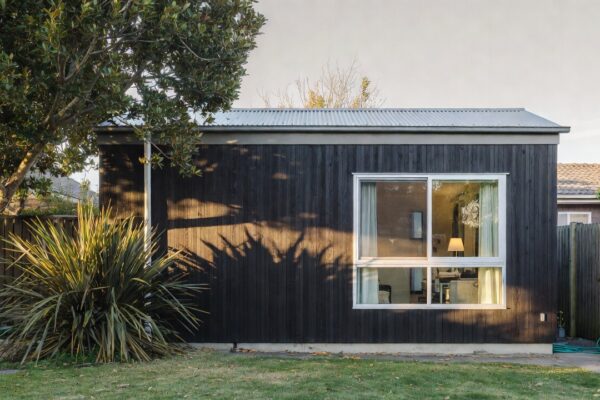
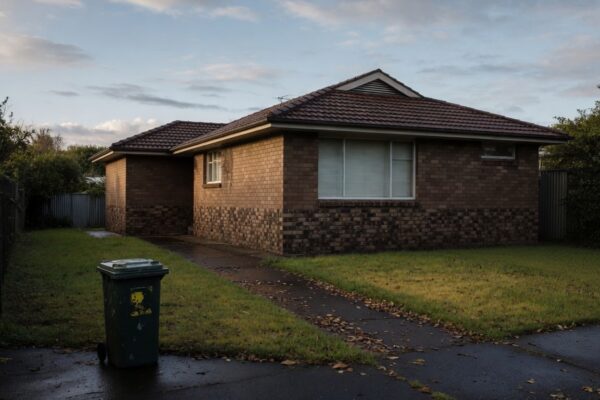
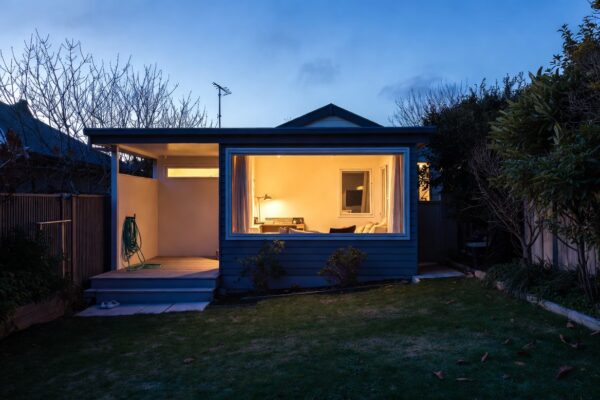
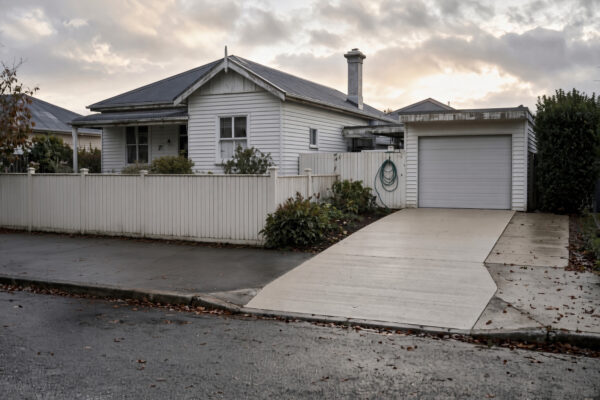
Picture a 1970s weatherboard house in Glenfield. Sometime around 2010, the previous owners lined the garage, added a window and a small bathroom, and started calling it the sleepout. Nobody applied for a building consent.
You bought the house last year. Now you want to refinance, or sell, or add a kitchenette and let the space to a tenant. That is usually the moment someone says the words “certificate of acceptance”, and most homeowners have never heard them before.
A certificate of acceptance (CoA) is the council’s formal acknowledgement that building work done without a building consent meets the Building Code, as far as the council can tell. A building consent is the council’s permission to carry out building work before it starts. The Building Code is the national set of performance standards every building in New Zealand has to meet, covering structure, fire safety, moisture, ventilation, energy use and more.
A CoA is not a retrospective building consent, and it is not a Code Compliance Certificate (the certificate the council issues when consented work is finished and signed off). It is its own document, with its own legal test, its own limits, and a habit of costing more than the fee on the council’s website suggests.
This guide works from the source documents rather than second-hand summaries: sections 96 to 99A of the Building Act 2004, Auckland Council’s current certificate of acceptance page, and its September 2025 guidance note AC1805, which sets out how the council actually assesses unauthorised building work. We cover who can apply, what a CoA can and can’t prove, what it really costs, how the process runs step by step, and when applying is the wrong move.
We’re Sonder Architecture, an Auckland design studio that handles the consent side of renovations, conversions and second dwellings. If you have unconsented work on your property, the first decision is not how to apply. It is whether a CoA is the right route at all.
What a Certificate of Acceptance Is Under NZ Law
The CoA lives in section 96 of the Building Act 2004. The Act gives the job to the “territorial authority”, which in Auckland simply means Auckland Council. Only the council can issue a CoA. A private building surveyor, an engineer or a designer can help you build the case, but none of them can issue the certificate.
The three situations a CoA covers
Section 96(1) lists exactly three situations where the council may issue one:
- Unconsented work by an owner. The work was done by the owner, or by a previous owner (the Act’s phrase is “predecessor in title”), and a building consent was required but not obtained. This is the one almost every homeowner is dealing with.
- Urgent work. Work that had to be carried out urgently under section 42 of the Act, for example to protect life or health, or to prevent serious damage to property, where getting a consent first wasn’t practical.
- A private certifier that can’t finish the job. Work that did have a building consent from a private building consent authority (one that isn’t a council), where that authority is unable or refuses to issue the Code Compliance Certificate.
The rest of this guide deals with the first situation, because that is the one sitting on most Auckland property files. If your work was consented by Auckland Council and simply never signed off, you don’t need a CoA at all. You need to close out the consent and apply for the Code Compliance Certificate, which our guide to selling a house without a CCC covers in detail.
The legal test the council has to apply
Section 96(2) sets the bar. The council may issue a CoA only if it is satisfied, “to the best of its knowledge and belief and on reasonable grounds”, that “insofar as it could ascertain” the building work complies with the Building Code.
The whole process hangs off that phrase. “Insofar as it could ascertain” means the council is only vouching for what it can actually see or verify. Framing behind finished linings, a waterproofing membrane under tiles, the reinforcing steel in a slab: if nobody can see it and nobody recorded it, the council may not be able to accept it.
The burden of proof sits with you, not the council. Auckland Council’s guidance note AC1805, How unauthorised building work is assessed, says it in so many words: section 96 places the burden of proof on the applicant to demonstrate that the work complies.
Important: A CoA does not make the original unconsented work lawful after the fact. Section 96(3) says it does not limit section 40, the rule that building work needing a consent must not be done without one. Section 40 carries a fine of up to $200,000, plus up to $10,000 for every day a continuing offence goes on. See section 40 of the Building Act 2004.
The 2024 change most guides haven’t caught up with
On 26 November 2024, Parliament added a new subsection to section 96. Section 96(4) now says that once a CoA has been issued for work, nobody needs to apply for a building consent for that same work. It was inserted by the Building (Earthquake-prone Building Deadlines and Other Matters) Amendment Act 2024.
Why does it matter? Read together, the two subsections draw a clear line. The offence of building without consent still stands, but once the council has accepted the work, you are not left needing a building consent for it as well. A CoA and a building consent are alternatives for the same piece of work, not two bills for it. Most of the CoA explainers online were written before this subsection existed.
The 1 July 1992 line
Building consents came in with the Building Act 1991. Before that, councils ran a building permit system under local bylaws. Auckland Council will not issue a CoA for unconsented work completed before 1 July 1992, according to its certificate of acceptance page. That older work belongs to the permit era, and the CoA process doesn’t reach back into it. We cover what you can do about pre-1992 work further down.
So the first fact to pin down is a date. A 1960s lean-to on a Mt Albert bungalow and a 2010s garage conversion in Glenfield sit in two completely different legal systems, even though both look like “unconsented work” on a buyer’s report.
💡 Homeowner tip: Work out when the work was done before anything else. Old real estate photos, aerial imagery, invoices and the memories of neighbours who have been on the street for decades are all useful. The date decides which process you are in.
What a CoA Can and Can’t Prove
The limits are written into the Act itself. A CoA is a limited document by design, and the law says so in plain terms. That isn’t a reason to avoid one. It is a reason to know exactly what you are paying for.
A certificate can be qualified
Under section 99(2) of the Building Act, a CoA may be “qualified” to say that only parts of the building work could be inspected. In practice, that means your certificate can list some work as accepted and other work as excluded.
AC1805 spells out how Auckland Council handles this. The CoA lists the building work the council inspected and could establish compliance for. Any work that can’t be verified is also listed, and excluded. The council’s CoA page adds that unverified work is marked “not approved” on the certificate itself.
Think about what that means for a buyer reading your LIM (Land Information Memorandum, the council’s report on everything it officially knows about a property). A certificate that accepts the framing and roof but marks the shower waterproofing “not approved” tells them exactly where the risk sits. A partial CoA can be more useful than no CoA, but it is not a clean bill of health.
The council’s liability is capped at what it saw
Section 99(3) limits the council’s liability for a CoA “to the same extent that the territorial authority was able to inspect the building work in question”. If the council couldn’t see it, the council isn’t standing behind it. The risk for the hidden parts stays with the owner.
It is judged against today’s Building Code, not the one in force when it was built
This is the detail that catches people out most often. AC1805 states that all plans submitted with a CoA must demonstrate compliance with the current Building Code, rather than the Building Code that was in place at the time of construction.
So a sleepout lined in 2009 is not assessed against 2009 rules. It is assessed against the Code as it stands on the day you apply. The insulation requirements under clause H1 alone have changed several times since 2022, as our guide to New Zealand insulation rules explains. The longer ago the work was done, the wider the gap between how it was built and what it now has to meet.
“People assume a CoA is the council grading old work against old rules. It isn’t. It’s today’s Code applied to work nobody inspected, so we price the insulation, the wet areas and the bracing as if they were new until the evidence says otherwise.”
— Sonder Architecture Team
It doesn’t stop the council taking further action
Auckland Council’s CoA page is blunt: “If we issue a CoA for unconsented building work, it does not mean we cannot take further action.” AC1805 adds that the council will take an issued CoA into account when deciding on enforcement, but it doesn’t remove its ability to act. We cover who is actually exposed to enforcement in a later section.
CoA versus CCC, side by side
The two certificates get confused constantly, partly because both end with the council saying the work meets the Code. A Code Compliance Certificate (CCC) is the council’s sign-off at the end of consented work. A CoA is the sign-off for work that never had a consent. A CCC cannot be issued for any work that is the subject of a CoA, according to AC1805, and a building consent can’t be issued retrospectively for work that is already finished.
| Question | Code Compliance Certificate (CCC) | Certificate of Acceptance (CoA) |
|---|---|---|
| When it applies | Work done under a building consent | Work done without a required building consent (s96) |
| Inspections | Inspected in stages while it was built | Assessed after completion; hidden work may be excluded |
| Code it is assessed against | The Code the consent was granted under | The current Code on the day you apply (AC1805) |
| Can it be partial? | Covers the consented work | Yes, may be qualified and list work as “not approved” (s99(2)) |
| Council liability | Normal liability for its inspections | Limited to what it could inspect (s99(3)) |
| Decision timeframe | 20 working days | 20 working days, paused for information requests (s98) |
| Work before 1 July 1992 | Not applicable | Not available (Auckland Council) |
💡 Homeowner tip: Before you apply, ask the question your bank or insurer will ask: would a qualified certificate with some items excluded actually solve your problem? If the excluded item is the one they care about, you may need to open up the work or replace it anyway.
Do You Have to Apply? Your Options for Unconsented Building Work
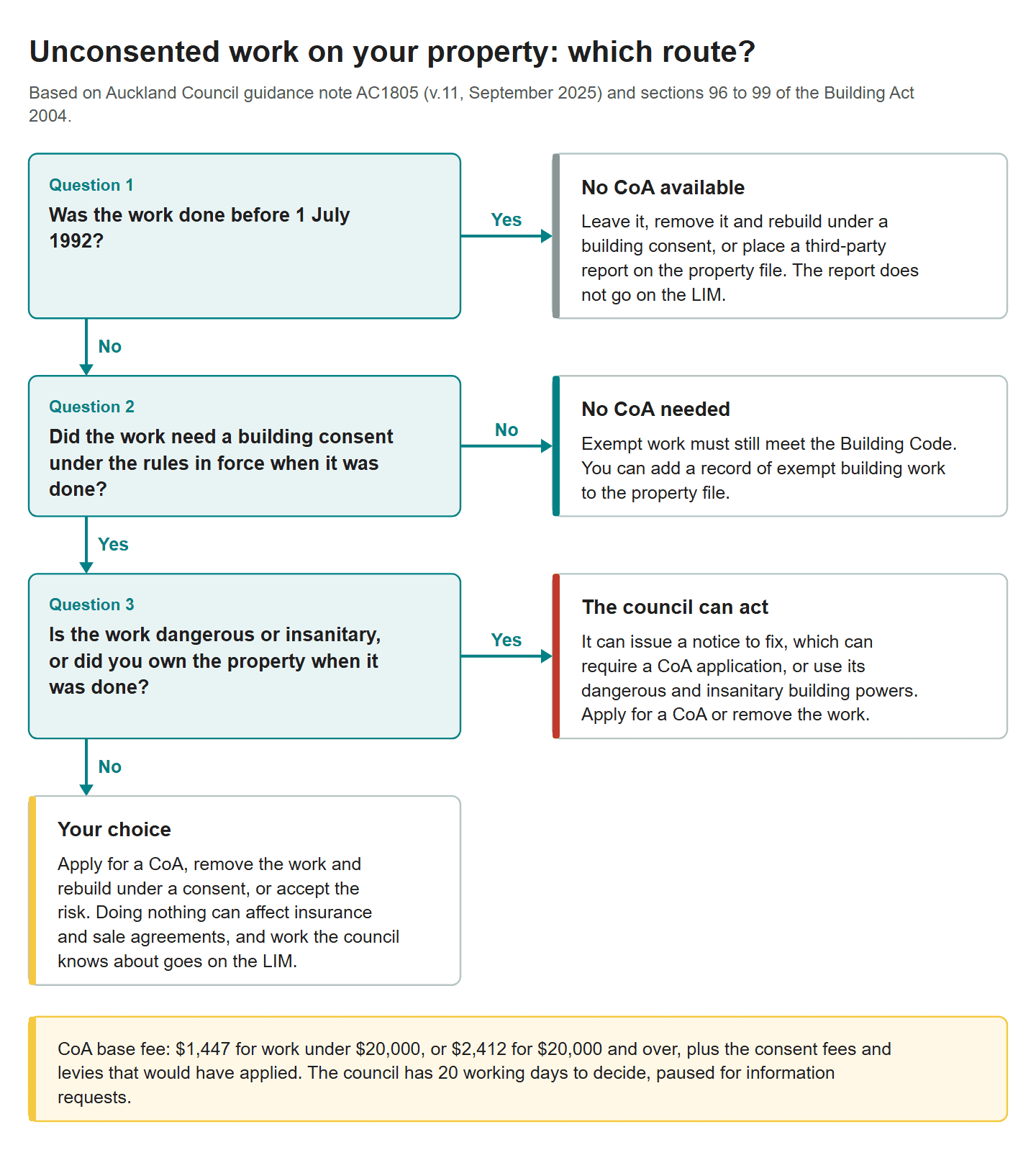
Not always. AC1805 asks the question directly, “Do I have to obtain a CoA for unconsented building work carried out after 1 July 1992?”, and answers it “No”. What you can do instead depends on three things: when the work was done, whether it needed a consent in the first place, and whether you owned the property when it was done.
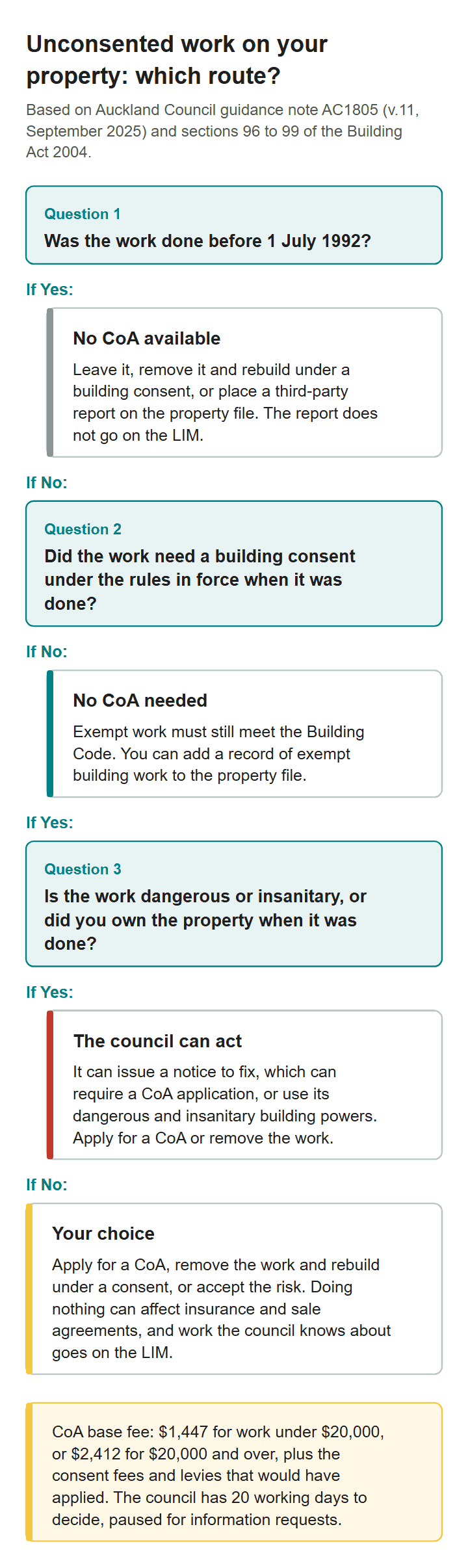
First, check whether it needed a consent at all
Plenty of “unconsented” work never needed a consent. Schedule 1 of the Building Act lists building work that is exempt from consent, within size and other limits: many small sheds, some decks, like-for-like repairs, and since recent changes, some standalone granny flats. Our guide to what you can build without a building consent in NZ walks through the current list.
There is a catch with timing. AC1805 notes that the exemptions have widened over the years, so work that needed a consent when it was built may not need one today, but if it was not exempt at the time, it may still require a CoA. The test is the rule in force when the work was done, not the rule you would build under now.
If the work genuinely was exempt, you don’t need a CoA. Auckland Council lets you add a record of exempt building work to your property file (the council’s record of plans, permits and consents for the address), which helps a future buyer see that it was done properly. Exempt work still has to comply with the Building Code; the exemption only removes the need for the consent.
Option 1: Apply for a CoA
This is the route for work you want to keep and have accepted. It suits work that was done reasonably well, where enough evidence exists, or can be uncovered, to show it meets today’s Code. The rest of this guide covers how it runs.
Option 2: Remove it, then rebuild with a consent
Sometimes the honest answer is that the work isn’t worth saving. AC1805 lists demolition as an option, with two checks first: whether the demolition itself needs a building consent under Schedule 1, and whether the Auckland Unitary Plan (the planning rulebook for the whole region) requires a resource consent, which is the council’s separate permission for how land is used. If you then want to rebuild, you get a building consent before starting.
We often run the numbers both ways for clients. A poorly built garage conversion might need so much opened up, replaced and re-documented to win a CoA that designing it properly and consenting it from scratch costs about the same and leaves you with a full CCC instead of a qualified certificate. That comparison is exactly what our feasibility work is for: we work out whether unconsented work is worth legalising or replacing before you spend on either.
Option 3: Accept the risk and do nothing (only in some cases)
AC1805 allows this, with tight conditions. If the work is not dangerous or insanitary, and you did not own the property when it was done, you may decide to accept the risks of ownership and take no action. “Insanitary” is the Building Act’s word for a building that is unhealthy to occupy, for example because moisture is getting in and causing dampness, or it lacks adequate drinking water or sanitary facilities (section 123).
The council attaches warnings to that option. The decision can affect insurance cover and your obligations under a sale and purchase agreement, and the council strongly recommends independent expert advice first. Once the council becomes aware of unauthorised building work, that information goes on the property’s LIM, where every future buyer will see it.
Important: Many sale and purchase agreements include a vendor warranty that no work has been done without a required permit or consent, AC1805 notes. If you are selling a property with unconsented work, talk to your lawyer before you sign, not after. See Auckland Council’s AC1805 guidance.
Owner at the time or later buyer: why it changes your exposure
This is the part of AC1805 that surprises people. Unless the work makes the building insanitary or dangerous, no enforcement action can be taken against an owner who was not the owner when the building work was done.
If you were the owner at the time, the picture changes. The council can issue a notice to fix under section 164 of the Building Act, which is a formal written direction to put a breach right, and AC1805 says that notice can require you to apply for a CoA. The council can also issue an infringement notice (an on-the-spot fine), complain about the practitioners who did the work, or prosecute under section 40. Whether it does depends on the circumstances.
And if the work is dangerous or insanitary, ownership history stops mattering. Section 124 gives the council power to fence off the building, post warnings and require work to remove the danger, whoever owns it.
Picture two neighbours in Birkenhead with near-identical unconsented sunrooms. One owner built theirs in 2015. The other bought their house in 2022 with the sunroom already there. If neither sunroom is unsafe, the council’s options against each are very different. The structures match, but the council’s options against each owner don’t.
Pre-1992 work: the third-party report
For work done before 1 July 1992, a CoA isn’t available. AC1805 says it isn’t necessary to do anything about it, but if you are concerned the work doesn’t comply, you can demolish it (with the same Schedule 1 and Unitary Plan checks) or get a third-party report from an independent expert.
A third-party report is placed on the property file as a public record only. It does not go on the LIM, and the council accepts no liability for what it says. The owner has to sign an agreement to that effect. The council also won’t inspect and “sign off” old permit-era work for a solicitor; there is no requirement under the Act for it to do so.
💡 Homeowner tip: If you are buying, ask for the property file as well as the LIM. The LIM summarises; the property file holds the actual plans and permits, which is often the fastest way to see whether the sleepout on the brochure was ever approved. Auckland Council explains the difference on its property files and LIM reports page.
How the CoA Process Runs in Auckland, Step by Step
Auckland Council only accepts CoA applications online. The application itself is the last step, not the first. Most of the work, and most of the cost, happens before anything is lodged.
Step 1: Find out what the council already holds
Start with the property file and, if you don’t already have one, a LIM, which you can order online from Auckland Council. You are looking for three things: whether any consent or permit exists for the work, whether a council notice about the work is already recorded, and what the approved plans for the rest of the house show. If a council consent exists for the work, you are on the CCC route, not the CoA route.
Step 2: Book a pre-application meeting
Auckland Council recommends a CoA pre-application meeting before you apply. It isn’t mandatory, but we’d treat it as such on anything larger than a minor alteration. The meeting establishes four things, according to AC1805: whether you need a PIM, whether a building consent would have been required for all of the work, whether a resource consent is required, and whether the work is likely to be approved.
A PIM (Project Information Memorandum) is the council’s report on what it knows about a site that is relevant to a particular building project. As above, a resource consent is the council’s permission to use land in a way the Unitary Plan doesn’t allow as of right, which is separate from the building side entirely.
The meeting usually involves a building officer and a planner, plus anyone else the work calls for, and you receive written minutes afterwards. AC1805 says they are held at the main area office closest to the property (Albany, Central or Manukau), except for recladding work, which is heard at 135 Albert Street in the city. Pre-application meetings carry their own fee, and the council may ask for documents at least three working days beforehand. You request one through the council’s pre-application guidance page.
Step 3: Sort the planning side first
All work has to comply with the Unitary Plan. If the unconsented work breaches a planning rule, such as a yard setback (how close you can build to a boundary), height in relation to boundary (the angled limit on how tall a building can be near a boundary) or site coverage (how much of the section buildings can cover), the council expects you to get the resource consent before you apply for the CoA. AC1805 is explicit that any PIM, resource consent or other approval should be obtained first. Planning breaches are dealt with under the Resource Management Act 1991 (RMA), not the Building Act.
This is where some CoA applications stall before they start. A sleepout built hard against a side boundary in Point Chevalier might be structurally sound and still need resource consent for where it sits. If that consent isn’t achievable, AC1805 notes the council can require removal.
Step 4: Build the evidence pack
This is the heavy lifting. AC1805 requires the documents to be “to the same standard as that submitted for a building consent”. In practice, the pack includes:
- Proof of ownership: the record of title, a sale and purchase agreement or another document showing the full names of all owners.
- Your reasons for applying: a short statement of why a CoA is needed.
- Two copies of fully detailed plans and specifications, professionally drawn, with engineering, bracing and energy efficiency calculations as they apply. Bracing is the system of walls and fixings that stops a building racking sideways in wind or an earthquake.
- A building report describing the work, with a statement confirming compliance with the Building Code, from a suitably qualified and independent professional.
- Supporting evidence: owner statements, delivery dockets, invoices, photographs taken during construction, statements from the people who did or witnessed the work, and gas or electrical energy works certificates.
Who can write that building report? Auckland Council lists a chartered professional engineer, a registered architect, a registered building surveyor (a member of the New Zealand Institute of Building Surveyors, NZIBS), a Level 3 accredited building surveyor (accredited through the Building Officials Institute of New Zealand, BOINZ), or, for wood burners and other solid fuel heaters only, a solid fuel appliance installation technician. The right author depends on what the work is; a structural question goes to an engineer, a weathertightness question often to a building surveyor. AC1805 adds that authors should be on the council’s Producer Statement Register, its list of professionals whose signed statements of compliance (producer statements) it accepts.
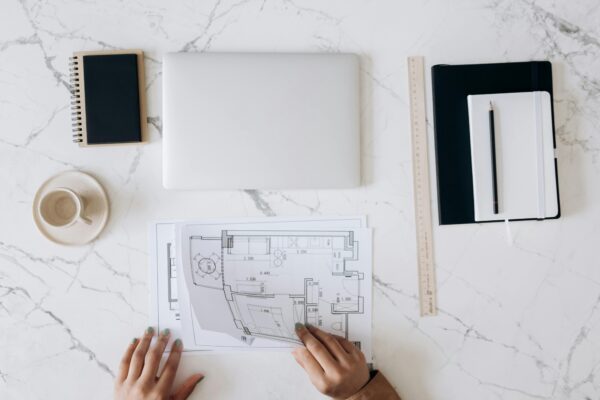
Where do we fit in? Our designers are Licensed Building Practitioners (LBPs, people licensed by the government to design or carry out certain building work) in the Design class. We are not on the council’s list of building report authors, and we won’t pretend otherwise. What we do is the other half of the pack: measuring the work as it stands, producing the as-built plans (drawings of the building as it actually stands) and specifications to consent standard, coordinating the engineer or surveyor who writes the report, and designing any remedial work the assessment turns up.
“The drawings are where most CoA applications fall over. A hand sketch of a garage conversion won’t get through. The council wants the same set it would have wanted before the work started, drawn as the building actually stands today.”
— Sonder Architecture Team
Step 5: Lodge and pay
You lodge online with the base fee, which is non-refundable. Under section 97(e) of the Act, you must also pay any fees, charges or levies that would have been payable if a building consent had been applied for before the work was done. We break the costs down in the next section.
Step 6: Assessment and inspection
Council officers check the work, plans and specifications against the Building Code, weighing your evidence and the opinion of your report’s author. “In most cases, they will also need to do an inspection,” the council’s CoA page says.
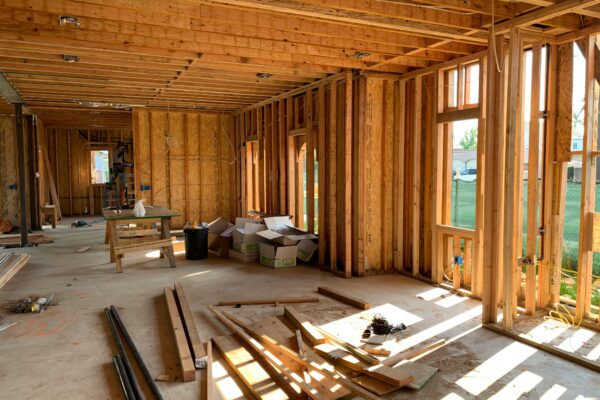
Where something critical is hidden, expect a request to expose it. That might mean cutting inspection holes in linings, lifting a section of flooring, removing a tile or two, or digging beside a footing. Opening up is often the difference between a full and a qualified certificate. It is also where costs climb, because everything opened has to be made good afterwards.
Step 7: The decision
Under section 98, the council must grant or refuse the application within 20 working days of receiving it. If it asks for more information, the clock stops until that information arrives. One of four things then happens:
- Granted in full. The CoA is issued and goes on the property file.
- Granted with qualifications. Some work is accepted and some is listed as excluded or “not approved”.
- Granted but withheld. If development contributions are owed, the council can hold the certificate back until they are paid (section 99AA). Development contributions are charges councils levy to fund the extra roads, pipes and parks that new homes create, so they matter most when the unconsented work created a second dwelling. The council explains them on its development contributions page.
- Refused. Section 99A requires the council to give written notice of the refusal and its reasons. AC1805 warns that a refusal can be followed by a notice to fix, or by a requirement to remove the work if it is dangerous or insanitary.
If you disagree with a refusal, you can apply to the Ministry of Business, Innovation and Employment (MBIE) for a determination, which is a binding ruling from the government’s building regulator. Section 177(3)(b) of the Building Act expressly covers a council’s decision on a certificate of acceptance. A determination is a last resort, not a second opinion; it takes time and you still need the evidence.
💡 Homeowner tip: AC1805 says a CoA “only applies to completed work and cannot be issued for proposed or incomplete work.” If the job is half-finished, either finish it to a standard you can evidence, or stop and get a building consent for the rest.
What a Certificate of Acceptance Costs in Auckland
The council’s fee is the easy part to find. It is rarely the biggest part of the bill.
The council base fee
Auckland Council publishes two base fees for a CoA, both payable when you lodge and both non-refundable, with “additional charges may apply” against each:
| Value of the unconsented work | CoA base fee |
|---|---|
| Up to $19,999 | $1,447 |
| $20,000 and over | $2,412 |
Source: Auckland Council, Certificate of Acceptance (CoA) for unconsented building work, checked 03 Oct 2026. Council fees change from time to time, so confirm the current figure before you budget.
The bills on top of the base fee
Here is what actually builds the total. We won’t put numbers against the items that depend entirely on the work and the consultant, because any figure we gave you would be a guess. What we can tell you is which lines to expect:
- Back-dated consent fees and levies. Section 97(e) requires you to pay the fees, charges and levies that would have applied had a building consent been sought before the work was done. You don’t escape the consent costs by skipping the consent.
- Additional council charges. The council lists both base fees with the note that additional charges may apply, so treat the base fee as a starting point.
- The pre-application meeting fee, if you hold one.
- The building report from an engineer or building surveyor.
- As-built plans and specifications drawn to consent standard, with any calculations the work needs.
- Opening up and making good: cutting linings, lifting floors or exposing foundations, then repairing everything afterwards.
- Remedial work: anything that fails the current Code and has to be fixed before the council will accept it.
- Development contributions, if the work created a new dwelling and they were never paid.
- Resource consent, if the work breaches a Unitary Plan rule.
The last three are the ones that turn a modest application into a serious project. A CoA for a well-documented 2015 deck is a small job. A CoA for a garage that became a self-contained flat in 2008 can mean new insulation, fire separation, a development contribution and a resource consent, before anyone talks about the certificate itself.
Is it worth it?
That depends on what the CoA unlocks for you. For a sale, a refinance or an insurance renewal, the answer is often yes, because a buyer’s lawyer or a lender may otherwise walk. For a low-value structure you could replace cheaply, removing it and rebuilding under consent can be the cleaner result. The comparison only works if both options are priced against the same scope, which is why we look at them side by side.
Important: Auckland Council will not issue a CoA while development contributions are unpaid, and section 99AA of the Building Act lets it withhold the certificate until they are. If your unconsented work created a second home on the section, ask about development contributions at the pre-application meeting.
Unconsented Work We See Most Often, and How Each Usually Plays Out
The legal test is the same for every job. What changes is how much of the work is hidden, and how far it sits from today’s Code. These are the patterns that come up most in Auckland.
Garage conversions
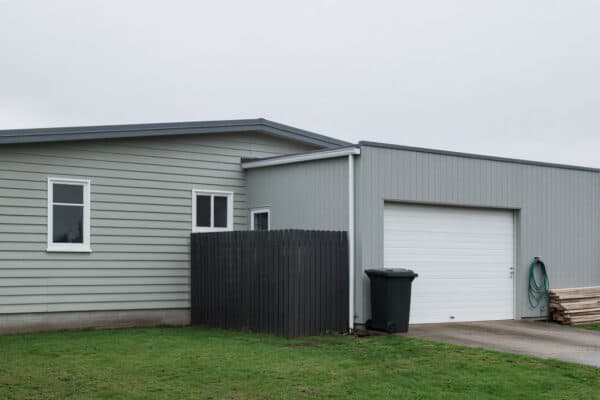
The classic. A garage gets lined, carpeted and turned into a bedroom, rumpus room or flat. Turning a garage into a habitable room is a building consent job, and our garage conversion costs guide covers why. The hardest items to evidence are usually the ones under the floor and inside the walls: whether the concrete slab has a damp-proof membrane (the plastic sheet underneath that stops ground moisture rising), how the walls are insulated, and whether ceiling heights, ventilation and natural light meet the Code for a habitable room.
If the conversion added a kitchen and is let to another household, there is a second question on top. Creating a separate home is a change of use under the Building Act, with its own compliance test, which we cover in our guide to change of use under the Building Act. Superior Renovations, our sister company, has a practical guide to converting a garage into a granny flat the consented way.
Sleepouts that grew a kitchen or bathroom
A sleepout can be exempt from consent within Schedule 1 limits. Add plumbing, a kitchenette or a toilet and it usually isn’t any more, and the drainage connection brings in its own requirements. Our guide to building a sleepout in NZ sets out where the exemption stops.
Bathrooms and wet areas
An added ensuite in a 1990s Howick two-storey is a typical case. The visible fittings are easy to assess. The waterproofing membrane under the tiles, and the drainage falls under the floor, are not, which is why wet areas are one of the items most often listed as excluded or that end up opened for inspection.
Decks, carports and enclosed verandas
Plenty of decks are exempt, but height above ground, and what the deck is attached to, can take one out of the exemption. Enclosing a carport or veranda to make a room changes the building’s envelope (its outer shell of walls, roof and windows) and usually needs a consent. These are often the most straightforward CoAs because the structure is exposed and can be looked at directly.
Recladding
Replacing cladding is generally a consent job, and it is one of the few CoA categories with its own pre-application venue at 135 Albert Street. If you are considering reclad work, Superior Renovations covers the consent question in can I reclad my house without building consent. Cladding is one area where opening up to inspect the framing behind it is common, because what sits behind the cladding is what decides weathertightness.
💡 Homeowner tip: Gather evidence before anyone touches the work. Photos from the build, the builder’s invoices, product delivery dockets and the electrician’s certificate are all listed by Auckland Council as acceptable supporting evidence, and every one you find may reduce how much has to be opened up.
Before You Apply: Picking the Right Route
Unconsented work feels like a problem with one answer. It usually has three or four, and the cheapest one is rarely the obvious one.
Pin down when the work was done, because 1 July 1992 decides whether a CoA is even possible. Check whether it needed a consent under the rules in force at the time. Work out whether you owned the property when it was built, because that changes your exposure. Then price the CoA route against removing and rebuilding, using the same scope for both, and remember that a CoA is judged against today’s Building Code and may come back qualified.
If you do apply, the application lives or dies on the evidence pack. Consent-standard drawings, the right independent report author, and the planning questions resolved first are what get a CoA through without months of information requests.
We’re based at 16 Link Drive, Wairau Valley, and Auckland Council consenting is a core part of our work. If you’ve found unconsented work on a property you own or are buying, call us on 0800 272 469 or start at sonderarchitecture.co.nz. We’ll tell you which route makes sense before you spend money on any of them.
➡ Book a free consultation with Sonder Architecture
➡ Request your free feasibility report
➡ What to do when a house you’re selling or buying has no CCC
➡ See recent projects we’ve done across Auckland
A certificate of acceptance, or CoA, is a document issued by the council under section 96 of the Building Act 2004 for building work that was done without a required building consent. It confirms that, as far as the council could ascertain, the work complies with the Building Code. It is not a retrospective building consent and it is not a Code Compliance Certificate. It can be qualified, meaning some parts of the work are accepted and others are listed as not approved. Auckland Council's base fee is $1,447 for work valued up to $19,999 and $2,412 for work valued at $20,000 or more, both non-refundable, with additional charges possible. Under section 97(e) of the Building Act you also pay the fees and levies that a building consent would have attracted. On top of that come the building report, consent-standard drawings, any opening up and remedial work, and development contributions if the work created a new home. Section 98 of the Building Act gives the council 20 working days to grant or refuse an application once it is received. If the council asks for more information, the clock stops until you provide it. In practice the preparation takes longer than the processing: a pre-application meeting, any resource consent, the building report and the as-built drawings all come before lodgement. No. Auckland Council will not issue a CoA for unconsented work completed before 1 July 1992, because that work was done under the old building bylaws and permit system. You can leave it, remove it and rebuild under a building consent, or place a third-party report from an independent expert on the property file. That report goes on the file as a public record only, not on the LIM, and the council accepts no liability for it. Under section 96(1)(a), a CoA is available where the work was done by the owner or a previous owner and a building consent was required but not obtained. It also covers urgent work under section 42 and work where a private building consent authority cannot or will not issue a Code Compliance Certificate. You apply online with Auckland Council, and a designer, engineer or building surveyor can help you prepare the evidence. Not always. Auckland Council's guidance note AC1805 says you can instead demolish the work and rebuild under a consent. If the work is not dangerous or insanitary and you did not own the property when it was done, you may also decide to accept the risk and take no action, though this can affect insurance and sale agreements. If you were the owner at the time, the council can issue a notice to fix requiring a CoA application. Auckland Council asks for a building report, including a statement confirming Building Code compliance, from a suitably qualified and independent professional. It lists a chartered professional engineer, a registered architect, a registered building surveyor (NZIBS), a Level 3 accredited building surveyor (BOINZ), or a solid fuel appliance installation technician for wood burners only. The right author depends on the work. Authors should be on the council's Producer Statement Register. Section 99A requires the council to give written notice of the refusal and the reasons. Auckland Council's guidance warns that a refusal can be followed by a notice to fix, or by a requirement to remove the work if it is dangerous or insanitary. You can apply to MBIE for a determination, a binding ruling on the dispute, because section 177 of the Building Act covers council decisions on a certificate of acceptance. No. Auckland Council says a CoA provides limited assurance and does not have the same value as a building consent that was assessed, inspected and signed off with a Code Compliance Certificate. The council could not inspect the work while it was built, so hidden items may be excluded, and section 99(3) limits its liability to what it was able to inspect. Check what your buyer, lender or insurer needs before you rely on one. The current one. Auckland Council's guidance note AC1805 says plans submitted with a CoA must show compliance with the current Building Code, not the Code in place when the work was built. That is why older unconsented work, especially anything involving insulation, wet areas or bracing, often needs upgrading or opening up before the council will accept it. Yes, but disclose it and get legal advice first. Auckland Council notes that many sale and purchase agreements include a vendor warranty that no work was done without a required consent, and once the council knows about unauthorised work it appears on the LIM. A CoA, a removal or an honest disclosure with a price adjustment are the usual paths. Our guide to selling a house without a CCC covers the sale side in more detail. Not necessarily. Section 96(3) of the Building Act says a CoA does not limit section 40, the offence of building without a required consent, which carries a fine of up to $200,000. Auckland Council says issuing a CoA does not stop it taking further action, although it will take the CoA into account. AC1805 also says no enforcement action can be taken against an owner who did not own the property when the work was done, unless it is dangerous or insanitary.
What is a certificate of acceptance in NZ?
How much does a certificate of acceptance cost in Auckland?
How long does a certificate of acceptance take?
Can I get a certificate of acceptance for work done before 1992?
Who can apply for a certificate of acceptance?
Do I have to get a certificate of acceptance for unconsented work?
Who writes the building report for a certificate of acceptance?
What happens if a certificate of acceptance is refused?
Is a certificate of acceptance as good as a Code Compliance Certificate?
Is unconsented work judged against the old Building Code or the current one?
Can I sell a house with unconsented work in NZ?
Does a certificate of acceptance mean the council cannot fine me?
References
- Building Act 2004, section 96 — Territorial authority may issue certificate of acceptance in certain circumstances
- Building Act 2004, section 99 — Issue of certificate of acceptance
- Building Act 2004, section 40 — Building work not to be carried out without consent
- Building Act 2004, section 164 — Issue of notice to fix
- Building Act 2004, section 177 — Application for determination
- Auckland Council — Certificate of Acceptance (CoA) for unconsented building work
- Auckland Council — AC1805 How unauthorised building work is assessed (v.11, September 2025)
- Auckland Council — Pre-application guidance
- Auckland Council — Add a record of exempt building work to a property file
- Auckland Council — Development contributions
- Auckland Council — About property files and LIM reports